
For rental property owners in Oakland, Berkeley, Emeryville, and the East Bay
Key Facts: California Security Deposit Rules at a Glance
| Rule | What It Means |
|---|---|
| Maximum deposit — most landlords (AB 12, effective July 1, 2024) | 1 month’s rent — no extra for pets, furnished units, or any other reason (California Civil Code §1950.5) |
| Maximum deposit — small landlord exception | 2 months’ rent, if the landlord is a natural person or single-member/all-natural-person LLC who owns no more than 2 residential rental properties totaling no more than 4 units. Does not apply if the tenant is a service member. |
| Return deadline | 21 calendar days from the date the tenant vacates — not the lease end date |
| Required documentation | Itemized written statement + receipts for any deductions over $125 |
| AB 2801 photo requirement | Move-in AND move-out photos required for all deposits covered by the law (AB 2801, effective July 1, 2024 / Jan 1, 2025) |
| Normal wear & tear | Never deductible — always the landlord’s cost of doing business |
| Oakland local rule | Same 21-day deadline; deposit disputes fall under RAP jurisdiction |
| Berkeley local rule | Same 21-day deadline; landlords must also pay annual interest on the deposit held (Berkeley Rent Board) |
| Bad faith penalty | Up to 2× the wrongfully withheld amount, plus attorney’s fees (Civil Code §1950.5(l)) |
What “Normal Wear and Tear” Actually Means
California law prohibits deducting for “normal wear and tear” — but the statute doesn’t define the phrase precisely, which is the source of most deposit disputes.
The practical standard: wear and tear is the deterioration that results from ordinary, intended use of a rental unit over time. It’s what happens to a unit when a reasonable tenant lives in it normally.
Side-by-side examples:
| Item | Wear & Tear — Not Deductible | Damage — Deductible |
|---|---|---|
| Carpet | Worn, matted, or faded after several years of use | Burns, stains, pet damage, tears |
| Paint | Faded, minor scuffs, small nail holes from pictures | Large holes, unauthorized paint colors, excessive marks |
| Walls | Small picture-hanging nail holes | Large holes, deep gouges, water damage from tenant negligence |
| Appliances | Normal use wear over time | Broken parts resulting from misuse or abuse |
| Cleaning | Reasonable dust, light dirt | Excessive filth requiring professional remediation |
| Blinds | Fading from sunlight over time | Broken slats, bent mechanisms from mishandling |
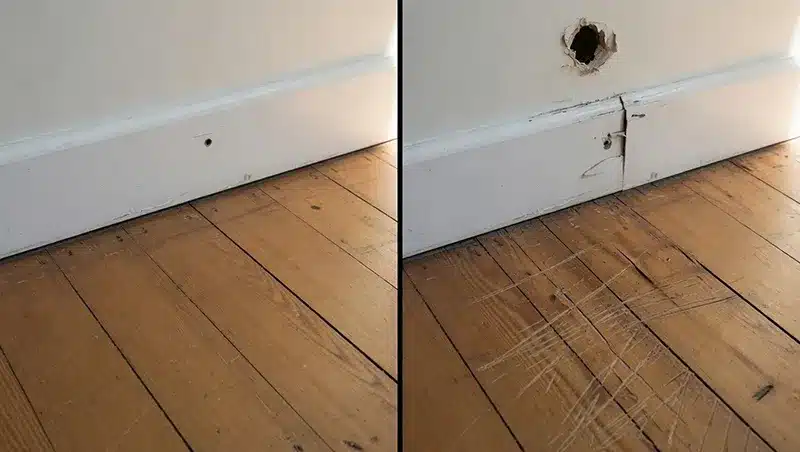
The useful life rule matters here. California courts recognize that interior paint has roughly a two-year useful life. If a tenant lived in a unit for four years and the paint is faded, repainting is wear and tear — not a deductible damage claim. The longer the tenancy, the harder it generally becomes to deduct for cosmetic items.
What You CAN Deduct From a California Security Deposit
California Civil Code §1950.5 permits landlords to deduct for:
Unpaid rent. Any rent owed at the time of move-out, including any final month shortfall.
Damage beyond normal wear and tear. Physical damage to the unit — holes in walls, broken fixtures, pet damage, unauthorized alterations — that exceeds ordinary use. Documentation and receipts are required for any deduction over $125.
Excessive cleaning costs. If a unit is left in a condition requiring professional cleaning beyond what a reasonable tenant would have left, those costs are deductible. The standard is “reasonable,” not “spotless” — a clean but not perfect unit generally cannot be charged for cleaning.
Restoration costs. If a tenant made unauthorized alterations (removed fixtures, painted without permission, installed shelving), you can deduct reasonable restoration costs.
Key replacement. Unreturned keys, fobs, or garage remotes.
What you cannot deduct: pre-existing conditions, items that were already worn or damaged at move-in, and anything that qualifies as normal wear and tear. This is exactly why move-in documentation is now legally required under AB 2801 — see below.
AB 2801: The Photo Documentation Requirement That Changed Move-In Protocols
AB 2801 is not widely understood yet, and that gap is expensive for landlords who aren’t following it.
What the law requires:
- Move-in photos: Landlords must photograph the unit’s condition before the tenant takes possession — not the day after move-in, before. The standard is before the tenant receives keys or access.
- Move-out photos: Landlords must photograph the unit’s condition after the tenant vacates and before returning the deposit or sending the itemized statement.
When it applies:
- Move-in photo requirement: effective July 1, 2025
- Move-out photo requirement: effective April 1, 2025
- For deposits entered into on or after January 1, 2026, both requirements apply in full

Storage and sharing: The law does not specify file format, but best practice is timestamped photos stored in a durable, retrievable format — cloud storage or property management software (such as AppFolio) — organized by unit and move-in/move-out date, and producible if a dispute arises.
The consequence of non-compliance: A landlord who fails to take required move-in photos loses the evidentiary foundation for damage claims. If you cannot document what the carpet looked like before the tenant moved in, you cannot prove the damage wasn’t pre-existing — and your deduction will not hold up in a dispute or in court.
For a dedicated breakdown of what AB 2801 requires and how to build it into your move-out workflow, see our AB 2801 photo documentation guide (publishing mid-June 2026) and the full California tenant move-out checklist.
The 21-Day Clock: When It Starts and What Happens If You Miss It

When the clock starts: The 21-day deadline runs from the date the tenant vacates — not the last day of the lease, not the day you receive keys, not the day you complete your inspection. If a tenant moves out June 15 and their lease runs to June 30, your deadline is July 6. (Civil Code §1950.5(g)) Note: the 21 day rule applies even in a lease break.
What must be sent within 21 days:
- The remaining deposit balance (if no deductions), OR
- An itemized written statement of deductions, plus receipts for any item over $125, plus the remaining balance after deductions
If contractor invoices aren’t back yet, you have a limited exception: send an estimated itemized statement within 21 days with a written notation that final costs are pending, then provide the final statement within 14 days of receiving the last invoice. Sending nothing is not a valid extension.
What happens if you miss the deadline: A court can rule that you’ve forfeited the right to any deductions and must return the full deposit. If the court also finds bad faith — that you withheld the deposit without legitimate basis — you can be ordered to pay the tenant up to 2× the wrongfully withheld amount, plus attorney’s fees.
Simple lateness may result in losing deductions. A bad faith finding means paying the tenant more than the deposit was worth.
For the full deadline breakdown — including what must be included, the contractor exception, and what bad faith withholding actually costs — see our guide to California’s 21-day security deposit return law (publishing late June) and the complete move-out checklist for California landlords.
How to Write a Compliant Itemized Statement
A compliant itemized statement under Civil Code §1950.5 must include:
- Each deduction listed separately — not “cleaning and repairs — $800” but broken out line by line
- The specific dollar amount for each deduction
- Receipts or invoices for any deduction over $125
- The remaining balance (total deposit minus total deductions)
- Your signature
A handwritten note with totals does not satisfy the requirement. Use a printed or typed format that itemizes each charge on its own line. Property management software typically generates a compliant form automatically.
Estimated vs. final statements: If repair work isn’t complete within 21 days, you may send an estimated itemized statement within 21 days with a note that final costs will follow, then provide the final statement within 14 days of the last invoice. This exception applies when work is actively underway — not as a reason to delay starting it.
Oakland and Berkeley: Local Rules That Go Beyond State Law
California law sets the floor. Oakland and Berkeley have additional requirements that directly affect how deposit disputes play out.

Oakland (Oakland Rent Adjustment Program):
The 21-day deadline applies identically. Deposit disputes involving rent-controlled units fall under Oakland’s Rent Adjustment Program (RAP). A tenant who believes a deposit was wrongfully withheld can file a RAP petition in addition to — or instead of — small claims court. The RAP process gives tenants a lower-friction path than litigation and is used more often than most self-managing landlords expect.
Berkeley (Berkeley Rent Board):
The 21-day deadline applies identically. Berkeley additionally requires landlords to pay annual interest on security deposits held for Berkeley rental units. The interest rate is set by the Berkeley Rent Board and updated periodically — check the current rate directly at rentboard.berkeleyca.gov.
Failure to pay this interest is not just a technical oversight. It is used routinely in Rent Board hearings to undermine landlord credibility in deposit disputes — even when the underlying deduction claims are otherwise legitimate.
Landlords managing properties in both Oakland and Berkeley frequently miss the Berkeley interest requirement because it has no Oakland equivalent. See our Oakland rent control and landlord guide for the full picture.
What We See at AEBP: The Most Common Deduction Mistake
From our team at All East Bay Properties, managing Oakland, Berkeley, Emeryville, and Richmond rentals since 2005:
The most expensive deposit mistake we see isn’t charging too much — it’s insufficient documentation.
AB 2801 now requires move-in AND move-out photos for deposits covered by the law. We’ve onboarded clients who had entirely legitimate damage claims they couldn’t enforce because they had no move-in photos to establish baseline condition. A $1,500 carpet replacement claim becomes a $0 recovery if you can’t prove the carpet wasn’t already damaged when the tenant moved in.
The second most common mistake: calculating the 21-day deadline from the lease end date instead of the actual move-out date. We track this automatically in AppFolio for every property we manage and send an internal reminder at day 14. For landlords managing their own properties, put it in your phone the day the tenant hands back the keys — not the day the lease ends.
The third: Berkeley landlords missing the annual deposit interest requirement. The dollar amount per unit is modest. But we’ve watched this single omission undermine otherwise valid landlord positions at Rent Board hearings more times than we can count.
For a step-by-step walkthrough of the full move-out process — including when the 21-day clock starts and what happens before the deposit accounting even begins — see our California tenant move-out checklist for landlords.
Frequently Asked Questions
Can I charge for carpet cleaning even if the tenant left it reasonably clean?
Under California law, the general rule is no — if the carpet is clean but shows ordinary wear from years of use, you cannot charge for professional cleaning as a security deposit deduction. Stains, pet odors, or damage beyond normal use are deductible with documentation, and the length of the tenancy matters: a carpet showing wear after five years is treated differently than new carpet that’s been damaged.
That said, there’s an important distinction between a deposit deduction and a lease obligation. At All East Bay Properties, our standard lease requires professional carpet cleaning at the end of every tenancy — not as a deduction we impose, but as a condition the tenant agrees to upfront. Every incoming tenant takes possession of a professionally cleaned unit; every outgoing tenant returns it the same way for the next resident. Tenants can hire any licensed professional they choose, or we arrange it and deduct the cost from the deposit per the lease terms.
This approach is legally defensible in California precisely because the obligation is established by contract at move-in, not applied as a surprise deduction at move-out. The key is that the requirement must be clearly stated in the lease — it cannot be imposed retroactively or used to circumvent the normal wear and tear standard for damage that isn’t carpet-cleaning-related.
If you self-manage and want to use a similar structure, have a real estate attorney review the language before it goes into your lease.
Can I charge for repainting if the tenant left marks on the walls?
It depends on the extent and length of tenancy. Minor scuffs after a three-year tenancy are wear and tear. Large unauthorized paint colors or significant damage requiring repainting a full room are deductible. California courts prorate for the remaining useful life of the paint — a two-year-old paint job has more deductible value than a five-year-old one.
What if I can’t get contractor bids within 21 days?
Send an estimated itemized statement within 21 days with a written notation that final costs are pending, and provide the final statement within 14 days of receiving the last invoice. This is a narrow exception — not a license to wait.
Does the 21 days include weekends?
Yes. California Civil Code specifies calendar days, not business days.
Can I deduct for a pet when no pets were allowed?
Yes — if the pet caused damage, you can deduct for that damage. On the deposit limit itself: under AB 12 (effective July 1, 2024),most landlords are capped at one month’s rent regardless of pets or furnishings. Small landlords who qualify for the exception (natural persons or all-natural-person LLCs owning no more than 2 properties with no more than 4 units total) may collect up to two months’ rent. No separate “pet deposit” on top of the cap is permitted under either tier. See our full AB 12 security deposit guide for details.
What if the tenant disputes my deductions?
They can file in small claims court (limit: $12,500 for individuals in California) or, for rent-controlled units in Oakland or Berkeley, file a RAP petition. Your best defense in either forum is complete documentation: move-in photos, move-out photos, dated inspection notes, itemized receipts — all timestamped and organized. See our security deposit return guide for what landlords need to know about the dispute process.
Can I use the deposit to cover unpaid utilities billed in my name?
If unpaid utilities are the tenant’s contractual obligation under the lease, yes — deduct them and document the basis with account statements showing the amount owed.
What’s the maximum deposit I can charge in 2026?
It depends on your ownership structure. Under AB 12 (effective July 1, 2024), the general rule is one month’s rent — with no extra allowed for pets, furnished units, or any other reason. This applies to most corporate landlords and larger portfolio owners.
There is a small-landlord exception: if you are a natural person (or an LLC where all members are natural persons) and you own no more than 2 residential rental properties with no more than 4 units total, you may collect up to 2 months’ rent. This exception does not apply if the tenant is an active service member.
In either case, no separate pet deposit, furnished-unit premium, or other add-on is permitted on top of the applicable cap. See our AB 12 guide for the full details on who qualifies for each tier.
Have Questions About Your East Bay Property?
We manage rent-controlled properties across Oakland, Berkeley, Richmond, and Emeryville and handle deposit compliance, AB 2801 photo documentation, and move-out processing for every property in our portfolio.
All East Bay Properties · Emeryville, CA · (510) 450-3800 · CalDRE #01516255
This page is for general informational purposes and does not constitute legal advice. California landlord-tenant law is subject to change. Consult a licensed attorney before taking action on any specific situation.