
Share this post
Last updated July 2026 — reflects confirmed Oakland RAP rate for August 1, 2026 – July 31, 2027 and current registration requirements.
Oakland Rent Control Quick Facts for 2026
- Allowable annual increase (AGA): 2.3% (effective August 1, 2026 – July 31, 2027)
- Applies to: Most multi-family (2+ units) properties. Also includes ADUs, and may apply to rented rooms, and SROs built prior to April 1, 2016
- Single-family homes and condos: Must be registered and are subject to the Just Cause ordinance.
- Registration required: Yes — annual renewal due by March 1; register at rentregistry.oaklandca.gov
- One increase per 12-month period: Yes — same rule as AB 1482
- Just cause eviction protections: Yes — applies to units with Certificate of Occupancy issued more than 10 years ago
- Banked increases: Allowed — but rules changed January 1, 2026 (capped at 3x current AGA per year)
- Local rules are stricter than AB 1482: 2.3% vs. the statewide 8.8% (effective August 1, 2026)
If you own rental property in Oakland, you are operating under one of the most closely regulated rental markets in California. Oakland’s Rent Adjustment Program (RAP) sets strict limits on how much you can raise rent each year — and those limits are far below the statewide AB 1482 cap, which rises to 8.8% beginning August 1, 2026. Through July 31, 2026, Oakland landlords of covered units are limited to 0.8%; beginning August 1, 2026, that limit rises to 2.3%. Getting it right protects your income. Getting it wrong can mean refunding unlawful increases, facing triple damages, and losing the ability to respond to tenant petitions.
This guide covers everything you need to know about Oakland rent control in 2026: which properties are covered, how the AGA works, registration requirements, the petition process, banked increases, just cause eviction rules — and what happens if you don’t comply.
Note: the video below was recorded for the August 2025–July 2026 rate period, when Oakland’s AGA was 0.8%. The figures spoken in the video reflect that period accurately. The written figures throughout this page have been updated to the confirmed 2.3% rate for August 2026–July 2027 — use the written figures for current compliance.

What Is the Oakland Rent Adjustment Program (RAP)?
The Oakland Rent Adjustment Program is the city agency that administers Oakland’s Rent Adjustment Ordinance (O.M.C. 8.22). The Ordinance sets a ceiling on annual rent increases for covered units, establishes a petition process for landlords and tenants to seek adjustments, and — together with Oakland’s Just Cause for Eviction Ordinance — provides a comprehensive framework of tenant protections.
Oakland’s rent control law predates AB 1482 by decades. Where both laws apply, Oakland’s local rules govern — they are stricter. AB 1482 functions as a backstop for units that fall outside Oakland’s RAP coverage. Through July 31, 2026, the allowable increase under Oakland’s ordinance is 0.8%, compared to 6.3% under the statewide law. Beginning August 1, 2026, those caps rise to 2.3% for Oakland and 8.8% statewide.
The RAP is administered at 250 Frank H. Ogawa Plaza, Suite 5313. Housing Counselors are available Monday through Thursday, 9:30 a.m. to 4:30 p.m., at rap@oaklandca.gov or (510) 238-3721.
Which Properties Are Covered — and Which Are Exempt?
Understanding whether your property is subject to Oakland’s RAP is the essential first step. There are two separate ordinances with different coverage rules: the Rent Adjustment Ordinance (which controls rent increases) and the Just Cause for Eviction Ordinance (which governs terminations). A unit can be subject to one, both, or neither.
| ✓ Covered by Oakland RAP (Rent Cap) | ✗ Exempt from Oakland Rent Cap |
|---|---|
| Multi-family (2+ units) properties built prior to April 1, 2016 — includes all dwelling units in the building | New construction: ground-up units with Certificate of Occupancy on or after April 1, 2016 (must be ground-up, not converted from existing space) |
| Single-family homes — must register; subject to Just Cause ordinance | Owner-occupied units (no room rented) — must provide proof of residency; subject to verification |
| Condominiums — must register; subject to Just Cause | Hotels/motels not occupied by the same tenant for 30+ consecutive days |
| ADUs, junior ADUs, in-law units built prior to April 1, 2016 — or created from existing residential space, or lacking a Certificate of Occupancy | Units vacant and unavailable for rent for the entire fiscal year (July 1–June 30) — written explanation required |
| Individually rented rooms in a single-family home under separate leases (30+ day tenancies) — each room registers as a separate unit | Publicly owned/operated units (City of Oakland, Oakland Redevelopment Successor Agency, or Oakland Housing Authority) |
Important: Even if a unit is exempt from the Oakland rent cap, it may still be subject to Oakland’s Just Cause for Eviction Ordinance, which applies to most units with a Certificate of Occupancy issued more than 10 years ago. And if a unit isn’t covered by Oakland’s local ordinance, it may still be subject to AB 1482’s statewide protections.
Oakland’s 2026 Allowable Rent Increase: 2.3% (Effective August 1, 2026)
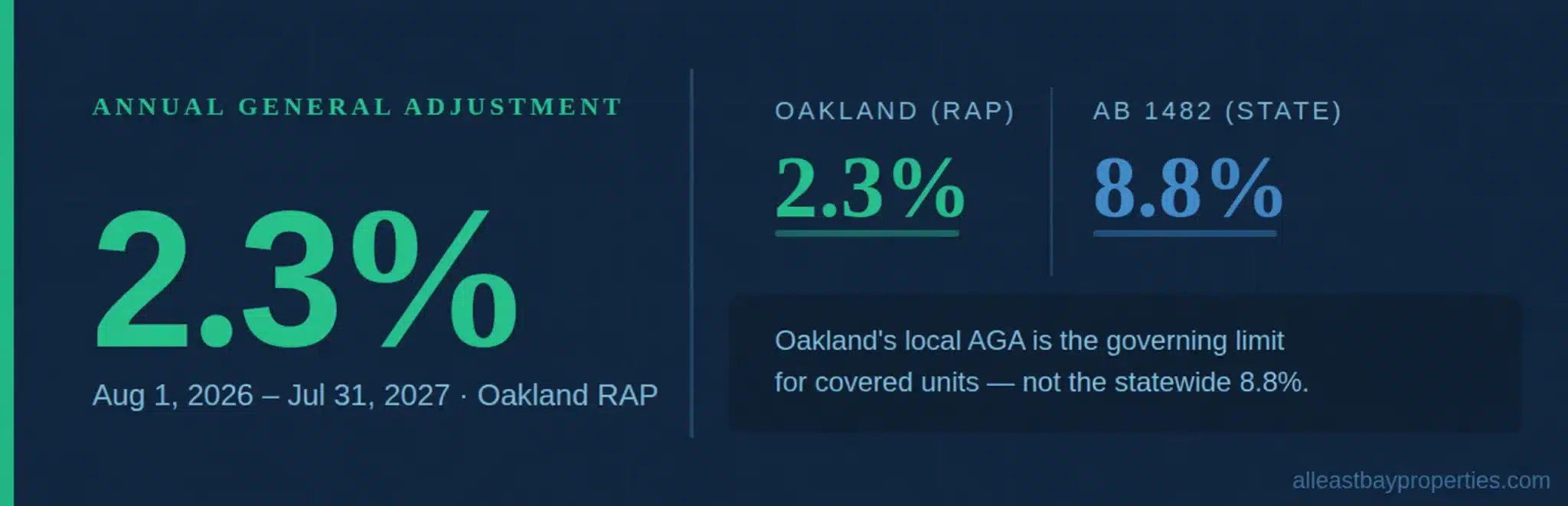
The Annual General Adjustment (AGA) for Oakland RAP-covered units is 0.8% for the period August 1, 2025 through July 31, 2026. Beginning August 1, 2026, the AGA rises to 2.3% for the period through July 31, 2027. This figure is set by the City of Oakland based on a formula tied to 60% of the change in the Consumer Price Index, with a maximum of 3%.
For comparison: the statewide AB 1482 cap is 6.3% through July 31, 2026, rising to 8.8% beginning August 1, 2026. Oakland landlords operating under the RAP are limited to a small fraction of what the statewide law would allow for non-Oakland properties. This gap is the single most common source of costly compliance errors for landlords who own in Oakland alongside properties in other jurisdictions.
Worked Example: Maximum Increase on a $2,200/Month Oakland Unit
| Step | Calculation | Result |
|---|---|---|
| Current monthly rent | — | $2,200.00 |
| Oakland AGA (effective Aug 1, 2026 – Jul 31, 2027) | 60% of CPI, max 3% | 2.3% |
| Confirm 12-month lookback (no prior increase) | Clear ✓ | Eligible |
| Dollar amount of increase | $2,200 × 2.3% | $50.60 |
| New maximum monthly rent | $2,200 + $50.60 | $2,250.60 |
This is the maximum — you are not required to take the full increase. However, you may not exceed it on a RAP-covered unit in any 12-month period without triggering the petition process.
Need help calculating your allowable Oakland rent increase? We track RAP rates and registration deadlines for every unit we manage — so our clients never exceed legal caps and never miss a deadline.
How Oakland’s Rules Layer on Top of AB 1482
Oakland’s RAP and California’s AB 1482 are separate laws with different coverage rules. The interaction between them can be confusing — here is how it works in practice:
- If a unit is covered by the Oakland RAP: Oakland’s AGA governs, not the AB 1482 cap — currently 0.8% vs. 6.3% through July 31, 2026, and 2.3% vs. 8.8% beginning August 1, 2026. The local rule is stricter, so it takes precedence.
The most common and costly mistake Oakland landlords make is applying the AB 1482 rate to a RAP-covered unit. If your property was built prior to April 1, 2016, it is very likely subject to Oakland’s local rules — and if it also predates 1983, Oakland’s rent cap (0.8% through July 31, 2026; 2.3% beginning August 1, 2026) applies on top of Just Cause protections. Confirm your property’s exact status with the Oakland RAP office.
Oakland Rent Registry: Registration Requirements and Deadlines
Since 2023, Oakland requires landlords to register all RAP-covered units through the Oakland Rent Registry. Registration must be renewed annually, with rent and tenancy information confirmed or updated by March 1st each year.

Registration is not optional — and the consequences of non-registration are significant. Under Oakland’s rules, unregistered property owners:
- Cannot lawfully implement a rent increase on the affected unit
- Cannot file landlord petitions for rent adjustments with the RAP
- May have failure to register raised as an affirmative defense in most eviction actions
- May face penalties for operating unregistered units
New 2025 requirement: As of April 15, 2025, Oakland landlords must attach a current Business Certificate to any rent increase notice served on a tenant. If the Business Certificate is missing or delinquent, the notice is invalid. This is a frequently missed step — build it into your increase process before serving any notice.
Annual RAP fee: Property owners must pay an annual RAP fee of $137 per covered unit, due January 1 and delinquent after March 1. Landlords who pay on time may pass 50% of the fee to the tenant. Confirm the current fee amount with the RAP Fee and Exemptions page.
Banked Rent Increases: What Changed in 2026
Oakland has historically allowed landlords to “bank” unused annual CPI increases and apply them in future years — providing flexibility when a landlord chose not to raise rent in a given year. However, Oakland’s City Council amended the banking rules effective January 1, 2026.
Under the new rules, banked increases are still permitted — but they are now subject to an annual cap of 3x the current AGA per year. Through July 31, 2026, at the 0.8% AGA, that is a maximum banked increase of 2.4% in any given year. Beginning August 1, 2026, at the 2.3% AGA, the maximum banked increase rises to 6.9% in any given year, even if you have accumulated many prior years of unused increases. The previous ability to bank increases for up to 10 years and apply them in a large single increase has been substantially curtailed.
If you have banked increases from prior years, work with a property management professional to understand exactly what is available to you under the new rules before serving any notice.
The Oakland RAP Petition Process
The RAP operates as a petition-based system. Both landlords and tenants can file petitions to seek adjustments beyond the standard AGA.
Landlord Petitions for Increases Above the AGA
Oakland landlords may file petitions to seek approval for increases above the AGA in limited circumstances, including:
- Capital improvement pass-through — for significant improvements to the unit or building
- Increased housing service costs — for documented operating expense increases
- Uninsured casualty loss repairs
- Constitutional fair return petition — based on investment return
- Additional occupant increase — up to 5% per additional occupant beyond the original lease
Any rent increase above the AGA requires a landlord petition filed with the RAP and approved before the increase is served. You cannot simply increase rent above the AGA and notify the tenant after the fact.
Tenant Petition Rights
Tenants in covered units have the right to file petitions to challenge rent increases they believe are unlawful, seek reductions for decreased housing services, or address other rent-related disputes. Tenants have 90 days from receiving a rent increase notice to file a petition challenging the increase.
Just Cause Eviction Protections in Oakland
Oakland’s Just Cause for Eviction Ordinance applies to most rental units with a Certificate of Occupancy issued more than 10 years ago — a broader scope than the rent cap itself. Even if your unit is exempt from the Oakland rent cap (for example, a single-family home or condo), it may still be subject to just cause eviction rules.
Oakland’s Just Cause ordinance recognizes 10 grounds for eviction, which fall into two broad categories:
At-Fault Just Cause
- Nonpayment of rent
- Material breach of the lease (after written notice to cure)
- Willful damage to the property
- Criminal activity or nuisance affecting other tenants or neighbors
- Subletting without authorization
- Refusal to sign a new lease with substantially the same terms
- Refusal to allow lawful entry after proper notice
No-Fault Just Cause
- Owner or qualifying family member move-in
- Withdrawal from the rental market under the Ellis Act
- Substantial rehabilitation requiring vacant possession
No-fault terminations require payment of relocation assistance. The amount varies depending on the no-fault reason and tenant circumstances — confirm current requirements with the RAP before serving any no-fault notice. Note that sale of the property, lease expiration, and changes in unit status are not valid just cause grounds for eviction in Oakland.
⚠️ What Happens If You Get This Wrong?
Overcharging rent in Oakland can become expensive quickly — and the consequences go beyond a simple refund.
- Refund of all unlawful rent collected — retroactively, for every month it was overcharged
- Treble (triple) damages in some cases under Oakland’s ordinance
- RAP petition hearings — time-consuming, costly, and on the public record
- Registration penalties for unregistered units — inability to lawfully raise rent or respond to petitions
- As of April 15, 2025: rent increase notices must have a current Business Certificate attached — missing this invalidates the notice
- Potential just cause complications on future tenancy actions if increases are challenged
Common Mistakes Oakland Landlords Make
- Applying the AB 1482 rate to an Oakland RAP-covered unit — Oakland’s local AGA governs, not the statewide cap (0.8% vs. 6.3% through July 31, 2026; 2.3% vs. 8.8% beginning August 1, 2026)
- Skipping or delaying annual rent registry renewal — failure to register by March 1 blocks rent increases and creates petition exposure
- Serving a rent increase notice without attaching a current Business Certificate — required as of April 15, 2025; missing this document voids the notice
- Implementing banked increases without recalculating under the new 2026 rules — the old 10-year banking window is gone
- Forgetting the 12-month lookback — one increase per 12-month rolling period, regardless of the reason for the gap
- Filing a termination notice without valid just cause — sale of property and lease expiration are not valid grounds in Oakland
Oakland, Berkeley, and AB 1482 Side by Side
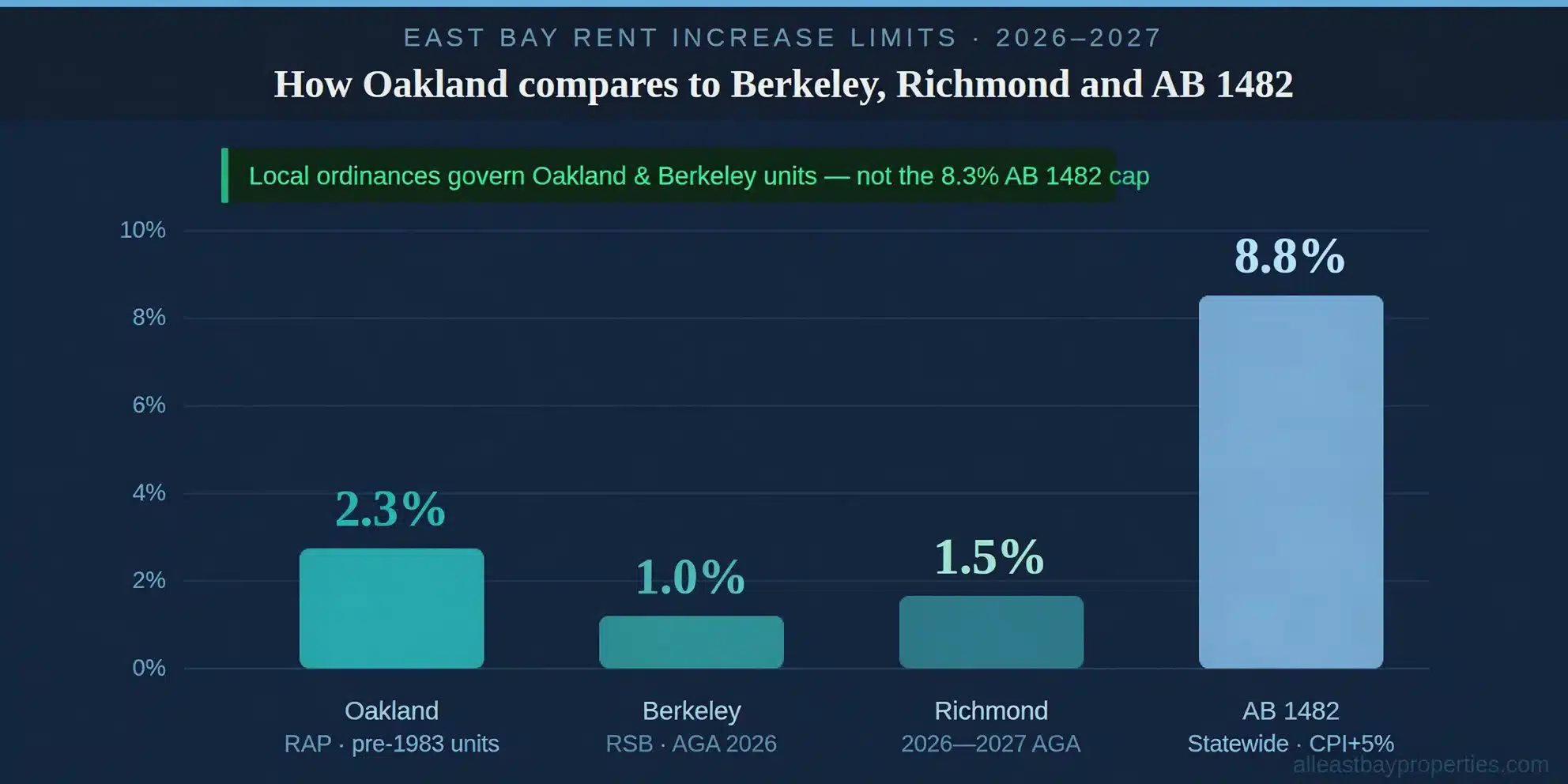
If you own properties across multiple East Bay jurisdictions, each city has its own rules, rates, and deadlines. Here is how Oakland compares:
| Jurisdiction | 2026–27 Max Increase | Registration Required? | Rate Updates |
|---|---|---|---|
| Oakland (RAP) | 2.3% (AGA, effective Aug 1, 2026) | Yes (RAP — by March 1) | July 31 annually |
| Berkeley (RSB) | 1.0% (AGA 2026) | Yes (Rent Board) | June 30 annually |
| Richmond | 1.5% (AGA 2026, confirmed; effective Sept 1, 2026) | Yes (Rent Program) | August 31 annually |
| Statewide (AB 1482) | 8.8% (effective Aug 1, 2026) | No | Annual (CPI, Aug–Jul) |
Frequently Asked Questions About Oakland Rent Control
How much can I raise rent on an Oakland unit in 2026?
For RAP-covered units, the maximum allowable increase from August 1, 2025 through July 31, 2026 is 0.8%. Beginning August 1, 2026 through July 31, 2027, the AGA rises to 2.3%. This is Oakland’s Annual General Adjustment. If you want to increase rent above this amount, you must file a petition with the Oakland RAP and obtain approval before serving notice on the tenant.
Which Oakland properties are subject to rent control?
Oakland’s RAP and Just Cause for Eviction Ordinance apply broadly to most residential rental units in properties built prior to April 1, 2016 — including multi-family buildings, and may apply to ADUs, rented rooms, and SROs. The rent cap (0.8% AGA through July 31, 2026; 2.3% AGA effective August 1, 2026) applies specifically to units in buildings with a Certificate of Occupancy before January 1, 1983. Units in properties built between 1983 and April 1, 2016 must still register and are subject to Just Cause protections, but are not subject to the AGA rent cap. Ground-up new construction with a Certificate of Occupancy on or after April 1, 2016 is exempt from both ordinances. If you are uncertain about your property’s status, contact the RAP Housing Counselors at (510) 238-3721.
Do I need to register my Oakland rental unit?
Yes. If your unit is covered by either the Rent Adjustment Ordinance or the Just Cause for Eviction Ordinance, you must register through the Oakland Rent Registry and renew annually by March 1. Failure to register prevents you from lawfully raising rent or filing landlord petitions, and it can be raised as an affirmative defense in eviction proceedings.
Can I still use banked rent increases in Oakland in 2026?
Banked increases are still allowed under Oakland’s ordinance, but the rules changed effective January 1, 2026. The new rules cap banked increases at 3x the current AGA per year. Through July 31, 2026, at the 0.8% AGA, that is a maximum of 2.4% in any given year from banked increases. Beginning August 1, 2026, at the 2.3% AGA, that maximum rises to 6.9% in any given year, regardless of how many prior years of banking you have accumulated. If you have a long history of unused increases, speak with a property management professional before attempting to apply them.
What is the difference between the RAP and Oakland’s Just Cause ordinance?
The Rent Adjustment Ordinance (administered through the RAP) governs how much rent can be increased on covered units. The Just Cause for Eviction Ordinance governs the grounds required to terminate a tenancy. The two ordinances have different — though overlapping — coverage rules. A unit can be subject to just cause protections even if it is exempt from the rent cap (for example, a single-family home may not have a rent cap but may still require just cause for eviction).
What if a tenant files a RAP petition against my rent increase?
Tenants have 90 days from receiving a rent increase notice to file a petition with the RAP challenging the increase. If a petition is filed, you will need to respond through the RAP process, which can include mediation and formal hearings. This is one reason accurate documentation of every increase — including the calculation basis, notice date, and delivery method — is essential. Landlords who cannot demonstrate compliance face having the increase invalidated and potentially refunding amounts collected.
Is Oakland rent control the same as AB 1482?
No — they are separate laws. Oakland’s Rent Adjustment Ordinance is a local ordinance, and it is stricter than California’s statewide AB 1482 Tenant Protection Act. For Oakland RAP-covered units, Oakland’s limit applies, not AB 1482’s — 0.8% vs. 6.3% through July 31, 2026, and 2.3% vs. 8.8% beginning August 1, 2026. AB 1482 provides a backstop for Oakland properties that fall outside local RAP coverage.
Ready to implement a compliant Oakland rent increase?
Our team monitors Oakland RAP rates, tracks registration deadlines, and structures every increase correctly — we do this for hundreds of units so our clients don’t have to.
We manage 600+ units across Emeryville, Oakland, Berkeley, and the East Bay — we navigate these rules for clients every day.
Related Articles
← AB 1482 Rent Cap Explained: California’s Statewide Rent Increase Limits for 2026 [March 9, 2026]
← Rent Increases in the East Bay: What Landlords Can (and Cannot) Do in 2026 [March 2, 2026]
→ California Rent Increase Notice Requirements in 2026 (And How to Raise Rent Without Creating Problems) [March 23, 2026]
Related video: Oakland Rent Control in 2026: RAP Rules, Allowable Increases & What Landlords Must Know
Sources
- Oakland Rent Adjustment Program — City of Oakland
- Oakland Rent Adjustment Ordinance (O.M.C. 8.22)
- Oakland Rent Registry
- Oakland RAP Fee and Exemptions
- California AB 1482 — Tenant Protection Act of 2019 (Civil Code §§1946.2, 1947.12)
- Berkeley Rent Stabilization Board — Annual General Adjustment
- Richmond Rent Increase Program
