
Share this post
Last updated July 2026 — reflects confirmed CPI data and city ordinance rates effective August 2026 (Richmond effective September 2026).
AB 1482 Quick Facts for 2026
- Prior rate (through July 31, 2026): 6.3% (5% + 1.3% CPI, Aug 2025 – Jul 2026) — no longer in effect for increases taking effect on or after August 1, 2026
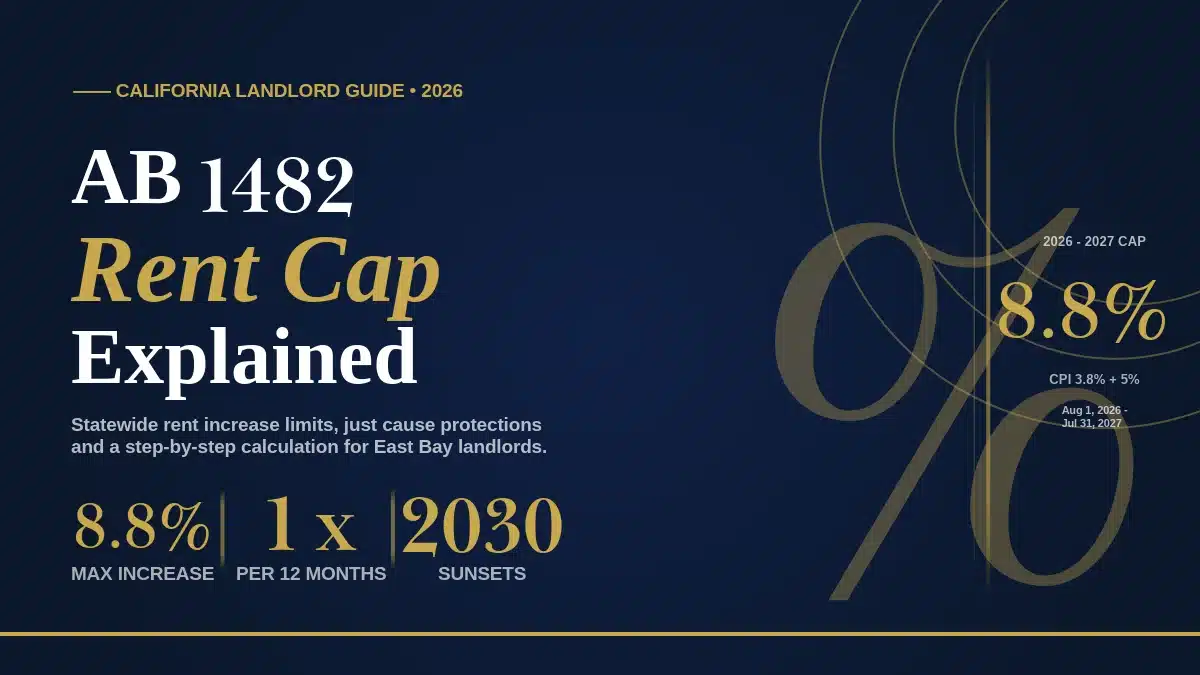
- ✅ Current rate (Aug 1, 2026 – Jul 31, 2027): 8.8% for the East Bay’s CPI region (5% + 3.8% CPI), based on the BLS’s April 2026 SF-Oakland-Hayward CPI release. AB 1482’s formula is set by state law and works the same everywhere in California, but the CPI figure it plugs in is regional — 8.8% is specifically the current figure for this region; other parts of the state use their own region’s CPI under the identical formula.
- Applies to most California rentals in buildings older than 15 years
- Only one increase allowed per 12-month period
- Covered units also require just cause for eviction after 12 months of tenancy
- Local rent control overrides AB 1482 in Oakland, Berkeley, and Richmond — local limits are far lower
If you own a rental property in California, AB 1482 — the Tenant Protection Act of 2019 — is one of the most important laws governing your business. It sets a ceiling on how much you can raise rent each year — the formula is set by state law and applies the same way everywhere in California, though the actual percentage varies by region — and it layers just cause eviction protections on top of that. Getting it right protects your income. Getting it wrong can mean refunding unlawful increases, facing tenant petitions, and even paying the other side’s attorney’s fees.
This guide covers everything you need to know about AB 1482 in 2026: how the rent cap works, which properties it covers, what just cause protections apply — and a step-by-step calculation example using the confirmed 2025–2026 CPI figures so you know exactly where you stand.

Video Transcript
If you own rental property in California, you’ve probably heard of AB 1482 — the state’s rent cap law. But there are two questions that actually matter: does it apply to your property? And if it does, exactly how much can you raise the rent? In the next couple of minutes, I’m going to walk you through both.
Let’s start with whether you’re even covered. AB 1482 covers most residential rentals in California — but not all of them. Here’s the quick version. If you own an apartment building or multi-family property that was built more than 15 years ago, you’re almost certainly covered. And here’s something people miss — that 15-year rule is rolling. A building from 2011 just became covered this year.
Now, single-family homes. A lot of landlords assume they’re automatically exempt. That’s only true if you’re not a corporation or LLC, and — this is the part people forget — you’ve actually served the tenant with a written exemption notice. Skip that notice, and you’re covered whether you meant to be or not.
And if you own in Oakland or Berkeley — pause here, because local rent control applies to you. AB 1482’s 6.3% is not your number. Oakland is 0.8%. Berkeley is 1.0%. Local rules take over entirely.
Okay — so if your property is covered by AB 1482, here’s what you need to know about actually calculating the increase. And I’m going to use real numbers so you can follow along with your own unit.
The formula is CPI plus 5 percent, with a maximum of 10 percent. For the current period — August 2025 through July 2026 — the confirmed CPI for the San Francisco-Oakland-Hayward metro is 1.3 percent. Add 5, and your maximum is 6.3 percent. The 10 percent cap isn’t triggered here.
Let me walk through a real example. Say your tenant is paying $2,400 a month. Take that $2,400, multiply by 6.3 percent — that’s $151.20. So the most you can charge is $2,551.20 per month. That’s your ceiling. You don’t have to take the full increase, but you can’t go above it.
One more thing that trips people up: you can only do this once every 12 months. And that clock runs from the date of your last increase — not the calendar year. So if you raised rent in June 2025, you can’t raise it again until June 2026, regardless of what month we’re in now.
One thing I want to flag quickly — AB 1482 isn’t just about the rent cap. If your unit is covered, you also have just cause eviction requirements. That means after a tenant has been there 12 months, you can’t end the tenancy without a qualifying reason. Non-payment, lease violation, owner move-in — those are all valid. But you can’t just ask someone to leave because you feel like it.
If you’re triggering a no-fault termination — like moving in yourself or doing a major renovation — you also owe the tenant one month’s rent as relocation assistance. That’s easy to miss and expensive when you do.
Getting this right every year — the right CPI figure, the right ceiling, the right notice — is one of those things that sounds straightforward until it isn’t. We calculate and document compliant rent increases for over 580 units across the East Bay, so our clients don’t have to think about it.
If you want the full breakdown — including the exemption rules, the Oakland and Berkeley specifics, and the notice requirements — the complete guide is linked in the description. It’s free, it’s detailed, and it has the numbers you need for 2026.
If this was useful, subscribe to our YouTube channel — we cover this stuff every week. And I’ll see you in the next one.
Note: this video and transcript were recorded using the 2025–2026 rates (AB 1482 6.3%, Oakland 0.8%). As of August 1, 2026, the East Bay’s AB 1482 rate rose to 8.8% and Oakland’s local AGA rose to 2.3% — see the updated figures in the text below.
What Is AB 1482?
AB 1482, the Tenant Protection Act of 2019, went into effect January 1, 2020. It established two statewide protections for qualifying California renters: a cap on annual rent increases and just cause requirements for eviction. Both apply to the same set of covered properties — if you’re subject to the rent cap, you’re also subject to just cause. The law is codified at Civil Code §§ 1946.2 and 1947.12.
It’s worth noting what AB 1482 is not: it is not a local rent control ordinance. Cities like Oakland, Berkeley, and Richmond have their own, stricter local laws. Where a local ordinance applies, it takes precedence over AB 1482. For properties in those cities, AB 1482 functions as a backstop — the local rules govern.
Which Properties Are Covered — and Which Are Exempt?
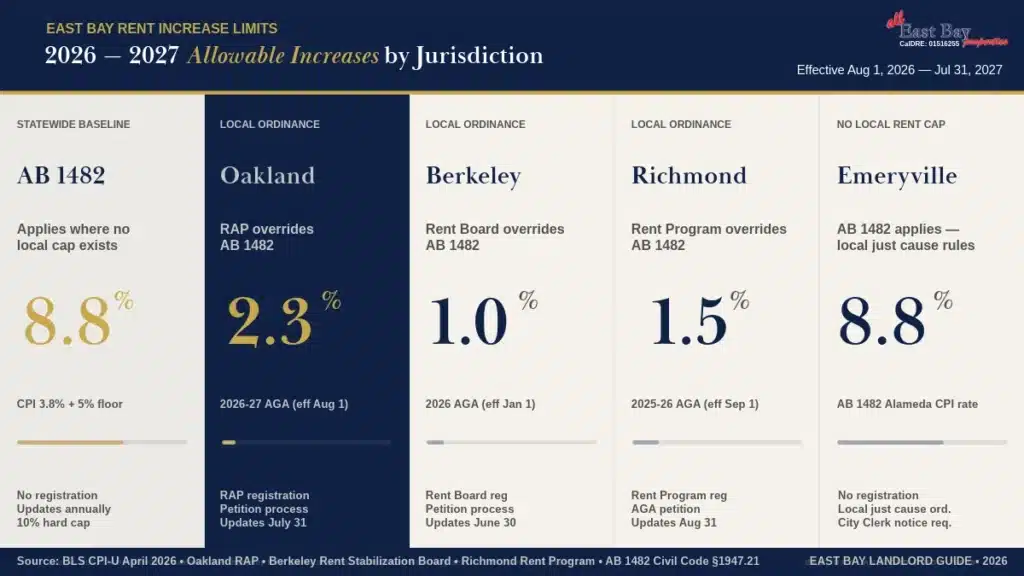
AB 1482 covers a broad range of residential rental units, but there are important exemptions. Understanding which side of the line your property falls on is the essential first step.
| ✓ Covered by AB 1482 | ✗ Exempt from AB 1482 |
|---|---|
| Units in buildings more than 15 years old (rolling — e.g., built in 2011 becomes covered in 2026) | Single-family homes (with proper written exemption notice) |
| Multi-family units (duplex or larger) | Condos sold separately to owner-occupants |
| Corporate-owned single-family rentals | Buildings constructed within the last 15 years |
| Units not subject to a stricter local ordinance | Duplexes where the owner occupies one unit |
| Mobile homes subject to the Mobilehome Residency Law (local park ordinances may also apply) | Subsidized affordable housing (some programs) |
Important note on single-family homes: Owner-occupant single-family homes are only exempt if the landlord has served the tenant with a proper written exemption notice as required by Civil Code §1946.2(e)(8)(B)(i) as follows:
“This property is not subject to the rent limits imposed by Section 1947.12 of the Civil Code and is not subject to the just cause requirements of Section 1946.2 of the Civil Code. This property meets the requirements of Sections 1947.12 (d)(5) and 1946.2 (e)(8) of the Civil Code and the owner is not any of the following: (1) a real estate investment trust, as defined by Section 856 of the Internal Revenue Code; (2) a corporation; or (3) a limited liability company in which at least one member is a corporation.”
Civil Code §1946.2(e)(8)(B)(i)
If you own a single-family home through a corporation, LLC, or REIT, the exemption does not apply — the property is covered by AB 1482 regardless of structure.
The Rent Cap Formula: CPI + 5%, Subject to a 10% Maximum
Under AB 1482, the maximum allowable rent increase in any 12-month period is 5% plus the percentage change in the regional Consumer Price Index (CPI), with a hard ceiling of 10% — whichever is lower. This is established under Civil Code §1947.12.
The CPI figure used is the April-to-April measurement for the region where your rental property is located. For East Bay properties, the applicable index is the San Francisco-Oakland-Hayward metro CPI-U, published annually by the U.S. Bureau of Labor Statistics.
For increases effective August 1, 2025 through July 31, 2026, the confirmed SF-Oakland-Hayward metro CPI figure was 1.3%, based on April 2025 CPI-U data from the BLS, producing a maximum allowable increase of 6.3% (1.3% + 5.0%). Beginning August 1, 2026, the applicable period shifts to August 1, 2026 through July 31, 2027, with a confirmed SF-Oakland-Hayward metro CPI figure of 3.8% for April 2026, producing a new maximum allowable increase of 8.8% (3.8% + 5.0%). The 10% cap is not triggered at either level.
How to Calculate Your Maximum 2026 Rent Increase (Step-by-Step Example)
Below is a worked example for a covered unit currently renting at $2,400/month, using the confirmed CPI rate for the SF-Oakland-Hayward metro area effective August 1, 2026 through July 31, 2027. (Through July 31, 2026, the prior 2025–2026 rate of 6.3% still applies — see table below for both.)
| Step | Calculation | Result |
|---|---|---|
| Current monthly rent | — | $2,400.00 |
| SF-Oakland-Hayward CPI (Apr 2026) | — | 3.8% |
| Add 5% to CPI | 3.8% + 5.0% | 8.8% |
| Apply 10% cap (8.8% is under cap) | 8.8% < 10% ✓ | 8.8% maximum |
| Confirm 12-month lookback (no prior increase) | Clear ✓ | Eligible |
| Dollar amount of increase | $2,400 × 8.8% | $211.20 |
| New maximum monthly rent | $2,400 + $211.20 | $2,611.20 |
Note: this table reflects the rate effective August 1, 2026 – July 31, 2027 (8.8% = 3.8% CPI + 5%). For increases effective before August 1, 2026, the prior 2025–2026 rate of 6.3% applies instead: $2,400 × 6.3% = $151.20, for a maximum rent of $2,551.20.
Beginning August 1, 2026, the landlord in this example can increase rent by up to $211.20 per month, bringing the new rent to $2,611.20. This is the maximum — you are not required to take the full increase. However, you may not exceed it in any 12-month period without violating AB 1482.
Need help calculating your allowable rent increase? We track CPI updates and local ordinance limits for every East Bay jurisdiction so our clients never exceed legal caps — and never leave money on the table.
The 12-Month Lookback Rule
Civil Code §1947.12 limits you to one rent increase per 12-month period. The lookback window runs from the date of the proposed new increase, not the calendar year. This means:
- If you raised rent on March 1, 2025, you cannot raise it again until March 1, 2026 at the earliest.
- You cannot split an increase into two smaller raises within a 12-month window to work around the cap.
- If you applied a partial increase earlier in the year, that counts — you cannot add more until the 12-month window has elapsed.
Always document the date and amount of every rent increase. You may need to demonstrate compliance if a tenant files a complaint.
Just Cause Eviction Protections
Tenants in AB 1482-covered units also have just cause eviction protections after 12 months of tenancy, per Civil Code §1946.2. This means you cannot terminate a tenancy without a qualifying reason. AB 1482 recognizes two categories of just cause:
At-Fault Just Cause
These are situations where the tenant has done something to breach the tenancy. Common grounds include:
- Failure to pay rent
- Material breach of the lease after written notice to cure
- Criminal activity or nuisance
- Subletting without authorization
- Refusal to allow lawful entry
No-Fault Just Cause
These are legitimate business reasons that are not the tenant’s fault. They require stricter notice requirements and, in most cases, relocation assistance equal to one month’s rent or higher depending on jurisdiction:
- Owner move-in (owner or qualifying family member intends to occupy)
- Withdrawal of the property from the rental market under the Ellis Act
- Substantial renovation or demolition requiring vacant possession
- Government order requiring vacancy
No-fault just cause terminations require payment of one month’s rent as relocation assistance, or a rent waiver of equivalent value, at the time notice is served. Failure to provide this assistance can invalidate the termination notice.
A Note on Emeryville
Emeryville has no local rent cap — so AB 1482’s East Bay rate applies there directly: 8.8% as of August 1, 2026 (up from 6.3%). But Emeryville does have its own just cause eviction ordinance, enacted in 2017, which operates independently of AB 1482. The grounds for termination are similar, but there is one procedural requirement that catches landlords off guard: when you serve a notice of termination, you must deliver a copy to the Emeryville City Clerk within 10 days. Failing to do so doesn’t invalidate the notice, but it is a compliance obligation worth building into your process. We’ll cover Emeryville’s rules in full in our Emeryville Landlord Guide → [coming later this month]
How Local Ordinances Layer on Top of AB 1482
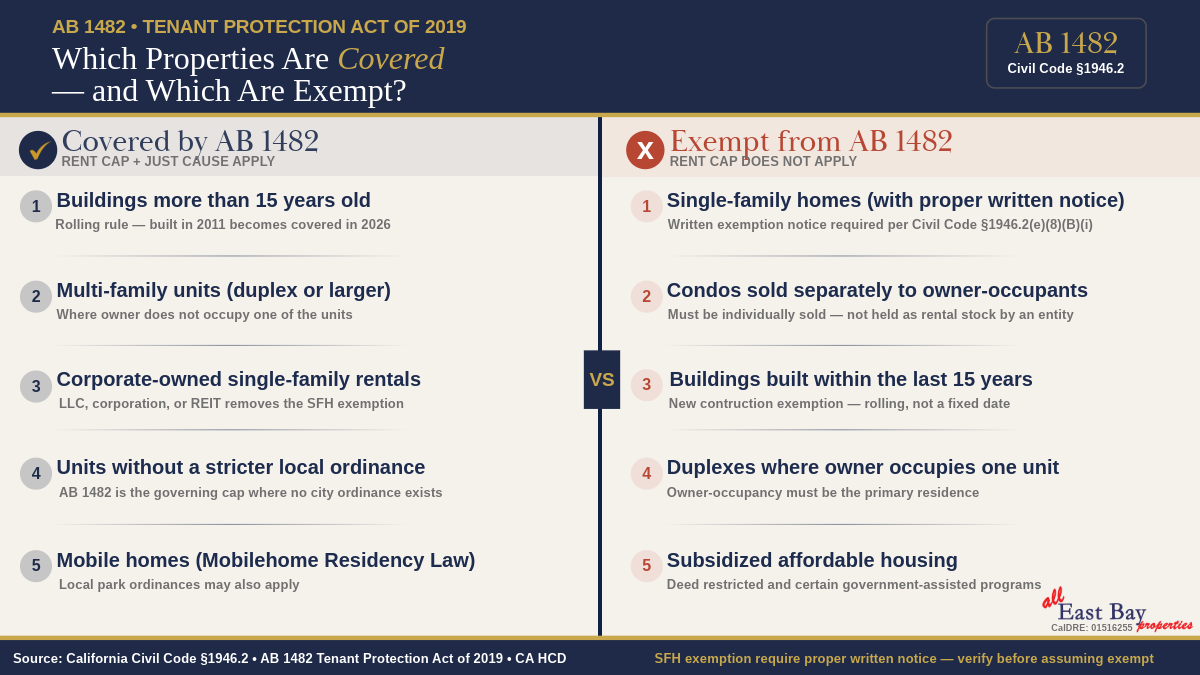
For East Bay landlords, AB 1482 is often the floor, not the ceiling. Oakland, Berkeley, Richmond, and other jurisdictions with local rent control impose stricter limits. In practice, most professionally managed properties in Oakland and Berkeley operate under local rent stabilization rules — not AB 1482’s default rate:
| Jurisdiction | Max Increase (effective date) | Registration Required? | Rate Updates |
|---|---|---|---|
| AB 1482 (East Bay region) | 8.8% (CPI 3.8% + 5%), in effect since Aug 1, 2026 (previously 6.3%) | No | Annual (CPI) |
| Oakland | 2.3% (local AGA), in effect since Aug 1, 2026 (previously 0.8%) | Yes (RAP) | July 31 |
| Berkeley | 1.0% (AGA 2026) | Yes (Rent Board) | June 30 |
| Richmond | 1.62% through Aug 31, 2026; 1.5% (AGA 2026, confirmed) beginning Sept 1, 2026 | Yes (Rent Program) | August 31 |
If your property is in Oakland or Berkeley, local rules apply — not AB 1482’s default figure. For a full breakdown, see our Oakland Rent Control Guide → and Berkeley Rent Control Guide → [coming later this month]
⚠️ What Happens If You Get This Wrong?
Incorrect rent increases are one of the most common compliance mistakes California landlords make — and they can become expensive quickly.
- Landlord must refund the full unlawful increase amount — retroactively, for every month it was collected
- Tenant may file a petition with the applicable rent board or take civil action
- Potential liability for the tenant’s attorney’s fees under Civil Code §1717
- Damage to the landlord-tenant relationship and risk to tenancy stability
- In Oakland and Berkeley: unlawful increases can trigger Rent Adjustment Program review and penalties
What We See Managing 600+ Units Across the East Bay
After calculating compliant rent increases for more than 600 units in Emeryville, Oakland, Berkeley, and Richmond, a few patterns show up consistently. The single most common error we catch when onboarding new clients is an Oakland or Berkeley landlord who has been applying AB 1482’s East Bay rate — 8.8% as of August 1, 2026, up from 6.3% — instead of their local AGA. The difference isn’t academic: at 8.8% on a $2,000 unit, that’s a $176 increase. At Oakland’s rate (2.3% as of August 1, 2026, up from 0.8%), the legal maximum is $46. A landlord who collected the higher amount owes a retroactive refund for every month collected. The second most common issue is the single-family exemption notice — specifically, landlords who assumed the exemption applied because they own a standalone house, but never delivered the required written notice to the tenant. We include the exemption notice as a standard part of our lease template for every eligible property. If you’re self-managing and haven’t done this, it’s worth verifying before your next increase.
Common Mistakes East Bay Landlords Make with AB 1482
- Applying AB 1482’s East Bay rate to an Oakland or Berkeley unit — local rates are far lower (Oakland’s local AGA is 2.3% as of August 1, 2026, up from 0.8%; Berkeley is 1.0%)
- Assuming a single-family home is automatically exempt without serving the proper written exemption notice per Civil Code §1946.2(e)(8)(B)(i)
- Forgetting to check the 12-month lookback before implementing an increase
- Using the wrong CPI region — AB 1482 requires the regional CPI for where the property is located, not the national figure (BLS SF-Oakland-Hayward data)
- Implementing a no-fault just cause termination without providing required relocation assistance per Civil Code §1946.2
Frequently Asked Questions About AB 1482
How much can California landlords raise rent in 2026?
For units covered by AB 1482, the maximum increase between August 1, 2025 and July 31, 2026 was 6.3% in the SF–Oakland–Hayward CPI region — confirmed by the BLS April 2025 CPI release (1.3% CPI + 5%). As of August 1, 2026 (through July 31, 2027), the confirmed maximum is 8.8% (3.8% CPI + 5%) for that same region — other CPI regions in California have their own current figure under the same formula. Units in Oakland and Berkeley are governed by stricter local ordinances — Oakland’s local AGA is 2.3% as of August 1, 2026 (up from 0.8%), and Berkeley is 1.0%.
Does AB 1482 apply to single-family homes?
Single-family homes are generally exempt, but only if two conditions are met: (1) the owner is not a corporation, LLC, or REIT, and (2) the tenant received the required written exemption notice under Civil Code §1946.2(e)(8)(B)(i). Missing either condition means the property is covered — even if it’s a standalone house.
Does AB 1482 apply in Oakland or Berkeley?
No — not as the governing rent cap. Local rent control ordinances in Oakland and Berkeley override AB 1482’s East Bay rate (8.8% as of August 1, 2026, up from 6.3%). Oakland landlords are limited to 2.3% as of August 1, 2026 (up from 0.8%), and Berkeley landlords to 1.0% for covered units. AB 1482 still provides a legal floor for properties that fall outside local ordinance coverage, but most professionally managed units in these cities are subject to the local rules.
What is the 12-month lookback rule?
Civil Code §1947.12 limits landlords to one rent increase per rolling 12-month period. The clock starts from the date of the most recent increase — not the calendar year. You cannot split increases across two periods to work around the cap, and partial increases earlier in the year count toward the annual total.
What are the just cause eviction rules under AB 1482?
After a tenant has lived in a covered unit for 12 months, you can only terminate the tenancy for a qualifying at-fault or no-fault reason under Civil Code §1946.2. At-fault causes include nonpayment of rent, lease violations, and criminal activity. No-fault causes (such as owner move-in or Ellis Act withdrawal) require payment of one month’s rent as relocation assistance at the time notice is served.
Does AB 1482 expire?
Under current law, AB 1482 is set to expire January 1, 2030, unless the California Legislature extends it — as confirmed in Civil Code §1947.12(f). Several proposals to make the law permanent have been introduced in prior sessions. Landlords should monitor legislative developments as the sunset date approaches.
Ready to implement a compliant rent increase?
We calculate the exact maximum increase for each unit, document the CPI basis, and prepare compliant notice — every year, automatically. You capture every dollar you’re entitled to without the compliance risk.
We manage 580+ units across Emeryville, Oakland, Berkeley, and Richmond — we navigate these rules for clients every day.
Related Articles:
- ← East Bay Rent Increases: What Landlords Can (and Cannot) Do in 2026 [March 2, 2026]
- → Oakland Rent Control in 2026: Rules, Allowable Increases & What Landlords Must Know [March 16, 2026]
- → California Rent Increase Notice Requirements in 2026 (And How to Raise Rent Without Creating Problems) [March 23, 2026]
Related video: AB 1482 Explained: Does California’s Rent Cap Apply to Your Property — and How Much Can You Raise Rent in 2026?
