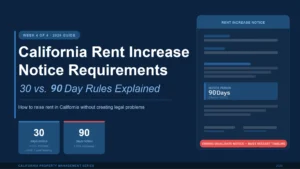

Does AB 1482 apply to your rental property — and how much can you actually raise the rent in 2026? This video walks through both questions with real numbers, including a step-by-step calculation on a $2,400/month unit you can follow with your own property.
Note: the video below was recorded for the August 2025–July 2026 rate period, when the AB 1482 cap was 6.3% and Oakland’s AGA was 0.8%. The figures spoken in the video reflect that period accurately. The written figures on this page have been updated to the confirmed rates for August 2026–July 2027 (AB 1482 8.8%, Oakland 2.3%) — use the written figures below for current compliance.
What This Video Covers
- Does AB 1482 cover your property? — 0:00
- Covered vs. exempt — the 15-year rolling rule — 0:19
- Single-family homes — the exemption notice trap — 0:41
- Oakland and Berkeley: local rules override AB 1482 — 1:00
- The CPI + 5% formula explained — 1:14
- Step-by-step calculation (2025–26 example figures): $2,400/month — 1:30
- The 12-month lookback rule — 1:52
- Just cause eviction — what covered units require — 2:28
- Relocation assistance — the rule most landlords miss — 3:00
- How we handle this for 600+ East Bay units — 3:07
What East Bay Landlords Need to Know
AB 1482 — California’s Tenant Protection Act of 2019 — sets a statewide ceiling on annual rent increases and layers just cause eviction protections on top. For increases effective August 1, 2026 through July 31, 2027, the confirmed maximum under AB 1482 is 8.8%: the formula is 5% plus the SF-Oakland-Hayward metro CPI of 3.8%, confirmed from April 2026 BLS data (the prior period, through July 31, 2026, was 6.3%). But if you own in Oakland or Berkeley, that number doesn’t apply to you — local ordinances override AB 1482 entirely. Oakland landlords are capped at 2.3% effective August 1, 2026 (was 0.8%). Berkeley landlords at 1.0% (unchanged, on its own calendar-year cycle). The statewide rate only governs where no stricter local ordinance exists.
Coverage under AB 1482 turns primarily on building age. Most multi-family residential buildings more than 15 years old are covered — and that 15-year threshold rolls forward each year, meaning buildings constructed in 2011 become covered in 2026. Single-family homes are exempt, but only if the landlord has served the tenant with the specific written exemption notice required by Civil Code §1946.2. If you own a single-family rental through an LLC, corporation, or REIT, the exemption does not apply regardless — the property is covered.
The calculation is straightforward once you know you’re covered: take your current rent, multiply by the maximum percentage (5% + regional CPI, not to exceed 10%), and confirm no rent increase has occurred in the prior 12 months. That 12-month lookback is a hard limit — one increase per period, no splitting raises to work around the cap.
Every covered unit also carries just cause eviction protections after 12 months of tenancy. You cannot terminate a tenancy without a qualifying reason — and for certain no-fault terminations, you owe the tenant one month’s rent in relocation assistance. This is the rule most landlords don’t discover until they’re already in the middle of a termination. If you’re issuing a no-fault termination notice on a covered unit, confirm the relocation obligation before you serve it.
Key Takeaways
- The AB 1482 maximum effective August 1, 2026 is 8.8% (5% + 3.8% CPI) for the SF-Oakland-Hayward metro, running through July 31, 2027. The prior-period maximum, through July 31, 2026, was 6.3%.
- Oakland (2.3% effective Aug 1, 2026) and Berkeley (1.0%) override AB 1482 — local ordinances are stricter and govern where they apply.
- Coverage is based on a rolling 15-year building age rule. Most multi-family buildings older than 15 years are covered.
- Single-family home exemptions require a specific written notice served on the tenant. Without it, the exemption doesn’t hold. Corporate-owned SFRs are covered regardless.
- One increase per 12-month period — the lookback runs from the date of the proposed increase, not the calendar year.
- Covered units require just cause for eviction after 12 months, and no-fault terminations may trigger a one-month relocation assistance obligation.
Laws & Resources Mentioned
- AB 1482 — Tenant Protection Act of 2019 (full text)
- Civil Code §1947.12 — Rent cap formula
- Civil Code §1946.2 — Just cause eviction
- BLS CPI SF–Oakland–Hayward, April 2026 release
- City of Oakland — Allowable Rent Increases (2.3% effective Aug 1, 2026)
- Berkeley Rent Stabilization Board — Annual General Adjustment
- Related: AB 1482 Rent Cap Explained — Full Guide
- Related: Oakland Rent Control in 2026
- Related: California Rent Increase Notice Requirements — 30 vs. 90 Day Rules
- Related: Rent Increases in the East Bay — What Landlords Can and Cannot Do in 2026
Have Questions About Your Property?
We manage 600+ units across Emeryville, Oakland, Berkeley, and Richmond — and we track every CPI update, local ordinance rate, and exemption requirement so our clients never raise rent more than they should, or less than they can.
Video Transcript (recorded for the 2025–2026 rate period — see note above for current 2026–27 figures)
If you own rental property in California, you’ve probably heard of AB 1482 — the state’s rent cap law. But there are two questions that actually matter: does it apply to your property? And if it does, exactly how much can you raise the rent? In the next couple of minutes, I’m going to walk you through both.
Let’s start with whether you’re even covered. AB 1482 covers most residential rentals in California — but not all of them. Here’s the quick version. If you own an apartment building or multi-family property that was built more than 15 years ago, you’re almost certainly covered. And here’s something people miss — that 15-year rule is rolling. A building from 2011 just became covered this year.
Now, single-family homes. A lot of landlords assume they’re automatically exempt. That’s only true if you’re not a corporation or LLC, and — this is the part people forget — you’ve actually served the tenant with a written exemption notice. Skip that notice, and you’re covered whether you meant to be or not.
And if you own in Oakland or Berkeley — pause here, because local rent control applies to you. AB 1482’s 6.3% is not your number. Oakland is 0.8%. Berkeley is 1.0%. Local rules take over entirely.
Okay — so if your property is covered by AB 1482, here’s what you need to know about actually calculating the increase. And I’m going to use real numbers so you can follow along with your own unit.
The formula is CPI plus 5 percent, with a maximum of 10 percent. For the current period — August 2025 through July 2026 — the confirmed CPI for the San Francisco-Oakland-Hayward metro is 1.3 percent. Add 5, and your maximum is 6.3 percent. The 10 percent cap isn’t triggered here.
Let me walk through a real example. Say your tenant is paying $2,400 a month. Take that $2,400, multiply by 6.3 percent — that’s $151.20. So the most you can charge is $2,551.20 per month. That’s your ceiling. You don’t have to take the full increase, but you can’t go above it.
One more thing that trips people up: you can only do this once every 12 months. And that clock runs from the date of your last increase — not the calendar year. So if you raised rent in June 2025, you can’t raise it again until June 2026, regardless of what month we’re in now.
One thing I want to flag quickly — AB 1482 isn’t just about the rent cap. If your unit is covered, you also have just cause eviction requirements. That means after a tenant has been there 12 months, you can’t end the tenancy without a qualifying reason. Non-payment, lease violation, owner move-in — those are all valid. But you can’t just ask someone to leave because you feel like it.
If you’re triggering a no-fault termination — like moving in yourself or doing a major renovation — you also owe the tenant one month’s rent as relocation assistance. That’s easy to miss and expensive when you do.
Getting this right every year — the right CPI figure, the right ceiling, the right notice — is one of those things that sounds straightforward until it isn’t. We calculate and document compliant rent increases for over 580 units across the East Bay, so our clients don’t have to think about it.
If you want the full breakdown — including the exemption rules, the Oakland and Berkeley specifics, and the notice requirements — the complete guide is linked in the description. It’s free, it’s detailed, and it has the numbers you need for 2026.
If this was useful, subscribe to our YouTube channel — we cover this stuff every week. And I’ll see you in the next one.