
Share this post
If your property manager has stopped returning calls, missed a compliance deadline, or added fees you didn’t sign up for, the thing that usually stops owners from switching isn’t the new manager — it’s uncertainty about the mechanics. Does the tenant’s lease have to change? Do you need their permission? What happens to the security deposit, and what else do you actually need to get from your current manager before you cut ties?
None of that has to be complicated, but it does have to be done in the right order. This is the process — including the records most owners forget to ask for until they’re already gone.
In Short: How to Switch Property Managers in California
Your property management agreement and your tenant’s lease are separate contracts — switching managers doesn’t require touching the lease, and you can do it mid-tenancy. Give your current manager written notice per your contract’s termination clause (30 days with no penalty is what AEBP recommends and most commonly sees in East Bay management agreements), make sure your tenant gets written notice within 15 days of the new manager taking over, as required by California Civil Code §1962(c), and get a full handoff from your outgoing manager: confirmation of the security deposit amount (and, if they were holding it in trust, a proper accounting), current tenant contact information, complete lease files, a current ledger, and any keys. Handled in that order, tenants generally never notice a disruption.
Key Facts: Switching Property Managers
| Question | Answer |
|---|---|
| Does switching PMs affect my tenant’s lease? | No. The management agreement and the lease are separate contracts. The rent, lease term, and substantive lease obligations remain unchanged; the tenant separately receives updated management and payment information. |
| Can I switch mid-lease? | Yes — there’s no requirement to wait for lease renewal. |
| How much notice do I owe my current PM? | Whatever your management agreement specifies. 30 days written notice, no penalty, is what AEBP recommends and most commonly sees in East Bay management agreements. |
| How much notice does my tenant get? | Within 15 days of the new manager taking over, in writing, per Civil Code §1962(c). |
| What happens to the security deposit? | Depends who’s holding it. Many East Bay owners hold their own tenants’ deposits directly — in that case there’s nothing to transfer, just an amount to confirm. If your outgoing manager was holding it in their broker trust account, they’re required to account for it and disburse it in accordance with the owner’s instructions, per Business & Professions Code §10145 — the statute doesn’t set a specific deadline for this. |
| What else do I need from my outgoing manager? | Current tenant contact info (phone and email), complete lease files for every unit, a current tenant ledger, and any keys or access devices they’re holding. |
| What if my tenant isn’t notified in time? | Per the statute itself: you may not be able to serve a pay-or-quit notice for rent that came due while they lacked the new payment information. |
Video Transcript
If you’ve got a property manager right now and you’re thinking about making a change, here’s the good news: switching is usually simpler than owners expect, as long as you handle things in the right order.
First: your management agreement and your tenant’s lease are two completely separate contracts. Terminating your PM doesn’t touch your tenant’s lease at all. The rent, the terms, the end date — none of that changes. You can switch mid-lease without any amendment or new signature from your tenant.
Second: check your termination clause. Thirty days written notice with no penalty is what we typically recommend and see in East Bay management agreements. If your contract has a 60- or 90-day window, or a penalty fee for leaving early, that changes your timeline — it doesn’t trap you, it just means you plan ahead.
Third — and this is the step most owners don’t think about — your tenant has to be notified in writing within 15 days of the new manager taking over. California Civil Code Section 1962 requires it: the new manager’s name, address, phone number, and where to pay rent. Every tenant we take on gets that notice before we collect a single rent payment.
Now, the security deposit. Most owners we work with hold deposits themselves — that’s actually the norm here. If your manager held it, they’re required to account for it and hand it over. If you hold it yourself, there’s nothing to transfer, but the amount needs to be confirmed. We include it in our transition paperwork as an AEBP practice, even though it’s not required by Section 1962.
And the deposit isn’t the only thing to collect. Get current contact information, the complete signed lease for every unit, a current ledger, and any keys or access devices. We check all of it before we consider an onboarding finished. Proper documentation from day one is essential for protection later on.
If you’re in Oakland, Berkeley, or Richmond, remember to update your rent registration with the new manager’s contact information as well.
Done right, none of this disrupts your tenant, and it doesn’t put your lease at risk. It’s about following the process. All East Bay Properties — check the link below for the full walkthrough, including our checklist for taking on a property from another manager.
When Switching Actually Makes Sense
Quality decline is the most common reason owners call us: a property manager who used to respond same-day now takes a week, maintenance requests sit longer, or monthly statements arrive late or not at all. The other recurring reasons: a compliance mistake you found out about after the fact — a rent increase notice that used the wrong rate, a missed RAP registration — or fees that weren’t disclosed clearly when you signed.
None of those require you to wait for a “better” moment. The right time to switch is when you’ve decided the current relationship isn’t working, not when the calendar happens to line up.
If you’re earlier in the process — still weighing whether professional management makes sense at all, rather than which company to switch to — see the real math on whether a property manager is worth it and what a property manager actually does day to day. If cost is the sticking point, our fee structure lays out exactly what to expect and what to watch for elsewhere.
Your Management Agreement and Your Tenant’s Lease Are Two Different Contracts
This is the fact that resolves most of the anxiety around switching: the agreement between you and your property manager has nothing to do, legally, with the lease between you and your tenant. One is a service contract. The other is a real property agreement with entirely different parties, terms, and protections.
Ending the management agreement doesn’t end, amend, or even technically touch the lease. Your tenant keeps paying the same rent, under the same terms, through the same lease end date, regardless of who’s collecting the check on your behalf. You don’t need your tenant’s permission to switch managers, and you don’t need a new lease signature. You do, however, owe your tenant something specific: notice of who to pay and how. That’s covered below.
| 1 Termination Clause | 2 Notify Tenant | 3 Security Deposit | 4 Records Handoff | 5 City Registration |
Step 1: Review Your Termination Clause
Pull your current management agreement and find the termination section before you do anything else. Thirty days written notice with no penalty is what AEBP recommends and most commonly encounters in East Bay management agreements. Some contracts specify 60 or 90 days, and some include an early-termination fee — often a month or two of management fees. None of that prevents you from switching; it just sets your timeline and, if a penalty applies, your cost of leaving now versus waiting it out.
Send the notice in writing, keep a copy, and note the date your management relationship officially ends — that date anchors everything else in this process.
Step 2: Notify Your Tenant in Writing — This Part Is Legally Required
California Civil Code §1962(c) requires a successor manager or owner to give tenants written notice within 15 days of succeeding the previous manager or owner. Per subsection (a), the notice has to include the new manager’s name, usual street address, and telephone number; where, how, and to whom rent should be paid; and who’s authorized to accept legal notices and service of process on the owner’s behalf.
This isn’t a formality you can skip if things are amicable. The statute states the consequence directly: a successor manager or owner who hasn’t complied “shall not serve a notice pursuant to paragraph (2) of Section 1161 of the Code of Civil Procedure or otherwise evict a tenant for nonpayment of rent that accrued during the period of noncompliance.” Plainly: if your tenant wasn’t properly notified, you may not be able to serve a pay-or-quit notice, or pursue eviction for nonpayment, for rent that came due during the period they didn’t have the new information. Sending this notice on day one of the new manager’s contract — not after the first missed payment — is the entire point.
From our files: every tenant we take on gets a written §1962(c) addendum before we collect a single rent payment from them. The new payment instructions and the authorized-notice contact are what §1962 actually requires us to disclose; we also include the security deposit amount and who’s holding it on the same form — that part isn’t a statutory requirement, it’s our own practice, so it’s never a question later.
Step 3: The Security Deposit — Find Out Who’s Actually Holding It
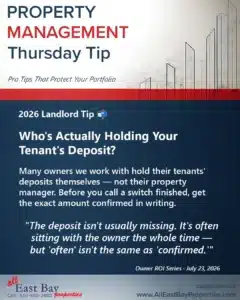
In the East Bay, the security deposit often isn’t sitting in a property manager’s trust account at all. Most of the owners we work with hold their tenants’ security deposits directly, rather than having the property manager hold them; a property manager actually holding the deposit in trust is the exception here, not the rule. Check which model your current and incoming manager use before assuming there’s a deposit to “transfer.”
If your outgoing manager was holding the deposit, it’s trust money, not the management company’s money — a real estate broker who accepts funds on someone else’s behalf must deposit them in a trust account and keep them there “until disbursed by the broker in accordance with instructions from the person entitled to the funds” (Business & Professions Code §10145). Once the management agreement ends, that duty to account for and disburse the funds doesn’t go away. If you hold the deposit yourself, there’s no transfer to chase down at all — but your new manager still needs the exact amount confirmed in writing and recorded accurately. AEBP also includes the amount and identifies who holds it in its own transition documentation, although that’s an AEBP practice rather than a disclosure required by Civil Code §1962.
From our files: when we onboard a property from another management company, this is still the step we check most carefully, regardless of who’s holding the money — get the number confirmed in writing before you consider the switch complete.
Step 4: Get the Full Records Handoff — Not Just the Money
The deposit gets most of the attention, but it’s rarely what actually causes problems in the weeks after a switch. Every time we onboard a property from another manager, we ask for four things beyond the deposit accounting:
- Current contact information for every tenant — phone and email. It’s surprising how often owners coming out of a self-managed stretch, or a property manager relationship that had gone quiet, don’t actually have a working phone number or email on file for one or more of their own tenants.
- The complete, signed lease and every addendum for each unit — not a summary, the actual documents.
- A current tenant ledger showing who’s paid, who’s behind, and any outstanding charges, so nothing gets double-billed or missed in the first month under new management.
- Any keys, fobs, or other access devices your outgoing manager is holding.
- A rundown of any open maintenance, compliance, or legal matters — active work orders, pending inspections, unresolved compliance notices, or anything currently in dispute.
None of this is legally mandated the way the §1962 notice or the deposit accounting is. But skipping it is how owners end up locked out of a unit, unable to reach a tenant during a maintenance emergency, or arguing over a late fee neither side can actually document.
Step 5: Update Your City Rent Registration
If your property is in Oakland, Berkeley, or Richmond and subject to that city’s registration requirements, keep the registered property-manager or agent contact information current — not just your own.
Oakland: the Rent Adjustment Program requires owners to confirm or update their tenancy registration annually through the online Rent Registry, with the 2026 renewal due March 2. If your manager changes between annual renewals, contact RAP’s Registration Unit at rentregistry@oaklandca.gov to get your file updated rather than waiting for the next cycle.
Berkeley: the Rent Stabilization Board’s online Rent Registry lets you update your unit and manager contact information any time, not just annually. Reach the Registration Unit at rentregistry@berkeleyca.gov or (510) 981-7368 ext. 2 with questions.
Richmond: the Richmond Rent Program has a specific form for this — the Amended Property Enrollment Form — for updating your contact information, property manager, or a unit’s status. File it by email at rent@ci.richmond.ca.us, by mail, or in person at 440 Civic Center Plaza, Suite 200, Richmond.
An out-of-date registration is a small thing until you need to serve a rent increase notice and the paperwork doesn’t match who’s actually managing the property.
Before You Switch: The Checklist
Everything above, in one scannable list. Don’t consider the transition finished until every box is checked:
- ☐ Written termination notice sent to your current PM, per your contract’s actual notice period
- ☐ Written §1962(c) notice sent to your tenant within 15 days of the new manager taking over
- ☐ Security deposit amount confirmed in writing — with a full trust-account accounting if your outgoing manager was holding it
- ☐ Current phone and email on file for every tenant
- ☐ Complete signed lease and all addenda for every unit
- ☐ Current tenant ledger showing payment status and any outstanding charges
- ☐ All keys, fobs, and access devices accounted for
- ☐ Open maintenance, compliance, or legal matters documented and handed off
- ☐ Oakland RAP, Berkeley, or Richmond rent registration updated with the new manager’s contact info
What Happens to Your Tenant, Deposit, and Lease
| Stays the Same | What Has to Happen | |
|---|---|---|
| Tenant’s lease | Rent, term, end date, all substantive lease conditions | No lease amendment or new signature is ordinarily needed; the tenant receives updated management and payment information separately |
| Security deposit | The amount owed to the tenant | If your outgoing PM held it in trust, they must account for it and disburse it (Bus. & Prof. Code §10145); if you hold it directly (the norm for most East Bay owners we work with), just confirm the amount is accurate |
| Rent payment instructions | — | Tenant gets written notice within 15 days per Civil Code §1962(c) |
| Tenant records | — | Contact info, signed lease files, and a current ledger should transfer from the outgoing manager |
| Keys & access devices | — | Confirm everything the outgoing manager is holding gets handed over |
| Open maintenance requests | — | Outgoing manager should hand off a list of open work orders and vendor contacts |
| Oakland RAP / Berkeley / Richmond registration | The registration itself | Agent/manager contact info must stay current — Oakland and Berkeley via their online Rent Registry, Richmond via the Amended Property Enrollment Form |
Timing the Switch
You don’t need to wait for lease renewal, and mid-lease switches are common and routine. That said, most owners prefer to time the handoff away from an active maintenance emergency or an in-progress eviction, simply because those situations benefit from continuity of whoever already has the history. If nothing urgent is in motion, there’s no reason to delay past your termination notice period.
The Bottom Line
Switching property managers is a manageable business decision as long as you follow the sequence: honor your termination notice, notify your tenant in writing within 15 days, confirm the security deposit accounting regardless of who’s holding it, and collect tenant contact info, lease files, a current ledger, and keys before you let the old relationship go. When we onboard a property from another manager, we handle all of it — including filing the updated RAP, rent board, or Richmond Rent Program registration — so nothing falls through the gap.
Sources
- California Civil Code §1962 — disclosure of manager/owner identity, service of process, and rent payment instructions; subsection (c) governs notice of a change in manager
- California Business & Professions Code §10145 — real estate broker trust fund deposit, maintenance, and disbursement duties
- California Civil Code §1950.5 — security deposit limits, permitted uses, and itemized-statement rules
- California Department of Real Estate — Trust Funds guidelines (RE 13)
- City of Oakland Rent Adjustment Program — Rental Unit Registration (annual renewal, deadlines, Rent Registry portal)
- Berkeley Rent Board — Registration (Rent Registry, Registration Unit contact)
- Richmond Rent Program — Enrollment and Registration, Amended Property Enrollment Form
Frequently Asked Questions
Can I switch property managers in the middle of my tenant’s lease?
Yes. Your management agreement and your tenant’s lease are separate contracts. Ending the management agreement doesn’t affect the lease terms, rent, or end date, and you don’t need your tenant’s consent to switch.
How much notice do I need to give my property manager before switching?
Whatever your management agreement specifies. Thirty days written notice with no penalty is what AEBP recommends and most commonly sees in East Bay management agreements; some contracts require 60–90 days or include an early-termination fee, so check your specific agreement before planning your timeline.
Does my tenant have to be notified when I switch property managers?
Yes — California Civil Code §1962(c) requires written notice within 15 days of the new manager taking over, including the new manager’s name, address, phone number, rent payment instructions, and who’s authorized to accept legal notices. The statute itself states that skipping this can prevent you from serving a pay-or-quit notice for rent due during the unnotified period.
What happens to my tenant’s security deposit when I change property managers?
It depends who’s holding it. If your outgoing property manager was holding it in their broker trust account, they’re required to account for it and disburse it according to the owner’s written instructions — to the owner directly, or to a new manager’s trust account if the owner directs it — per Business & Professions Code §10145’s trust fund handling rules. The statute doesn’t set a deadline for this, just an obligation to track and disburse the funds as instructed. Many East Bay owners hold their tenants’ deposits directly rather than having the property manager hold them — in that case there’s no transfer to arrange, just confirmation that the amount is recorded accurately for the incoming manager’s records. AEBP also documents the amount and who holds it in its tenant transition paperwork, although §1962 does not require that deposit information.
Do I need to update my Oakland, Berkeley, or Richmond rent registration when I switch managers?
Yes, in all three East Bay cities with rent programs. Oakland’s and Berkeley’s online Rent Registries both let you update your manager’s contact information — Oakland’s is confirmed annually (2026 deadline: March 2), Berkeley’s can be updated any time. Richmond has a dedicated form for this, the Amended Property Enrollment Form, filed with the Richmond Rent Program.