
Share this post
Most landlords who ask this question already suspect the answer. They’ve had a late-night maintenance call. They’ve wrestled with a rent increase notice. They’ve spent a Sunday afternoon researching whether Oakland’s Rent Adjustment Program applies to their unit.
The question isn’t really “is a property manager worth it?” It’s “is the fee worth what I’m dealing with?”
This post gives you the math to answer that honestly — including the costs most self-managing landlords don’t account for until something goes wrong.
Quick Answer: Is a Property Manager Worth It?
For most Oakland, Berkeley, and Emeryville landlords, professional property management becomes cost-effective when it prevents even one significant vacancy loss, compliance mistake, or maintenance escalation in a given year. Whether it’s worth it for you depends on your available time, your familiarity with local rent regulations, and your tolerance for the operational and legal complexity that comes with East Bay rental ownership. The math below will help you work that out.
Key Facts: The Real Cost Breakdown
| Factor | Self-Managing | With AEBP |
|---|---|---|
| Monthly management fee | $0 | 6–8% of rent collected |
| On a $2,800/mo unit | — | $168–$224/mo |
| Average hours/month | 6–10 hrs (owner handles all) | 0 hrs (we handle it) |
| Turnover vacancy exposure | Often 5+ weeks | Marketed immediately at move-out |
| RAP registration | Owner tracks and files | Tracked and handled |
| Rent increase notices | Owner drafts and serves | Calculated correctly, served on time |
| After-hours maintenance | Owner coordinates | Bilingual 24/7 line |
AEBP fee structure: 6–8% monthly management, no setup fee, no maintenance markup, no cancellation penalty. See our full fee breakdown →
Video Transcript
If you manage your own rental property in Oakland, Berkeley, or another East Bay city, this video is going to show you the math most landlords never actually run.
The question we hear all the time is: “Is a property manager worth the fee?” And it’s the wrong question. The right question is: “What is self-managing actually costing me — and is that less?”
Let’s start with the fee, because that’s what everyone fixates on.
At All East Bay Properties, we charge 6 to 8 percent of monthly rent collected. On a $2,800 a month unit — which is pretty typical for Oakland — that’s about $196 a month. Roughly $2,350 a year. No setup fee. No markup on repairs. No cancellation penalty. That’s it.
Now let’s look at what it costs to self-manage.
The PM Trends Report 2026 found something that surprises most landlords: self-managing owners estimate their vacancy at about 3 weeks between tenants. The actual average — measured across thousands of real rentals —
Editor’s note (September 2026): The 5.1-week figure is ShowMojo’s 2025 median time on market. The 3-week figure is an owner survey estimate. They measure different things, so the “70% longer” comparison in the video isn’t like-for-like. See the corrected Vacancy Gap section below.
On a $2,800 unit, the difference between 3 weeks and 5 weeks of vacancy is about $1,300 in income that just didn’t happen. Delayed listing, non-professional photos, slow screening — it adds up quietly.
Here’s what makes the East Bay different from the rest of California.
Oakland and Berkeley landlords aren’t just managing properties. They’re tracking two separate rent control systems — AB 1482 statewide, and Oakland’s Rent Adjustment Program — with rates that change every year.
For the 2026-to-27 year, effective August 1st: AB 1482 moves to 8.8 percent. Oakland RAP moves to 2.3 percent. Berkeley holds at 1 percent.
Which one applies to your unit depends on when it was built and how it’s held. Serve the wrong notice, use the wrong rate, miss a filing deadline — and you don’t just lose that increase. You may have to start the entire process over.
That’s not a hypothetical. It’s the most common reason landlords call us.
When you hire a professional property manager in the East Bay, you’re getting leasing and placement, rent collection and enforcement, maintenance coordination with vetted vendors at no markup, full compliance tracking, monthly owner accounting, and 24/7 tenant communication — including a bilingual line for after-hours emergencies. All of that for 6 to 8 percent.
The landlords who come to us after years of self-managing almost never say the fee was too high. They talk about the thing that finally went wrong — the repair that escalated, the notice that got voided, the tenant situation that cost them three months.
In many cases, preventing even one of those events in a year offsets the entire management fee.
If you want to run the actual numbers on your property, we’re happy to do that with you — no pitch, just math.
All East Bay Properties — link below for the full breakdown, including our complete fee structure.
The Fee Is Not the Biggest Number
Here’s where the math usually surprises landlords: the management fee is rarely the largest cost in the real comparison.
On a $2,800/month Oakland unit, 7% management works out to $196/month — $2,352/year.
Now look at what a single mistake can cost:
| Event | Estimated Cost |
|---|---|
| Property manager at 7% on $2,800/mo unit | $2,352/year |
| One extra vacancy week | ~$647 |
| Two extra vacancy weeks | ~$1,294 |
| 30 extra days vacant at turnover | ~$2,800 |
| Rent increase notice served incorrectly | Notice voided; months of eligible increases lost |
| Missed RAP registration | Potential penalties, administrative costs, delayed rent increase eligibility |
| Habitability claim from deferred maintenance | Potentially thousands in repairs + legal costs |
In many cases, preventing even one major vacancy loss, compliance error, or maintenance escalation can offset a significant portion of the annual management fee — sometimes more.
What Self-Managing Actually Costs You
The time cost is real, but it’s not the whole story.
The owners who come to us after years of self-managing almost never mention the fee first. They mention the thing that finally went wrong — the tenant who stopped paying, the repair that escalated into a habitability claim, the rent increase notice that turned out to be invalid.
The PM Trends Report 2026 (Harris Poll, n=500 small landlords) found that self-managing landlords spend an average of 6–10 hours per month on routine property tasks, with that number climbing substantially during turnovers or maintenance events. That time has a real cost even if you don’t bill yourself for it.
The Compliance Cost Is Unique to the East Bay
Oakland, Berkeley, and Emeryville landlords face some of the most layered rental regulations in California — and those regulations change every year.
For the 2026/27 year (effective August 1, 2026):
- AB 1482 statewide rent cap adjusts to 8.8% (up from 6.3% last year) – bls.gov
- Oakland RAP allowable increase moves to 2.3% (up from 0.8%) – oaklandca.gov
- Berkeley AGA holds at 1.0% (unchanged from January 1, 2026) – berkeleyca.gov
A self-managing landlord in Oakland has to know which rate applies to their specific unit based on its age, construction type, and rental history — and serve the notice correctly, with the right timing, in the right format. Getting any of that wrong doesn’t just mean a smaller increase. It can mean a voided notice, a Rent Board hearing, or losing months of rental income you were legally entitled to collect.
This is not hypothetical. It’s among the most common situations that leads landlords to call us.
The Vacancy Gap
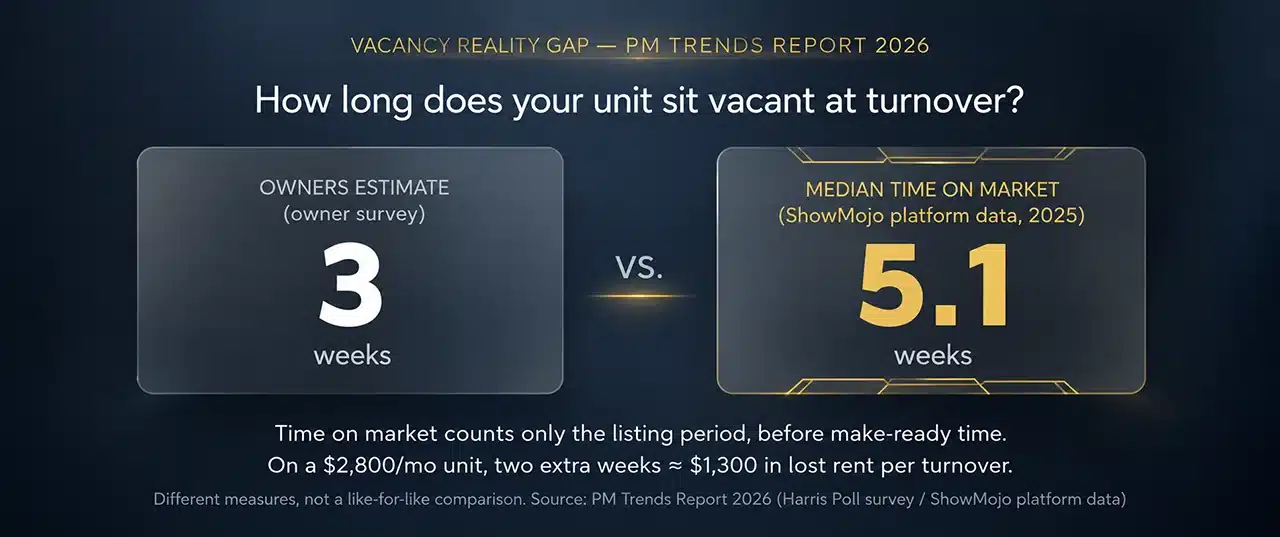
The PM Trends Report 2026 found that small landlords estimate their typical vacancy at about 3 weeks. ShowMojo’s 2025 platform data puts the national median time on market at 5.1 weeks, and that counts only the listing period, before make-ready time is added. The two figures measure different things, but they point the same way: most owners underestimate how long a turnover really takes. (PM Trends Report 2026)
In the East Bay, where our own listings lease in 25–30 days on average, every extra week beyond that is lost income.
What drives it:
- Delayed listing after move-out (cleaning, repairs, photography queued after vacancy begins)
- Non-professional photos and listing descriptions
- Slow inquiry response time
- Screening missteps that result in a placement that doesn’t work out
A property manager running a tight turnover process — pre-leasing inspection, professional marketing, prompt screening — routinely closes that gap. On a $2,800 unit, the difference between 3 weeks and 5 weeks of vacancy is roughly $1,300 in recoverable income.
A Real Scenario: The Math on One Oakland Duplex
One of our clients self-managed an Oakland duplex for several years before contacting us. When we worked through the numbers together, we looked at:
- Annual management fee at 7% across both units: ~$4,700/year
- Their estimated annual cost of self-managing: lost vacancy days, one compliance misstep, and roughly 8 hours/month of their own time valued conservatively — well above the management fee
They were spending more to self-manage than they would have paid a property manager. They just hadn’t done the math in one place.
Your numbers will be different. The point is to actually run the calculation before assuming the fee is the expensive option.
Calculate Your Own Self-Management Cost
Before deciding, answer these four questions honestly:
- How many hours per month do you spend on rental tasks — leasing, maintenance, tenant communication, compliance?
- What is that time worth per hour, conservatively?
- How many vacancy days did you have at your last turnover?
- Have you ever had to re-serve a notice, redo a lease amendment, or miss a filing deadline?
If the sum of your time plus your vacancy drag plus any compliance cost exceeds your management fee — professional management is already paying for itself on paper. The question becomes whether you want to keep absorbing that cost.
When Self-Managing Does Make Sense
In the interest of being direct: there are situations where self-managing is the right call.
- You have significant property management background and genuinely enjoy the operational work
- You live on-site or nearby, reducing response time and vendor coordination overhead
- Your property is simple — single-family, stable long-term tenant, low maintenance history
- Your rental income is low enough that the percentage fee is a meaningful share, and you have the time and expertise to manage compliantly
If those conditions are true for you, self-managing may work well. The landlords for whom it reliably becomes costly are those managing without the time, legal fluency, or vendor network to do it well — and discovering that only after something goes wrong.
What the Fee Buys You
When you pay a property manager in the East Bay, you’re not just outsourcing inconvenience. Professional management covers:

- Leasing and tenant placement — professional marketing, showings, thorough screening, compliant lease execution
- Rent collection and enforcement — consistent collection, documented late notices, legal escalation when needed
- Maintenance coordination — vetted vendors, no markup on repairs, documented work orders
- Compliance tracking — rent increase calculations specific to your unit, RAP registration, just cause documentation
- Owner accounting — monthly statements, year-end reporting, AppFolio portal access
- 24/7 tenant communication — bilingual line, after-hours emergencies handled without a call to you
AEBP’s fee for all of this is 6–8% of monthly rent collected — $168–$224/month on a $2,800 unit. No setup fee. No maintenance markup. No cancellation penalty.
The Right Question to Ask
“Can I afford a property manager?” is the wrong frame. The better question is: “What is self-managing actually costing me — and is that less than the fee?”
For most East Bay landlords managing one to five units, the honest answer involves more than time. It involves compliance risk, vacancy exposure, vendor access, and a regulatory environment in Oakland, Berkeley, and Emeryville that is genuinely more complex than most of California.
If you’d like to talk through your specific situation, we’re happy to do that with no obligation.
Frequently Asked Questions
How much do property managers charge in the East Bay?
Most charge between 6–10% of monthly rent. AEBP charges 6–8%, with no setup fee, no maintenance markup, and no cancellation penalty. See our full fee breakdown →
Is a property manager worth it for a single rental property?
Often yes — especially in Oakland, Berkeley, or Emeryville, where rent control regulations, RAP compliance, and just cause eviction rules add significant complexity that most individual landlords aren’t set up to track on their own.
Is a property management fee tax deductible?
In most cases, property management fees are considered a rental property operating expense and may be deductible against rental income. Every landlord’s tax situation is different — consult a qualified CPA or tax professional for guidance specific to your property and ownership structure.
What does a property manager do that I can’t do myself?
Practically speaking, most of what a property manager does, you can do yourself. The question is whether you’ll do it correctly, consistently, and at the right time. In a rent-controlled city with strict notice requirements and penalty structures, the margin for error is low.
How do I know if I’m ready to hire a property manager?
A practical signal: if you’ve had more than two maintenance escalations in the past year, missed any required notice deadlines, or found yourself uncertain about your specific unit’s rent increase limits — those are the situations where professional management tends to pay for itself.