
Share this post
Quick Answer
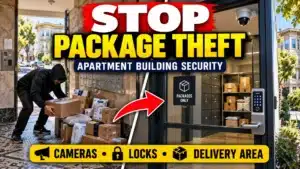
To reduce package theft in an apartment building, start with where deliveries are left and who can reach them. Cameras can document incidents and may deter theft; controlled access can reduce opportunities to take packages. No option eliminates the risk. In most older East Bay buildings, a practical order is: (1) find where carriers actually leave packages, (2) move them behind a locked door with a code you can change, or into lockers if you have the space, (3) give tenants a written package policy, and (4) don’t rely on a postal key alone to protect a package area, because Bay Area mail carriers have been robbed for those keys. Civil Code §1941.3 does not itself require a package room or lockers; separate property-specific requirements and commitments, including what you promise tenants and any packages your staff agree to hold, may still matter.
Key Facts: Apartment Package Theft
| What | The fact | Source |
|---|---|---|
| Apartment vs. house risk | Apartment and condo residents are more than three times as likely as single-family residents to have had a package stolen. In the three-month period covered by the October 2025 survey, apartment residents were victimized 3.5 times as often as homeowners. | Security.org, Oct 2025 survey of 3,307 U.S. adults |
| How common it is | About 1 in 4 Americans have had a package stolen. The average stolen package was worth $222. | Security.org, Oct 2025 |
| Is a package room or locker required? | Not under Civil Code §1941.3 itself. That section addresses specified locks, not package storage. | Civil Code §1941.3 · Required by law (and its limits) |
| If your staff accept packages | Agreeing to hold someone’s property can create a deposit and a duty of care. A free (gratuitous) depositary must use at least slight care; a depositary for hire must use at least ordinary care. | Civil Code §1846 / §1852 · Required by law; how it applies to a building is a question for an attorney |
| Postal keys | An Oakland carrier’s postal keys were stolen in May 2024. In a separate Berkeley incident reported in October 2022, thieves entered with a key that the building manager believed was a carrier master key. | NBC Bay Area, May 2024; NBC Bay Area, Oct 2022 |
| Reporting mail theft | U.S. Postal Inspection Service: 877-876-2455 or uspis.gov/report. Call 911 first if a crime is in progress. | USPS |
Prefer video? Watch the 2-minute companion video below, or visit the video page with chapter links and a full transcript.
Video Transcript
How can you reduce package theft in an apartment building? Start with where deliveries are left and who can reach them. Cameras can document incidents and may deter theft, but they work best alongside a controlled delivery area.
First, walk the route a delivery driver takes. Where do packages actually end up? In a lot of older Oakland and Berkeley buildings, that’s an open lobby or a mail alcove near the street.
Then close that gap. In our view, a locked package room with a code you can change is often the most practical fix for an older building, where the layout allows. Lockers can work too, if you have the floor space and power. If most of your packages come from Amazon, ask about its building-access program.
Put a written package policy in front of tenants, and remind them not to buzz in unexpected or unverified visitors, even if they claim to have a delivery.
One more East Bay reality. When we asked our local post office what owners can do, the best advice they had was a PO box. Mail carriers here have been robbed for the keys that open apartment mailboxes and building key boxes. So don’t let a postal key be the only thing protecting your package room.
At AEBP, package theft is a common complaint we hear from tenants. The full guide, with an options table and five common questions, is linked below.
The Short Answer: Control Where Packages Land
Much package theft in apartment buildings isn’t sophisticated. A box sits somewhere anyone can reach, for long enough that someone takes it. So a good place to start is narrowing who can reach the spot where packages wait. Every option below is a version of that.
This guide is the owner’s side: what to change in the building. If you’re asking whether a landlord is legally responsible for a stolen package, or you’re a tenant whose package disappeared, our package theft liability guide covers that. For the broader picture of what California requires for building locks and when a landlord is liable for crime, see our guide to landlord security duties.
Step One: Find Out Where Packages Actually Land
Before buying anything, walk the route a driver takes, ideally on a weekday afternoon when deliveries peak. Strongly recommended best practice. Note four things:
- How drivers get in. Through a buzzer, a code, a key box, or by waiting for a tenant to open the door?
- Where boxes end up. The lobby floor, a mail alcove, a stairwell, outside a unit door, or on the front steps?
- Who else can reach that spot. Is it behind the building’s locked entry door, or reachable from the sidewalk?
- How long packages sit there. Ask tenants. A few hours behind a locked door is a different risk than overnight in an open vestibule.
Required by law: for covered multifamily buildings, Civil Code §1941.3(a)(3) addresses locking mechanisms on exterior doors serving common areas with access to dwelling units, subject to the section’s scope and exceptions. Strongly recommended best practice: keep existing closers working so doors latch reliably. Before changing doors or converting a closet into package storage, have a qualified professional check applicable fire, egress and accessibility requirements. See our landlord security duties guide
Package Theft Options Compared for Older East Bay Buildings
Professional opinion and general guidance, not a vendor endorsement. Costs vary widely by building, so they’re shown as relative tiers. Get written quotes before deciding. “Older layout fit” refers to the small lobbies, narrow halls and street-facing mail alcoves common in pre-1960 Oakland and Berkeley apartment buildings.
| Option | What it does | Older layout fit | Upkeep | What it doesn’t solve | Relative cost |
|---|---|---|---|---|---|
| Written package policy | Tells tenants where packages go, who handles them and what to do about a theft | Works anywhere | Update yearly and before the holidays | Doesn’t physically protect anything | Lowest |
| Locked package room or closet with a keypad | Moves packages behind a second locked door, with a code you can change | Often the best fit. Can reuse a storage closet or part of a mailroom. | Change the code on a schedule and after any theft; keep the door closer working | Codes spread over time; anyone with the code can still take a box | Low to moderate |
| Smart package lockers | Each package goes in its own compartment; the tenant gets a pickup code | Needs wall or floor space, usually power, and sometimes network access. Must not narrow an exit path. | Vendor service contract; oversized items still need a backup spot | Large boxes, carriers that won’t use the lockers, outages | Highest; usually hardware plus an ongoing fee |
| Carrier access programs (for example, Amazon Key for Business) | Lets verified drivers open the entry door during a delivery, so boxes don’t pile up outside | Works with many existing buzzers and fob systems | Device on your entry system; review who has access | Covers one carrier; gets boxes inside, not into a locked room | Confirm current U.S. property eligibility, installation costs and ongoing fees directly with the provider |
| Security cameras | Records what happened; visible cameras may deter some thieves | Works anywhere with power | Keep it working and retain footage; don’t advertise more than it does | Does not physically secure packages; deterrence and recovery are not guaranteed | Low to moderate |
| Off-site delivery (PO box, carrier pickup points, delivery to work) | Tenant routes packages away from the building | Works anywhere; it’s the tenant’s choice | None for the owner; worth listing in your package policy | Costs the tenant time and sometimes money; some shippers won’t deliver to a PO box | None to owner |
Professional opinion: for many older East Bay buildings, a strong starting combination is a locked package room or closet plus a written policy, where the layout and fire, egress and accessibility requirements allow. Lockers are a good fit when there’s space and enough package volume to justify an ongoing fee. A carrier access program helps most where packages currently pile up outside a locked front door.
The Postal Key Problem
Many apartment buildings give the mail carrier access through a postal lock: a key box by the front door, or the master door on a bank of mailboxes. That works only as long as the keys stay with carriers, and in the Bay Area they haven’t always.
- In May 2024, two suspects took a mail carrier’s postal keys on Euclid Avenue in Oakland. A U.S. Postal Inspector told NBC Bay Area, “The keys only have one use if you’re not a letter carrier and that’s to steal mail.”
- In October 2022, surveillance video at a Berkeley apartment building on Le Conte Avenue showed someone open the building’s key box with a key, let a second person in, open several mailboxes and take a package. The building manager believed it was a carrier master key (NBC Bay Area).
- Nationally, USPS reported 412 letter carrier robberies in fiscal 2022 and announced plans to replace 49,000 older arrow locks with electronic locks (USPS, May 2023). In May 2026, the USPS Office of Inspector General still found many of the same arrow key accountability problems it had identified before (report 25-137-R26).
What that means for an owner. Strongly recommended best practice: don’t let a postal lock be the only barrier between the street and your package area. Put packages behind a second door with its own code. If the building’s postal key box or mailbox panel is damaged or appears to have been opened, report it to your local post office and the Postal Inspection Service, and repair any building hardware that’s yours to maintain. Mail theft is a federal crime, so the Postal Inspection Service is the right agency, alongside the police.
What Doesn’t Work on Its Own
- Relying on cameras alone. Camera footage can help document an incident. Strongly recommended best practice: use cameras alongside controlled access and prompt pickup, rather than relying on footage alone.
- Informally accepting packages for tenants. A manager or neighbor who starts signing for packages “as a favor” may have created a deposit, which comes with a duty of care. Under Civil Code §1846, even a free depositary must use at least slight care. Best practice: if you accept packages, do it under a written policy, or don’t do it.
- Calling the building “secure.” If your listing or lease promises a secure package room, keep it secure. A promise you can’t keep is where liability tends to start. Describe the actual feature instead (“a locked package room with a keypad”).
- A code nobody changes. A keypad code shared with every carrier and every past tenant slowly turns back into an open door.
What to Tell Tenants: A Written Package Policy
A one-page package policy costs nothing and sets expectations on both sides. Strongly recommended best practice. Cover:
- Where packages go (the package room, lockers, or the lobby) and how to get in
- Whether management accepts packages (and if so, which ones and for how long)
- Pick up packages promptly, and use delivery alerts (USPS Informed Delivery is free)
- Don’t buzz in anyone you aren’t expecting, even if they say they have a delivery, and don’t prop doors
- Alternatives for valuable items: carrier pickup points, signature-required delivery, delivery to work, or a PO box
- How to report a theft: to the carrier and retailer, to the police, to the Postal Inspection Service for mail, and to management so you can spot a pattern
Send a reminder before the holiday shipping season, when package volume and theft both climb. And keep a simple log of the thefts tenants report. A pattern in one spot tells you where to spend money next.
What We See at AEBP
Package theft is a common complaint we hear from tenants across the 600+ East Bay units we manage.
When we asked our local post office what building owners can do about it, the answer was blunt: the best advice they had was to get a PO box. They didn’t have a better solution to offer for package theft. They also told us mail carriers are being robbed for their master keys, which matches the Bay Area reports above. We took two lessons from that conversation. First, owners shouldn’t wait for the carriers to solve this; the fix has to happen inside the building. Second, a PO box is a reasonable option to mention in a tenant package policy, but it’s the tenant’s call, and it isn’t a building-level fix.
None of the buildings we currently manage use smart package lockers, so the locker row in the table above comes from vendor information and general industry practice, not our own track record.
Owner Checklist Before the Holiday Shipping Season
- Walk the delivery route and note where packages land and who can reach them
- Check required common-area entry locks. Strongly recommended best practice: test any existing door closer and confirm the door latches reliably.
- Move packages behind a second locked door with a changeable code, or price out lockers if space allows
- Change package-room codes now and set a schedule for changing them again
- Check common-area lighting at the entry, mail area and package area
- Send tenants the written package policy and a holiday reminder
- Make sure listings and the lease describe package features accurately
- Report damaged postal key boxes or mailbox panels to the post office and the Postal Inspection Service
Bottom Line
No setup eliminates every theft, and Civil Code §1941.3 does not itself require a package room. But you can start by checking existing doors and delivery arrangements before pricing improvements: a lobby door that latches, a second locked door with a code you control, and a clear written policy. Add lockers or carrier access if the building and the package volume justify it, and treat cameras as one layer that documents incidents and may deter some theft, not as the whole answer.
Frequently Asked Questions
What’s the cheapest way to reduce package theft in an apartment building?
Start by checking that the entry door latches reliably and giving tenants a written package policy. Then consider moving packages behind a second locked door, such as a storage closet or part of the mailroom with a keypad lock, where the layout and fire, egress and accessibility requirements allow. A written policy and repairs to existing hardware may be lower-cost starting points; a new package room needs a property-specific quote.
Are California landlords required to provide package lockers or a package room?
Civil Code §1941.3 does not itself require either. That does not settle every building’s obligations: check applicable local requirements, approvals and lease commitments. Obligations around packages usually come from what you promise in a lease or listing, from packages your staff agree to hold, and from known, repeated problems in areas you control. Our package theft liability guide covers when a landlord can be responsible for a stolen package.
Should management accept packages for tenants?
Best practice: only under a written policy. Agreeing to hold a tenant’s package can make you a depositary with a duty of care under California law: at least slight care if you do it free (Civil Code §1846), and at least ordinary care if you’re paid for it (§1852). Whether a particular arrangement counts as a deposit, and which standard applies, is a question for an attorney. A written policy should say which packages you accept, where they’re stored, how long you’ll hold them, and how tenants pick them up. If you can’t commit to that, it’s safer not to accept packages at all and say so in the policy.
Does a PO box solve package theft?
For an individual tenant, it can take the building out of the equation for mail and USPS packages. It’s what our local post office recommended when we asked. The limits: it’s the tenant’s cost and time, and many private carriers won’t deliver to a standard PO box. Some post offices offer a street-style address for PO boxes that lets UPS, FedEx and Amazon deliver there, but only at participating locations. It’s a good option to mention in your package policy, not a substitute for fixing the building.
What should happen when mail or packages are stolen from the building?
The tenant should contact the carrier and retailer and file a police report. Stolen mail, or a mailbox or postal key box that’s been opened or damaged, should also go to the U.S. Postal Inspection Service at 877-876-2455 or uspis.gov/report. Ask tenants to tell management too. As the owner, log each report, check the door and lock involved, and look for a pattern. Repeated thefts from the same spot are a signal to change how that spot is controlled.
Sources
- Package theft rates and values: Security.org, 2025 Package Theft Report (survey of 3,307 U.S. adults, October 2025)
- Required locks: Required by law. California Civil Code §1941.3
- Duty of care when holding property: Civil Code §1846 and §1852
- Oakland carrier key robbery: NBC Bay Area, May 2, 2024
- Berkeley apartment mail theft with a key: NBC Bay Area, October 11, 2022
- Carrier robberies, arrow lock replacement and reporting: USPS and U.S. Postal Inspection Service, May 12, 2023
- Arrow key accountability: USPS OIG, report 25-137-R26, May 19, 2026
- PO box street addressing: USPS PostalPro, Premium PO Box Service Street Addressing
- Amazon Key delivery-access mechanism: Amazon’s explanation of verified, time-limited building access. Confirm current local availability and terms directly with Amazon.
- Post office conversation, tenant complaint frequency and portfolio size: AEBP direct experience and company data
Tired of Package Complaints?
We manage 600+ rental units across Oakland, Berkeley, Emeryville and the wider East Bay. Let’s talk about where packages land at your property and what it would take to fix it.