
Share this post
Can You Sue Your Apartment Complex for Stolen Packages?
You can file a claim, and California small claims court handles claims up to $12,500 for individuals. But winning usually requires more than a missing package. In California, a landlord generally isn’t responsible for a package a carrier leaves in a lobby or mailroom. Responsibility can shift when the landlord promised secure package storage, accepted the package on the tenant’s behalf, or knew about a security problem in an area it controls (such as a broken entry lock or a pattern of thefts from the same spot) and didn’t act reasonably. For most tenants, the faster recovery is the retailer or carrier, credit card purchase protection, or renters insurance.
Key Facts: Package Theft in California Apartments
| What | The fact | Source |
|---|---|---|
| Default liability rule | We found no California statute that generally makes a landlord responsible for carrier-delivered packages left in common areas; Civil Code §1941.3, for example, covers specified locks, not package storage. Liability usually turns on a promise, an accepted package, or a known, unaddressed security problem. | General negligence principles; see our landlord security duties guide · Case law, stated generally |
| If management accepts a package | Agreeing to hold someone’s property can create a deposit and a duty of care. A free depositary must use at least slight care; one paid for it, at least ordinary care. | Civil Code §1846 / §1852 · Required by law |
| Required building locks | Locks on exterior doors into common areas of multifamily buildings, plus unit deadbolts and window locks. Packages and package rooms aren’t on the list. | Civil Code §1941.3 · Required by law |
| Small claims limit | $12,500 for individuals; $6,250 for businesses | California superior courts |
| Apartment vs. house risk | Apartment and condo residents are more than three times as likely to have had a package stolen; 3.5 times as often in the three-month period covered by the October 2025 survey | Security.org, Oct 2025 survey |
| Prop 36 (in effect since Dec 18, 2024) | Values from multiple thefts can be added together to reach the $950 felony threshold, and a third theft conviction can be charged as a felony | Cal. DOJ bulletin 2024-DLE-19 (Penal Code §§490.3, 666.1) |
| Mail theft | Federal crime; report to the U.S. Postal Inspection Service at 877-876-2455 or uspis.gov/report | USPS |
What’s New in This 2026 Update
- New theft data. Security.org’s October 2025 survey found apartment residents are victimized far more often than homeowners. It replaces older national estimates we could no longer source.
- Prop 36 is now in effect. California voters approved it in November 2024, and its theft provisions took effect December 18, 2024. It changes how repeat package thieves can be charged. It doesn’t change landlord liability.
- The postal key problem hasn’t gone away. In May 2026, the USPS Office of Inspector General again found problems with how carrier “arrow keys” are tracked and safeguarded. Those keys open many apartment mailboxes and building key boxes.
- Owners now have their own playbook. Building fixes (package rooms, lockers, carrier access and a written package policy) moved to our new guide, How to Stop Package Theft in an Apartment Building. This page focuses on liability and what tenants can do.
Are Apartments Responsible for Stolen Packages?
Generally, no. A California landlord isn’t an insurer of tenants’ property, and Civil Code §1941.3, the main building-lock statute, does not itself require package storage or protection of packages a carrier leaves in a common area. Local requirements and lease commitments can still matter. When a package disappears from a lobby or mailroom, the loss usually falls on the tenant, the retailer or the carrier. Case law and statute, stated generally; how it applies to a specific building is a question for an attorney.
That default can change in four situations:
| Situation | Why it matters | Example |
|---|---|---|
| The landlord promised it | A lease clause or listing that promises secure package storage or a package service creates an expectation the landlord has to meet | A listing advertises a “secure package room,” but the door lock has been broken for weeks |
| The landlord accepted the package | Agreeing to hold a tenant’s package can make the landlord a depositary, with a duty of at least slight care (free) or ordinary care (paid) under Civil Code §§1846 and 1852 | The manager signs for a package, then leaves it in an unlocked office |
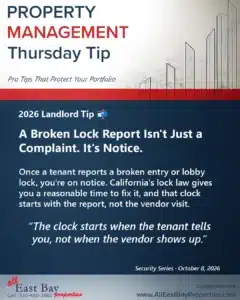
| A required lock was broken and the landlord knew | Civil Code §1941.3 requires working locks on exterior doors into common areas, and makes the landlord responsible for fixing a reported defect within a reasonable time | Tenants reported the lobby door doesn’t latch, and thefts continued while it went unrepaired |
| A known pattern in an area the landlord controls | Repeated, reported thefts from the same spot can make the next one foreseeable, which courts weigh against how burdensome a fix would be | Several reported thefts from an open vestibule, and no change in how packages are handled |
Even in those situations, a tenant still has to show the landlord’s failure actually contributed to the loss. For how California courts weigh foreseeability and burden, and the cases behind it, see our guide to landlord security duties.
What to Do If Your Package Is Stolen
Work through these in order. The first two are usually the fastest way to get your money back.
- Check first. Ask neighbors and building staff, and look for a misdelivery.
- Contact the retailer and the carrier. Many retailers will replace or refund a package marked delivered but not received.
- Check your credit card. Some cards include purchase protection for stolen items.
- File a police report. It creates a record, and insurers and retailers often ask for it.
- Report mail theft separately. If mail or a USPS package was taken, or a mailbox was opened or damaged, report it to the U.S. Postal Inspection Service at 877-876-2455 or uspis.gov/report.
- Tell your landlord or property manager in writing. Include the date, where the package was left, and any door or lock problem you noticed. Written reports are how a pattern gets noticed and fixed.
- Consider renters insurance. Many renters policies cover theft of personal property, subject to your deductible. Check your policy before filing.
How Tenants Can Prevent Package Theft
- Use delivery alerts and pick packages up quickly. USPS Informed Delivery is free; UPS and FedEx have similar tools.
- Ship valuable items elsewhere: a carrier pickup point, a locker location, or your workplace.
- Require a signature on high-value deliveries so they aren’t left unattended.
- Consider a PO box. Some post offices offer a street-style PO box address that UPS, FedEx and Amazon can also deliver to, but only at participating locations.
- Don’t buzz in strangers, even if they say they have a delivery, and don’t prop entry doors.
- Use your building’s package room or lockers if it has them, and report a broken lock or door right away.
What Prop 36 Changed for Package Thieves
Under California law, stealing property worth $950 or less is generally petty theft. Package thieves often take many small items, so each theft alone stayed under that line. Prop 36, in effect since December 18, 2024, added two tools prosecutors can use. Required by law (criminal statutes):
- Penal Code §490.3: the value of property from multiple thefts can be added together to reach the $950 felony threshold.
- Penal Code §666.1: a petty theft by someone with two or more prior theft convictions can be charged as a felony.
What this means for a building: a police report for each theft matters more than it used to, because separate reports are what let thefts be connected. Prop 36 doesn’t change whether a landlord is responsible for a stolen package.
For Owners: The Short Version
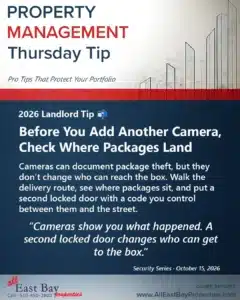
- Keep every common-area entry door closing, latching and locking. It’s required by Civil Code §1941.3, and it’s the first line of package protection.
- Describe package features accurately. Don’t promise a “secure” package room you can’t keep secure.
- Don’t accept packages informally. If you accept them, do it under a written policy.
- Log theft reports and act on patterns.
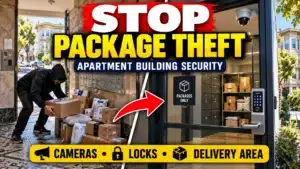
The full owner’s playbook, with a comparison of package rooms, lockers, carrier access and cameras for older East Bay buildings, is in How to Stop Package Theft in an Apartment Building.
What We See at AEBP
Package theft is a common complaint we hear from tenants across the 600+ East Bay units we manage. When we asked our local post office what building owners can do about it, the best advice they had was to get a PO box. They didn’t have a better solution, and they told us mail carriers are being robbed for their master keys. That’s why we tell owners the fix has to happen inside the building, and why we tell tenants a PO box is worth considering for anything valuable.
Frequently Asked Questions
Are apartments responsible for stolen packages in California?
Generally not, when a carrier leaves a package in a lobby or mailroom. Responsibility can shift if the landlord promised secure package storage, accepted the package, or knew about a security problem in an area it controls, such as a broken entry lock or repeated thefts from the same spot, and didn’t act reasonably.
Can I sue my apartment complex for a stolen package in small claims court?
You can file; individuals can claim up to $12,500 in California small claims court. To win, you’d generally need to show the landlord had a duty (a promise, an accepted package, or a known and unaddressed problem), failed to meet it, and that the failure caused your loss. Keep your delivery confirmation, police report and any written reports you made to management. This is general information, not legal advice for your situation.
Can I break my lease because of package theft?
Package theft by itself isn’t one of the conditions that make a unit untenantable under Civil Code §1941.1. A broken required lock is different: Civil Code §1941.3 lets a tenant use the repair remedies in §1942 if the landlord doesn’t fix it within a reasonable time after notice. Breaking a lease has real financial consequences, so talk to a tenant attorney or local tenant organization before doing it.
Does renters insurance cover stolen packages?
Often, yes, because many renters policies cover theft of personal property. Your deductible applies, and for a single package it may be more than the item is worth. Try the retailer, carrier and credit card first, then check your policy for larger losses.
Is package theft a felony in California?
It can be. Theft of property worth more than $950 can be charged as grand theft. Under Prop 36, the values from multiple thefts can be added together to reach that threshold (Penal Code §490.3), and a petty theft by someone with two or more prior theft convictions can be charged as a felony (§666.1). Taking mail from USPS custody, such as a mailbox, is also a federal crime.
Sources
- Required locks and repair remedies: California Civil Code §1941.3
- Duty of care when holding property: Civil Code §1846 and §1852
- Prop 36 theft provisions and effective date: California Department of Justice, Information Bulletin 2024-DLE-19
- Small claims limits: Superior Court of California, Small Claims
- Package theft rates: Security.org, 2025 Package Theft Report (survey of 3,307 U.S. adults, October 2025)
- Mail theft reporting: USPS and U.S. Postal Inspection Service
- Arrow key accountability: USPS OIG, report 25-137-R26, May 19, 2026
- PO box street addressing: USPS PostalPro
- Post office conversation, tenant complaint frequency and portfolio size: AEBP direct experience and company data
Updated October 2026. General information, not legal advice.
Own a Building With a Package Problem?
We manage 600+ East Bay rental units with a 24/7 bilingual maintenance line. Let’s talk about where packages land at your property and how to fix it.