
💡 Thursday Landlord Tip
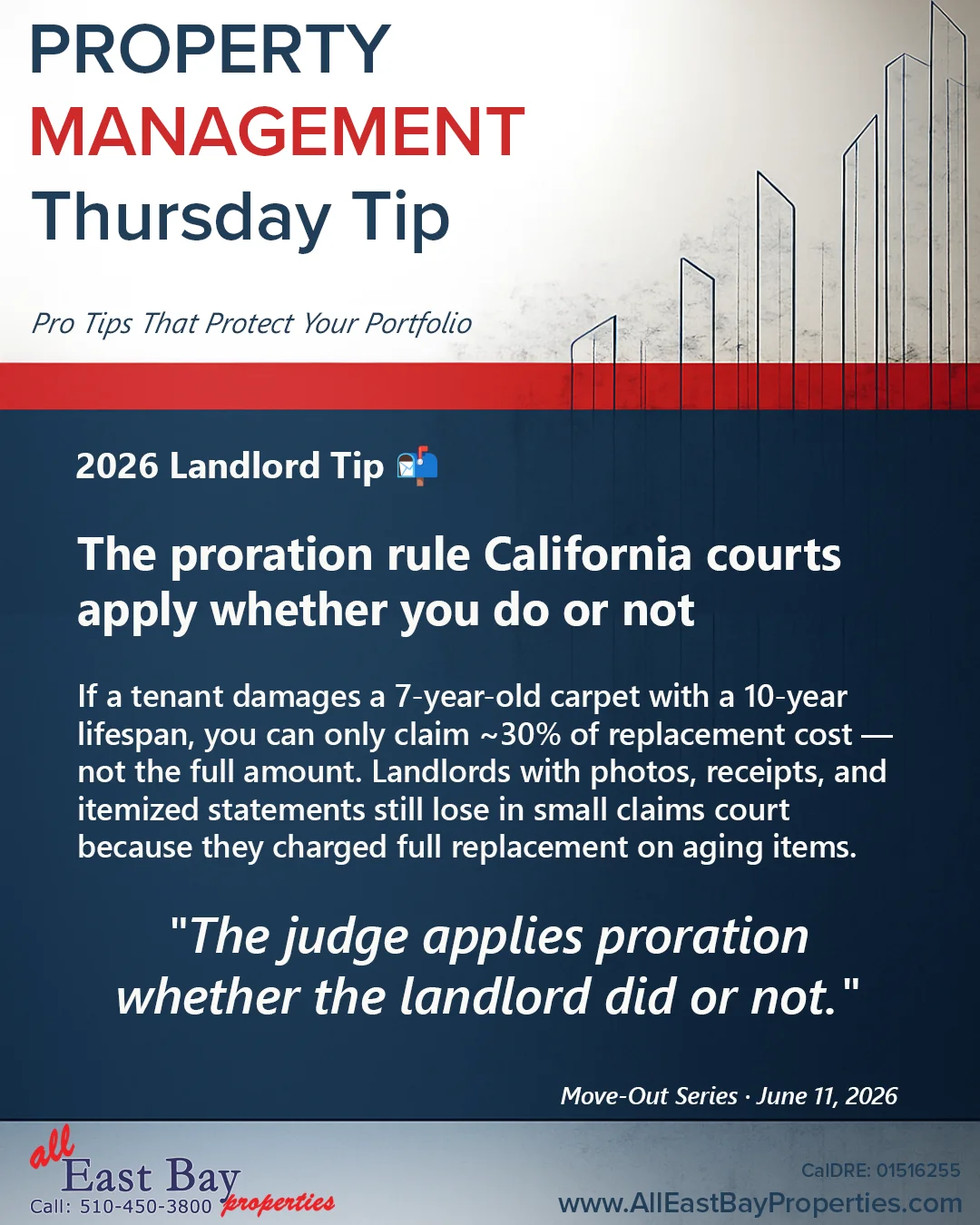
The proration rule California courts apply — whether you do or not
Here’s a scenario we see play out in small claims court more often than it should:
A landlord does everything right. Move-in and move-out photos. Itemized statement sent within 21 days. Receipts attached. And they still walk out with a fraction of what they claimed — not because the damage wasn’t real, but because they charged full replacement cost on an item that was already most of the way through its useful life.
California law doesn’t let you charge a tenant for the full cost of replacing a damaged item if that item was already worn down from years of use. You can only recover the remaining useful life — and a judge will calculate that whether or not you did.
What the proration rule actually means
When a tenant damages something in your rental, your recoverable amount isn’t the invoice total. It’s the invoice total adjusted for how much useful life the item had left.
| Item | Useful Life | Age at Move-Out | Replacement Cost | Recoverable Amount |
|---|---|---|---|---|
| Carpet | 10 years | 7 years | $2,000 | ~$600 (30% remaining) |
| Interior paint | 2 years | 2+ years | $800 | $0 (fully consumed) |
| Vinyl flooring | 10 years | 5 years | $1,500 | ~$750 (50% remaining) |
| Blinds | 5 years | 4 years | $300 | ~$60 (20% remaining) |
The math is straightforward. What trips landlords up is not knowing to apply it — or not having documentation of item age to support the calculation.
What we see in East Bay deposit disputes
In small claims court and Oakland RAP proceedings, the proration rule is one of the most consistent reasons a landlord’s otherwise solid case gets reduced. The landlord has the photos. They have the receipts. They sent the itemized statement on time. But they charged $2,000 for carpet that was already 7 years old, and the judge awarded $600.
The frustrating part: the tenant damaged the carpet. The claim was legitimate. The documentation was there. The loss was entirely on the math.
“The judge applies proration whether the landlord did or not.”
The one thing to do at move-in that protects every future claim
Document the age and condition of every major item when a tenant moves in — not just photos of condition, but a note of approximate age. Carpet installed in 2019. Blinds replaced in 2022. Paint last done in 2023.
That documentation does two things: it lets you calculate a defensible prorated claim at move-out, and it shows the court you approached the deduction in good faith. Both matter.
Move-in documentation checklist for proration:
- Date of last carpet installation or replacement
- Date of last interior paint (by room if phased)
- Age of appliances
- Age of window coverings
- Date of any major flooring replacement
- Condition notes for each — photograph alongside the age record
This takes about five extra minutes at move-in and can be the difference between recovering $600 and recovering nothing on a legitimate damage claim.
💡 This Week’s Takeaway
Proration applies to every damage claim involving a non-new item — carpet, paint, floors, blinds, appliances. The rule isn’t discretionary. Document item age at move-in so you can calculate and defend the right number at move-out, not just the invoice total.
📘 Learn More
- Normal Wear and Tear vs. Damage: The California Landlord’s Guide to Security Deposit Deductions (2026) — this week’s full guide, including the proration example, the 21-day deadline, and the AB 2801 photo requirements
- California Security Deposit Deductions: The Complete Reference — AEBP’s evergreen guide
This tip is part of our ongoing education series for Bay Area landlords focused on compliance, risk reduction, and smarter property management. 📋 Browse all Thursday Landlord Tips →
