
Share this post
Part of the May 2026 Series: Legal Notices, Evictions & Owner Protections
· May 4 — California Eviction Law 101
· May 11 — Serving the Right Notice the Right Way
· May 18 — The Alameda County UD Timeline (this post) · May 28 — Self-Help Eviction Penalties & Owner Protections
Key Facts for East Bay Landlords
- The unlawful detainer (UD) is the only legal mechanism for recovering possession of a California rental unit. There is no shortcut, and there is no faster path if a tenant refuses to leave.
- Total timeline: 40 to 60+ days from serving the initial notice to physical lockout — depending on whether the case is contested and whether your notice and service were done correctly the first time.
- Tenants have 5 calendar days to respond after being served with the UD summons (CCP §1167)— the 5-day window begins the day after service, and if day 5 falls on a weekend or court holiday, it rolls to the next court business day.
- A defective notice or improper service restarts the entire clock. This is the single most common reason Alameda County UD cases get dismissed before they’re even heard.
- Habitability defenses are routinely raised in Alameda County UD proceedings — even in nonpayment cases. An open repair request at the time you file can eliminate your entire rent recovery claim.
- The Alameda County Sheriff, not the landlord, executes the lockout. Once the court issues a Writ of Possession, the Sheriff’s Civil Division schedules the posting — which in our experience typically takes 2–4 weeks depending on their queue — before physically removing a non-compliant tenant.
- Oakland and Berkeley landlords face additional procedural requirements tied to local just cause ordinances — including relocation assistance obligations for no-fault terminations that must be met before or concurrent with the notice.
- Self-help eviction is illegal in California regardless of what the tenant owes. Changing locks, removing belongings, or shutting off utilities without a court order exposes landlords to actual damages, punitive damages, and attorney’s fees under Civil Code §789.3.

Video Transcript
If you’ve ever tried to evict a tenant in California, someone probably told you it takes about 30 days. That number is wrong — and if you’re managing in Oakland or Berkeley, it can be very wrong.
In this video we’ll walk through exactly what the eviction process looks like in Alameda County in 2026 — every stage, realistic timeframes, and where timelines fall apart before reaching a courtroom. The full written guide is linked below. Let’s get into it.
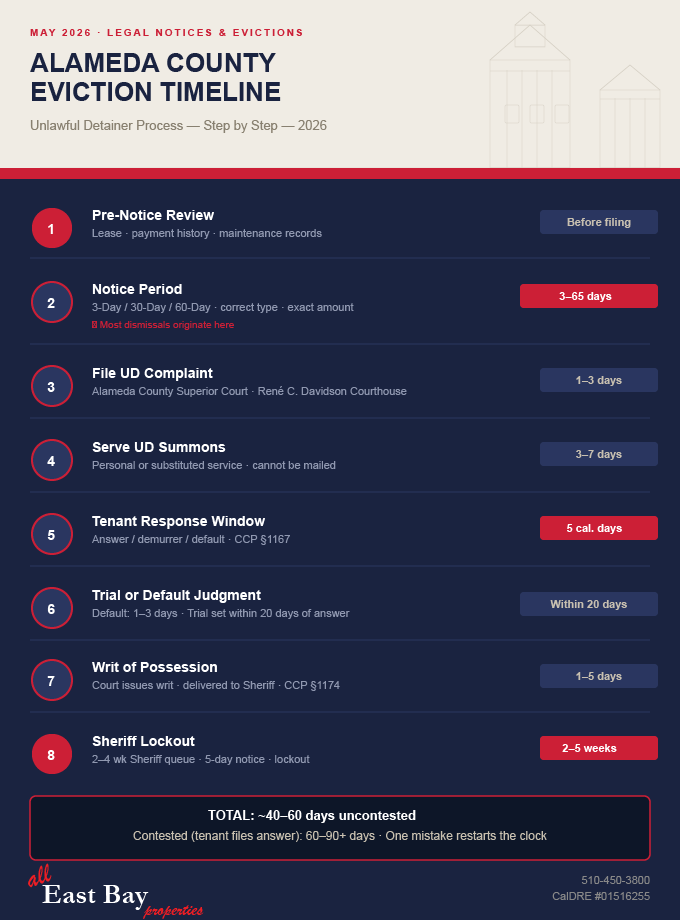
Here’s the honest answer to how long an eviction takes. Uncontested — right notice, filed correctly, tenant doesn’t respond — you’re looking at 40 to 60 days from first notice to possession. Contested — tenant files an answer, case goes to trial — plan for 60 to 90 days or more. And one mistake at any stage doesn’t slow things down. It restarts the clock entirely.
There are eight stages in the unlawful detainer process — from pre-notice review all the way to Sheriff lockout. Here’s where each one fits, and where most cases actually fail.
Stage one happens before you serve anything. Pull your lease, your payment records, and your maintenance records. Any open repair request at the property is the first thing a tenant attorney will look for when you file. A habitability defense can eliminate your entire rent recovery — not reduce it, eliminate it. Get that file organized before the notice goes out.
Stage two — the notice period — is where more Alameda County UD cases get dismissed than anywhere else. Three things kill cases here. Wrong notice type: a 3-Day Notice to Quit for nonpayment instead of a 3-Day to Pay or Quit — void on its face, dismissed. Wrong dollar amount: must be exact, courts dismiss over rounding errors. Filing one day too early: post-and-mail service adds five calendar days to the notice period — miss that and you’re dismissed.
Oakland landlords — these two rules catch even experienced owners. First: Oakland’s Just Cause Ordinance requires a minimum 30-day notice for nonpayment — not the standard California 3-Day Notice. A state-form notice on an Oakland property is defective on its face. Second: the amount owed must equal or exceed one month of HUD Fair Market Rent for that unit size — not the tenant’s actual rent. If your tenant pays $1,000 a month under rent control but the HUD Fair Market Rent is $2,000 — they need to be $2,000 behind before you can serve. At $1,000 a month, that’s two months behind before the clock can even start. Below the threshold, the notice is defective and the UD won’t survive.
Once the notice period expires, you file the unlawful detainer complaint with the Alameda County Superior Court — René C. Davidson Courthouse in Oakland. The court then issues a summons that must be personally served on the tenant — it cannot be mailed. Service takes 3 to 7 days. The tenant’s response window begins the day after service.
After service, the tenant has just five calendar days to respond — much faster than the 30 days in regular civil court. But in Oakland and Berkeley, tenant legal aid organizations are well-funded and actively advertise. The contested case rate in Alameda County is higher than almost anywhere else in California. Plan for a contested case. Don’t assume a default.
No tenant response — request a default judgment within 1 to 3 court days, getting you possession and any rent claimed. Tenant responds — trial within 20 days, bench trial, judge only. The defense that blindsides landlords most often is habitability. An open repair request when you file can become a defense that eliminates your entire rent recovery. Not reduces it — eliminates it.
After judgment, you request a Writ of Possession and deliver it to the Alameda County Sheriff’s Civil Division. This is where owners are consistently surprised. In our experience across Oakland, Berkeley, Emeryville, and Albany — it typically takes two to four weeks from writ delivery before the Sheriff even posts the 5-day notice on the property. That’s not 5 to 10 days. Two to four weeks just to get to the posting. Then five days for the tenant to voluntarily vacate. Then the Sheriff returns to execute. Total from writ to possession: three to five weeks. The court moves in days. The Sheriff moves in weeks. That’s the real timeline.
This is non-negotiable. No locks changed. No belongings removed. No utilities shut off — at any point before the Sheriff executes. Even after judgment. Even while the writ is in queue. Self-help eviction is illegal in California. Penalties include actual damages, punitive damages, and the tenant’s attorney’s fees. Wait for the Sheriff.
Four things push timelines from 40 days toward 90 or beyond: a defective notice that restarts everything, a habitability defense with a separate abatement hearing, a sustained demurrer requiring refile, or the Sheriff’s queue — which is baked in to every case. In any contested UD, what you can prove matters more than what happened. Signed lease, organized payment records, timestamped maintenance records, everything in writing, notice and proof of service. For Oakland — just cause cited on the notice face. Build that file before things go sideways.
At All East Bay Properties, we maintain this documentation in AppFolio for every property we manage — from day one. When we need to pursue a UD, the file is ready. We’re not assembling records the morning before trial. That’s what allows owners to move quickly through a process that too many landlords learn is more complicated than they expected — after it’s already gone sideways.
The full written guide — every stage, every citation, complete Oakland requirements — is linked below. If you’re navigating an active situation or want a team that handles this so you never have to — visit alleastbayproperties.com to schedule a free consultation. Next in this series: self-help eviction penalties and owner protections. Thanks for watching — from all of us at All East Bay Properties.
Start Here: Which Timeline Are You Probably Facing?
Before diving into the stage-by-stage breakdown, most Alameda County landlords fall into one of four situations — each with a different realistic outlook:
| Your Situation | Likely Timeline | What Drives It |
|---|---|---|
| Clean notice, tenant unlikely to respond | 40–60 days | Default judgment path — notice period + court processing + Sheriff queue |
| Tenant already disputing repairs or rent | 60–90+ days | Habitability defense likely; documentation is your protection |
| Oakland or Berkeley no-fault termination | 90–120+ days | 30/60-day notice + local just cause + relocation assistance + Sheriff queue |
| Habitability complaints or code enforcement open | Contested — timeline uncertain | Address all open issues before filing or risk rent abatement |
If your case is already in progress, jump directly to the stage you’re in: Notice Period · Filing the UD · Tenant Response · Trial · Writ & Lockout
Who This Guide Is For
→ East Bay landlords who have served a notice and are preparing to file — or who have already filed — a UD in Alameda County
→ Self-managing owners in Oakland or Berkeley who aren’t sure what happens after the notice period expires
→ Any landlord who has heard the UD process takes “months” and wants to understand exactly why — and what they can do about it
→ Property owners who want to understand the full process before they ever need it, so they’re not learning it under pressure
Introduction
Most East Bay landlords understand that eviction requires a legal process. Fewer understand how long each stage actually takes — and crucially, which mistakes cause the whole thing to stop and restart from scratch.
From our day-to-day experience managing properties across Oakland, Berkeley, Emeryville, and other East Bay cities: the landlords with the longest eviction timelines are almost never the ones with the most difficult tenants. They’re the ones who served the wrong notice type, missed the mailing step on post-and-mail service, or filed the UD one day before the extended notice period had fully run. Every one of those mistakes is fixable — but only before it happens.
The unlawful detainer is a summary proceeding, specifically designed to move faster than ordinary civil litigation. When the notice and service are done correctly, it does. When they’re not, the UD process doesn’t slow down — it stops entirely, the case gets dismissed, and the clock resets. Understanding the full timeline in advance is the single most effective thing an Alameda County landlord can do to protect themselves.
The Full Alameda County UD Timeline
Stage-by-Stage Overview
| Stage | What Happens | Realistic Timeframe |
|---|---|---|
| 1. Pre-Notice | Review lease, payment history, maintenance records | Before notice is served |
| 2. Notice Period | Tenant has time to pay, cure, or vacate | 3–8 days (3-Day); 30–65 days (30/60-Day) |
| 3. Filing the UD | Complaint filed at Alameda County Superior Court | 1–3 days after notice expires |
| 4. Service of Summons | Tenant served with UD summons | 3–7 days after filing |
| 5. Tenant Response Window | Tenant has 5 calendar days to respond | 5 calendar days after day of service |
| 6. Default or Trial | Default judgment (if no response) or trial set | 1–3 days (default); within 20 days of response (trial) |
| 7. Judgment & Writ | Court issues judgment and Writ of Possession | 1–5 days after judgment |
| 8. Sheriff Lockout | Sheriff posts 5-day notice; executes lockout | 2–4 weeks after writ delivered (Sheriff queue), then 5 days |
| Total — Uncontested | Notice through lockout, no complications | ~40–60 days |
| Total — Contested | Tenant responds, case goes to trial | ~60–90+ days |
One observation from our portfolio: The cases that run long almost always trace back to a procedural issue at Stage 2 — not at trial. Getting the notice right is where the timeline is actually won or lost.
Fastest Realistic Alameda County UD Timeline (2026)
If the notice was correct, service was proper, the tenant does not respond, and the Sheriff’s queue is moving normally — some Alameda County landlords regain possession in as few as 40 days from initial notice to lockout.
One procedural mistake at any stage can restart the process entirely.
This is the best-case scenario and it requires everything to go right: correct notice, proper service, no tenant response, no court delays, and a Sheriff’s queue that isn’t backed up. In practice, most uncontested cases run 45–60+ days once you account for court processing time and the Sheriff’s scheduling — the Sheriff’s Civil Division alone typically takes 2–4 weeks from writ delivery before posting the 5-day notice, and that window alone accounts for much of the difference between a theoretical fast timeline and a realistic one. Contested cases — where the tenant files an answer — run 60 to 90+ days.
Stage 1: Pre-Notice Review — Before You Serve Anything
The UD process technically begins with serving a notice. But the work that protects you in an Alameda County courtroom starts before the notice is printed.
Before serving any notice, pull together:
Your lease. Confirm the exact rent amount, the lease term, and whether AB 1482 just cause requirements have been met. In Oakland and Berkeley, verify which local ordinance applies and whether any local procedural requirements — relocation assistance, language notice, rent board registration — must be satisfied before or concurrent with termination.
Payment history. Know the exact amount owed and the specific periods it covers. A 3-Day Notice to Pay or Quit is void if the dollar amount is wrong. Courts have dismissed cases over rounding errors on the rent amount.
Maintenance records. This is the item most landlords skip — and the one that creates the most exposure. Any open repair request, unresolved code enforcement complaint, or documented habitability issue will be the first thing a tenant attorney looks for when the UD is filed. A habitability defense doesn’t have to win to do damage — it can trigger a rent abatement calculation that eliminates your entire rent recovery for the period the unit was substandard.
Document everything: every repair request received (date, method, exact wording), every acknowledgment sent, every work order created, every vendor visit with entry notice and invoice, and every completed repair with a written close-out to the tenant. Critically, document any instance where a tenant resists or prevents access for repairs. If a tenant refuses entry after proper written notice, log that refusal in writing immediately — date, time, what happened, and who was present. That record serves two purposes: it defeats a habitability defense based on conditions the tenant actively prevented you from repairing, and it supports a separate just cause ground (refusal of access) if the pattern continues.
Communication history. Everything in writing — every notice, warning, maintenance acknowledgment, lease violation notice, and follow-up. If a conversation happens by phone or in person, send a written summary afterward: “Following up on our conversation today regarding…” and keep a copy. For email, CC yourself on every communication to the tenant so you have a sender-timestamped copy in your own inbox independent of the sent folder. Texts are better than nothing but should be supplemented with email confirmations for anything material. In a contested case, you need to hand the court a coherent, chronological paper trail — not explain why the record only exists in screenshots.
Stage 2: The Notice Period — Where Most Timelines Break Down
The notice period is the time between serving the notice and the date by which the tenant must comply. It sounds simple. It’s where more Alameda County UD cases fail than at any other stage. Notice requirements are governed by California Code of Civil Procedure §1161 and §1162.
Notice Period by Type
| Notice Type | Situation | Period (Personal/Substituted Service) | Period (Post and Mail) |
|---|---|---|---|
| 3-Day Notice to Pay or Quit | Nonpayment | 3 business days | 3 business days + 5 calendar days |
| 3-Day Notice to Cure or Quit | Lease violation | 3 business days | 3 business days + 5 calendar days |
| 3-Day Notice to Quit | Illegal activity / incurable violation | 3 business days | 3 business days + 5 calendar days |
| 30-Day Notice to Terminate | No-fault; tenant < 1 year (Civil Code §1946.1) | 30 calendar days | 30 calendar days + 5 calendar days |
| 60-Day Notice to Terminate | No-fault; tenant 1+ years (Civil Code §1946.1) — see Section 8 note below | 60 calendar days | 60 calendar days + 5 calendar days |
Oakland nonpayment notices — 30-day minimum required: Under the Oakland Just Cause Ordinance, a nonpayment eviction notice in Oakland must give the tenant at least 30 days to pay or quit — not 3 days as under California state law. Serving a standard California 3-Day Notice to Pay or Quit on an Oakland covered unit is defective on its face. This is one of the most common and costly errors Oakland landlords make when using generic state-form templates.
Section 8 / subsidized tenants — extended notice period: For tenants with Section 8 vouchers or other federal rental assistance, applicable federal regulations may require a longer notice period than the 60-day state minimum. Verify the specific requirements for any subsidized tenancy before serving a no-fault termination notice.
The Post-and-Mail Extension: The Detail That Restarts the Most Clocks
When a notice is served by posting it on the door and mailing a copy — because no one of suitable age was available at the property — the notice period does not begin on the day you post and mail. California law adds five calendar days to account for the mailing. A 3-Day Notice served by post and mail becomes an 8-day notice (3 business days + 5 calendar days). Filing a UD before all eight days have fully elapsed is grounds for automatic dismissal.
This catches landlords because posting and mailing feels like service — it looks done. But the extended period is a legal requirement, not a guideline, and Alameda County courts enforce it without exception.
When the Notice Period Ends on a Weekend or Holiday
If the last day of the notice period falls on a Saturday, Sunday, or court holiday, the deadline rolls to the next court business day. Filing the UD before that date is premature and subject to challenge.
The Acceptance-After-Service Problem
Once a 3-Day Notice to Pay or Quit has been served, accepting any payment from the tenant — even a partial payment — can constitute waiver and void the notice entirely. The instinct to take what’s offered makes sense. The legal result is that you’ve signaled the tenancy continues. If you’re in a payment dispute with a tenant after serving a 3-Day Notice, do not accept any payment without first consulting a property manager or attorney.
Stage 3: Filing the UD Complaint
Once the notice period has expired without compliance, the landlord files an unlawful detainer complaint with the Alameda County Superior Court. The court handles UD filings at the René C. Davidson Courthouse in Oakland.
What Gets Filed
The UD complaint identifies the parties, the property, the legal basis for eviction (the notice type and the grounds), and the relief sought — possession of the unit and any unpaid rent. The complaint must attach a copy of the notice and proof of service.
Filing fees apply. As of 2026, fees vary based on the amount of rent claimed. Check the Alameda County Superior Court’s current fee schedule, as court fees are adjusted periodically.
What to Expect After Filing
Once the complaint is filed and accepted, the court issues a summons. The summons must be personally served or served by substituted service (with a follow-up mailing) — it cannot simply be mailed or posted. The clock for the tenant’s response begins the day after they are served with the summons, not the date the complaint was filed.
Timeline from filing to summons served: typically 3–7 days.
Stage 4: The Tenant’s Response Window
How long does a tenant have to respond to a UD in California?
After being served with the UD summons, the tenant has 5 calendar days to file a written response (CCP §1167). The 5-day window begins the day after service — not the day of service. If day 5 falls on a weekend or court holiday, the deadline rolls to the next court business day. This compressed timeline is what makes UD proceedings move faster than ordinary civil cases, where defendants typically have 30 days.
What Tenants Can Do in This Window
File a written answer. The answer admits or denies the allegations and raises affirmative defenses. Common defenses in Alameda County include:
- Procedural defects: Wrong notice type, improper service, incorrect rent amount, premature filing
- Habitability: Uninhabitable conditions the landlord failed to repair — including any open maintenance request at the time the notice was served
- Retaliatory eviction: If the notice was served within 180 days of a protected tenant activity, Civil Code §1942.5 creates a presumption of retaliation that shifts the burden to the landlord
- Just cause violation: In Oakland or Berkeley, a claim that the termination doesn’t meet the applicable local just cause standard
File a demurrer. A demurrer challenges the legal sufficiency of the complaint — arguing that even if everything the landlord alleges is true, it doesn’t legally justify eviction. Demurrers based on procedural defects are the most common.
Do nothing. If the tenant does not respond within the 5-day window, the landlord can request a default judgment. A default can typically be obtained within 1–3 court days of the deadline passing, and it entitles the landlord to possession and any rent claimed in the complaint.
The 5-day window in practice: In Oakland and Berkeley, where tenant legal aid organizations are well-resourced and actively advertise their services, the response rate is higher than in most other California jurisdictions. Landlords filing in Alameda County should plan for a contested case, not assume a default.
Stage 5: Trial — What Happens When the Tenant Responds
What happens if a tenant contests the eviction?
If the tenant files an answer, the case is set for trial within 20 days of the response being filed. UD trials in Alameda County are bench trials — decided by a judge, not a jury (unless either party demands a jury trial and pays the required fee, which is uncommon in residential cases).
The Defenses That Matter Most in Alameda County
Habitability is the defense landlords are most commonly blindsided by in a nonpayment UD. If the tenant raises it and succeeds — even partially — the court may abate rent for the period the unit was substandard. In a case where the landlord is seeking $3,000 in unpaid rent, a successful habitability defense can reduce that recovery to zero. The dollar amount the UD was filed to collect can be eliminated by an unresolved repair request.
The documentation that defeats a habitability defense: timestamped work orders, written acknowledgments, vendor invoices filed by date, and entry notices for every maintenance visit. If you’re managing this in AppFolio, the maintenance history is already organized and exportable. If you’re self-managing over email and text, assemble that record before trial — not after the defense is raised.
Retaliatory eviction most often extends timelines in Oakland and Berkeley. If the tenant shows the notice was served within 180 days of a protected activity — a repair complaint, a rent board inquiry, a request for habitability repairs — the burden shifts to the landlord to prove the termination was for a legitimate, unrelated reason.
Procedural defects raised at trial — wrong notice type, improper service, premature filing — typically result in immediate dismissal. The court doesn’t ask whether the landlord had good grounds. It asks whether the process was followed correctly.
Mid-process check: If a tenant has responded and raised a habitability defense, now is the time to review your maintenance file — before trial, not at trial. All East Bay Properties owners have this documentation organized in AppFolio from day one.
Stage 6: The Writ of Possession and Sheriff Lockout
How long does the Sheriff take after a writ is issued in Alameda County?
A judgment for possession does not automatically remove the tenant. The landlord must obtain a Writ of Possession from the court clerk and deliver it to the Alameda County Sheriff’s Civil Division for execution under CCP §1174.
Once the Sheriff receives the writ:
Step 1: The Sheriff’s Civil Division schedules the posting. This is not immediate — in our experience managing properties across the East Bay, it typically takes 2–4 weeks from the date the writ is delivered before the Sheriff posts the notice, depending on the Civil Division’s current queue. This wait is the single largest variable in the post-judgment timeline and the reason the “40-day uncontested eviction” is a best case, not a typical case.
Step 2: The Sheriff posts a 5-day notice on the rental unit, giving the tenant one final window to vacate voluntarily.
Step 3: If the tenant has not vacated after 5 days, the Sheriff returns to physically remove the tenant and return possession to the landlord. At that point, the landlord may change the locks.
Realistic timeline from writ delivery to lockout: 3–5 weeks total — 2–4 weeks waiting for the Sheriff to schedule the posting, plus the mandatory 5-day notice period, plus the return visit. The court portion of the process moves in days; the Sheriff portion moves in weeks.
Critical: The landlord cannot change the locks, remove the tenant’s belongings, or interfere with the tenant’s possession at any point before the Sheriff executes the lockout — even after a judgment is entered, and even during the weeks the writ is sitting in the Sheriff’s queue. Taking matters into your own hands before the Sheriff acts is self-help eviction. Civil Code §789.3 applies until the Sheriff physically returns possession to you.
The 2026 Alameda County Reality Check
California’s unlawful detainer is designed as a summary proceeding — faster than ordinary civil litigation. In Alameda County, that design runs into a specific local reality that landlords should factor into their expectations.
Oakland and Berkeley tenants have access to well-organized legal aid networks that actively advertise their services and lower the barrier to filing a written answer. Judges in Alameda County expect strict procedural compliance from landlords — not because they favor tenants, but because the UD rules exist precisely to protect both sides from shortcuts. And the volume of habitability and just cause defenses raised in this county is meaningfully higher than in most other California jurisdictions.
The practical result: Alameda County landlords should budget for a contested case as the likely scenario — not the exception. The landlords who move fastest through the process are the ones who treated it that way before they ever served the first notice.
What Realistically Extends the Timeline
These are the situations that push an Alameda County UD from 40–60 days toward 90 days or beyond:
1. A defective notice discovered at filing. The court clerk or tenant’s attorney identifies a defect in the notice or service, the UD is dismissed, and the landlord starts over. This adds the full notice period — 3 to 60+ days — to the timeline.
2. A habitability defense requiring a separate abatement hearing. When the defense has merit, courts sometimes schedule a separate hearing on the rent abatement calculation. This can add 2–4 weeks.
3. A sustained demurrer. If the court finds a legal defect in the complaint, the landlord must amend and refile. This adds 1–3 weeks.
4. A jury demand. Uncommon in residential UD cases but possible. Jury trials take longer to schedule and run longer than bench trials.
5. Continuances. Courts occasionally grant them. In contested Alameda County cases — particularly those involving habitability defenses or just cause disputes — continuances can add 2–4 weeks.
6. The Sheriff’s scheduling queue. The Alameda County Sheriff’s Civil Division executes writs in the order received, and the wait between writ delivery and the actual posting of the 5-day notice is typically 2–4 weeks — not days. This is baked into every Alameda County UD regardless of how smoothly the court portion went. It is the primary reason we quote owners a 40–60 day minimum for uncontested cases rather than the 30-day figure that circulates in generic California eviction guides.
What Alameda County Landlords Most Commonly Misunderstand About the UD Process
These are the assumptions that restart timelines, invite defenses, and turn straightforward situations into months-long disputes — not because the landlord had bad grounds, but because they misread how the process actually works.
1. “I accepted a partial payment after serving the notice, so we’re working something out.” Accepting any payment after a 3-Day Notice to Pay or Quit may void the notice entirely. The tenancy doesn’t need to be formally reinstated — acceptance of any amount signals it continues. If you’ve served notice and the tenant offers money, consult a property manager or attorney before you take it.
2. “I filed the UD the morning after the notice period expired.” The period must be fully elapsed — meaning the day after the last day of the notice period. For post-and-mail service, add 5 calendar days. Filing even one calendar day early is premature. Alameda County courts will dismiss on this.
3. “My texts and emails count as documentation.” They exist, but they aren’t organized. In a contested case, you need to produce a coherent, chronological record — not a screenshot hunt the morning before trial. Texts count as evidence; disorganized texts lose cases.
4. “A judgment means I can change the locks.” No. A judgment means you can request a Writ of Possession. The writ means the Sheriff’s Civil Division will add your case to their queue — which typically runs 2–4 weeks before they even post the 5-day notice. Only after the Sheriff posts the notice, the 5 days elapse, and the Sheriff returns to execute the lockout do you regain possession. Changing the locks at any earlier point — including during the weeks the writ sits in the Sheriff’s queue — is self-help eviction, illegal in California regardless of what the court has ordered.
5. “The Oakland notice rules are the same as the California state form.” They’re not — in two distinct ways. First, California’s standard UD notice forms don’t include Oakland’s just cause citation requirement. A generic state-form notice for an Oakland property is missing required language and is defective on its face. Second, and less widely understood: for nonpayment evictions, Oakland requires a minimum 30-day notice period — not the 3-day notice that California state law permits — and the amount owed must equal or exceed one month of HUD Fair Market Rent for a unit of equivalent size. A long-term rent-controlled tenant paying $1,000/month on a unit with a $2,000 HUD FMR needs to be $2,000 behind before a valid 30-Day Notice can be served. A notice served using the California state 3-Day form on an Oakland covered unit is defective regardless of the amount owed.
How Oakland and Berkeley Add Procedural Layers
For properties in Oakland and Berkeley, the UD process runs through an additional set of local requirements that affect both the notice and the filing stages. Oakland’s requirements in particular go well beyond what California state law mandates — and several of them are recent enough that self-managing owners are commonly unaware of them.
Oakland Just Cause Ordinance — O.M.C. Chapter 8.22
All eviction notices for covered units must cite the specific just cause ground on the face of the notice. A notice that omits the just cause — even if the underlying grounds are completely legitimate — is defective and subject to challenge in a UD proceeding. The ten recognized just cause grounds under Oakland law are nonpayment of rent, material lease violation, substantial property damage, nuisance, unlawful activity, refusal of access, owner move-in (principal residence), qualifying family member move-in, Ellis Act withdrawal, and substantial rehabilitation requiring vacancy.
Coverage after Measure V (effective December 30, 2022): Just cause requirements now apply to virtually all residential rental units in Oakland — including units built after December 31, 1995. The only exemption is ground-up new construction that received a Certificate of Occupancy within the past 10 years, on a rolling basis. If your property was built after 1995 and the CO was issued more than 10 years ago, just cause applies.
The HUD Fair Market Rent Threshold for Nonpayment Evictions
This is the Oakland rule that most surprises landlords — including experienced ones.
Under O.M.C. §8.22.300, a nonpayment of rent eviction is only valid if the amount owed is no less than one month of HUD Fair Market Rent for a unit of equivalent size in the Oakland metro area. The practical consequence: the legally required minimum delinquency for a nonpayment eviction is the HUD FMR for that unit type — not the tenant’s actual contract rent.
What this means in practice: If a long-term, rent-controlled tenant pays $1,000 per month for a one-bedroom, but the current HUD Fair Market Rent for a one-bedroom in the Oakland metro area is $2,000, the tenant must be at least $2,000 behind — not $1,000 — before the landlord can serve a valid 30-Day Notice to Pay or Quit (Oakland requires 30 days not the standard 3-day). At $1,000 per month, that means the tenant effectively needs to be two months behind before the eviction process can legally begin.
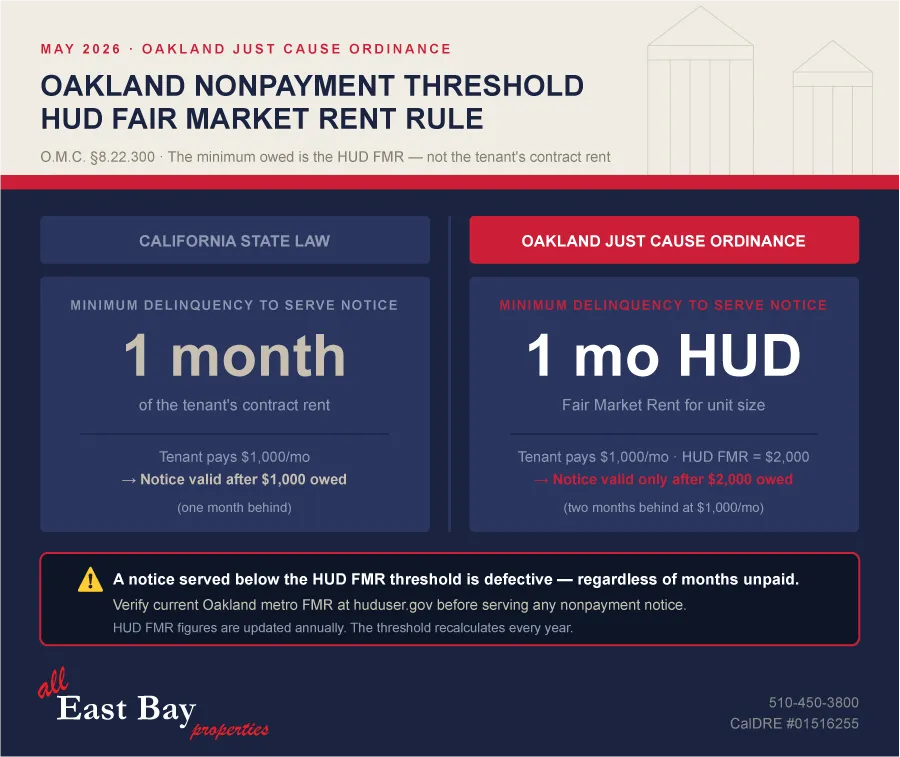
This threshold is recalculated annually as HUD updates its Fair Market Rent figures. Current Oakland metro FMR data is available at HUD’s Fair Market Rents page. Before serving any nonpayment notice on an Oakland property, verify the current FMR for the applicable unit size and confirm the amount owed meets or exceeds it. A notice served when the delinquency is below the HUD threshold is defective and will not support a UD.
From our portfolio: This rule hits hardest on older tenancies under rent control — exactly the situations where a landlord is most likely to assume the process works the same as anywhere else. A tenant paying $1,200 per month on a unit with a $2,400 HUD FMR needs to miss three months of payments before the delinquency exceeds the threshold. We’ve seen landlords serve notices and file UDs on amounts that looked substantial but fell short of the applicable FMR minimum. Those cases don’t survive a challenge.
The 10-Day RAP Filing Requirement — No Exceptions
Every eviction notice served on an Oakland tenant — for any just cause ground — must be filed with the Oakland Rent Adjustment Program (RAP) within 10 calendar days of service on the tenant. Failure to file within this window is an independent defense available to the tenant in the UD proceeding — the landlord’s failure to comply is itself grounds to challenge the eviction, separate from any defect in the notice itself.
Notices are submitted by email to evictionnotices@oaklandca.gov. RAP retains filed notices for one year. This is not optional and it is not limited to certain notice types — it applies to every eviction notice served on a covered Oakland unit.
December 2024 Amendment — No-Fault Evictions Blocked for Business-Tax-Delinquent Owners
As of December 2024, owner move-in and substantial rehabilitation evictions (collectively “no-fault evictions”) are prohibited for property owners who are delinquent on Oakland business taxes. Additionally, any notice for a no-fault eviction must now include: (1) a copy of the owner’s current Business Tax Certificate, and (2) a written statement informing the tenant of the limitations on evictions by owners delinquent on business taxes. A no-fault eviction notice that omits either of these items is defective.
Measure V — School Year Protection for No-Fault Evictions
A no-fault eviction notice cannot be structured so that the notice-to-quit period expires during the Oakland Unified School District’s regular school year, if the household includes minor children enrolled in school or educators employed by OUSD. Landlords pursuing owner move-in or substantial rehabilitation evictions must verify the household composition before calculating the notice expiration date.
Relocation Assistance for No-Fault Terminations
No-fault evictions (owner move-in, Ellis Act, substantial rehabilitation) require relocation assistance paid to the tenant as a condition of the termination. Under AB 1482 (Civil Code §1946.2) statewide, the floor is one month’s rent. Oakland’s requirements for Ellis Act withdrawals are significantly higher — verify current amounts with RAP before serving any no-fault notice. Failure to pay required relocation assistance is grounds for dismissal of the UD.
Berkeley Good Cause Ordinance — B.M.C. Chapter 13.76
Berkeley landlords must be current on rent board registration to pursue certain eviction actions. A lapse — even unintentional — can delay or complicate the UD. For no-fault terminations, Berkeley’s relocation assistance requirements must be satisfied concurrent with or prior to the notice.
From our day-to-day experience in Oakland: The notice-filing requirement and the HUD FMR threshold are the two Oakland-specific rules that catch self-managing owners most often — and they’re both invisible on standard California eviction notice forms. If you’re using a generic state-form template for an Oakland property, it almost certainly doesn’t include the required just cause citation, and it gives you no prompt to verify the FMR threshold before serving. Both failures are fatal to the UD.
The Documentation Standard That Gets You Through a Contested Case
In any Alameda County UD that goes to trial, what you can prove matters more than what actually happened. The documentation that gives you the strongest position:
- Lease agreement — signed, current, includes required AB 1482 language (or documented exemption) and identifies the monthly rent amount precisely
- Payment records — organized by date, showing every payment received and every period for which rent is claimed; exportable from your property management system
- Written communication history — every notice, warning, maintenance acknowledgment, and lease violation notice preserved in writing; phone conversations followed up with written summaries; all emails CC’d to yourself for a sender-timestamped copy independent of the sent folder
- Maintenance records — every repair request logged with date received, acknowledged, work-ordered, and completed; vendor invoices by property and date; written documentation of any instance where the tenant resisted or prevented access, logged immediately with date, time, and what occurred
- Notice and proof of service — the notice itself, completed correctly, with a declaration of service identifying who served it, how, when, and where
- Prior written warnings — for lease violation cases, any prior written notice to the tenant about the same or related conduct
- Local compliance records — for Oakland properties, proof that the just cause ground was cited on the notice face; for Berkeley properties, current rent board registration
All East Bay Properties maintains this documentation in AppFolio for every property in our portfolio from day one — not assembled retroactively when a dispute arises. When we need to pursue a UD for an owner, the file is already organized.
If your maintenance records, payment history, or notice documentation aren’t organized right now, that’s the problem to solve before the tenancy goes sideways.
The 4 Most Common Reasons Alameda County UD Cases Get Dismissed
1. Premature filing — the notice period hadn’t fully expired. This happens most often with post-and-mail service, where landlords miss the required 5-calendar-day extension. Filing one day early is a defective filing — dismissed, start over.
2. Wrong notice type for the grounds. A 3-Day Notice to Quit served in a nonpayment situation (instead of a 3-Day Notice to Pay or Quit) is void on its face. The court doesn’t ask whether the tenant actually owes rent. Wrong notice type: dismissed, clock resets. We’ve seen this cost landlords 6 to 8 weeks in situations where the underlying grounds were completely valid.
3. Incorrect rent amount on a 3-Day Notice to Pay or Quit. The notice must state the exact amount owed. Courts have dismissed cases where the amount differed from the verified ledger — even by small margins. Use the exact figure from your payment records. Round numbers are a red flag.
4. Missing the mailing step on substituted or post-and-mail service. Both methods require a mailing to the tenant completed on the same day as the physical posting. Completing the mailing the following day — or not completing it — renders service defective. Defective service means the notice period never legally started. Dismissed.

Can a Landlord Evict in Alameda County Without Going to Court?
No. The unlawful detainer filed with Alameda County Superior Court is the only legal path to recovering possession. There is no administrative process, no landlord-side option to remove a tenant without a court order, and no shortcut — regardless of how clearly the tenant has violated the lease or failed to pay rent. Self-help eviction (changing locks, removing belongings, shutting off utilities) is illegal in California under Civil Code §789.3 and exposes landlords to actual damages, punitive damages, and the tenant’s attorney’s fees.
What to Do Right Now If You’re Mid-Process
If you’ve served a notice and the tenant hasn’t complied: Before filing the UD, verify that the notice period has fully expired (accounting for the service method and any weekend/holiday extensions), that the notice type matches the grounds, and that the rent amount matches your payment ledger exactly. Do not file until all three are confirmed.
If you’ve filed the UD and the tenant has responded: Pull your maintenance records immediately. Any open repair request, unresolved code enforcement complaint, or habitability issue should be addressed and documented before the trial date. A habitability defense is harder to defeat if the condition was still unresolved when the UD was filed.
If the court has dismissed your case: Identify the defect before serving a corrected notice. Serving the same defective notice again doesn’t fix it — it adds time. If you’re not sure what went wrong, consult a property manager or attorney experienced in Alameda County UD practice before proceeding.
If you haven’t started yet: A solid lease, current maintenance documentation, and a clear understanding of which just cause rules apply to your property are the foundation of a fast, successful UD when you need one. The time to build that foundation is now.
Summary: The Alameda County UD at a Glance
| Stage | Key Requirement | Approximate Timeframe |
|---|---|---|
| Pre-notice review | Lease, payment history, maintenance records | Before notice served |
| Notice period (3-Day) | Correct type, exact amount, proper service | 3–8 days |
| Notice period (30/60-Day) | Just cause ground cited; relocation assistance if no-fault | 30–65 days |
| UD filing | Complaint + notice + proof of service | 1–3 days after notice expires |
| Summons service | Personal or substituted service on tenant | 3–7 days |
| Tenant response window | 5 calendar days from day after service | 5 calendar days |
| Default judgment | Requested if tenant doesn’t respond | 1–3 days after deadline |
| Trial (if contested) | Scheduled within 20 days of tenant’s response | Within 20 days |
| Writ of Possession | Issued after judgment | 1–5 days |
| Sheriff lockout | 2–4 weeks for Sheriff to schedule posting + 5-day notice + execution | 3–5 weeks total |
| Total — Uncontested | ~40–60 days | |
| Total — Contested | ~60–90+ days |
Frequently Asked Questions
How long does an eviction take in Alameda County in 2026?
From serving the initial notice to physical possession: a realistically uncontested case — where the tenant doesn’t respond to the UD — typically runs 40 to 60 days. The court portion moves relatively quickly; the biggest single factor extending uncontested timelines is the Alameda County Sheriff’s Civil Division queue, which in our experience runs 2–4 weeks between writ delivery and posting of the 5-day notice. A contested case, where the tenant files an answer and the case goes to trial, typically runs 60 to 90+ days. Cases with procedural errors at the notice stage, contested habitability defenses, or continuances can run longer still. The biggest variable you can control is whether the notice and service were done correctly the first time.
Is there a California eviction moratorium in effect in 2026?
No. The statewide California eviction moratorium that was in place during the COVID-19 emergency period has expired. There is no active statewide eviction moratorium in California as of 2026. Local emergency protections tied to the pandemic have also expired in Oakland and Berkeley. The standard California eviction process — just cause requirements, notice periods, unlawful detainer — governs all residential tenancies.
Can I file the UD the day after the notice period expires?
Yes — but only if you’re confident the period has fully elapsed. For a 3-Day Notice served by personal service, the 3-day period begins the day after service. For post-and-mail service, add 5 calendar days. If the notice period ends on a weekend or court holiday, the deadline rolls to the next court business day. Filing prematurely — even by one day — is grounds for dismissal.
What happens if the tenant files an answer claiming habitability problems?
The case proceeds to trial and the habitability defense is litigated. Courts may abate (reduce) the rent owed for the period the unit was substandard. In the worst case, a successful habitability defense eliminates the landlord’s entire rent recovery for the affected period. Your maintenance documentation — work orders, acknowledgments, invoices — is the evidence that defeats or limits this defense. If there were open repair requests at the time you filed the UD, address them and bring documentation of resolution to trial.
How long does the Sheriff take after a writ is issued in Alameda County?
Once the Writ of Possession is delivered to the Alameda County Sheriff’s Civil Division, the writ enters their queue — and in our experience, it typically takes 2–4 weeks before the Sheriff posts the 5-day notice on the property. After the 5-day notice is posted, if the tenant hasn’t vacated, the Sheriff returns to execute the lockout. Total realistic time from writ delivery to lockout is 3–5 weeks. This wait is inherent to the Alameda County Sheriff’s scheduling and is not something the landlord can accelerate. Plan for it when setting expectations about how long the process will take.
Do I need an attorney to file a UD in Alameda County?
Landlords can file in pro per (without an attorney). However, in Oakland and Berkeley — where just cause rules are rigorously enforced, tenant legal aid is well-organized, and procedural defects are quickly identified by opposing counsel — most experienced property managers strongly recommend working with an attorney for contested cases. For uncontested matters with clean notices and documentation, some landlords successfully self-represent. The risk of self-representation rises significantly if the tenant files an answer.
What is the Writ of Possession and how does it work?
After the court enters a judgment for possession, the landlord requests a Writ of Possession from the court clerk. The writ is delivered to the Alameda County Sheriff’s Civil Division, which adds it to their queue. The Sheriff typically takes 2–4 weeks to schedule and post the 5-day notice on the property. After the 5-day notice period, if the tenant hasn’t vacated, the Sheriff returns to execute the lockout. The landlord cannot change the locks or take any action to remove the tenant at any point before the Sheriff executes — including during the weeks the writ is in queue. Doing so is self-help eviction and is illegal in California.
Can the tenant stop the lockout after the writ is issued?
In some circumstances. Tenants can file an emergency motion for a stay of the writ, typically claiming the case shouldn’t have proceeded or that new circumstances have arisen. Courts rarely grant stays after judgment, but it does happen — particularly for elderly or disabled tenants in Oakland or Berkeley, where local ordinances provide additional protections.
What are the Oakland and Berkeley-specific requirements that affect the UD?
Oakland’s Just Cause Ordinance requires that the specific just cause ground be cited on the face of every eviction notice for covered units. For nonpayment evictions, the amount owed must equal or exceed one month of HUD Fair Market Rent for a unit of equivalent size in the Oakland metro area — not the tenant’s contract rent. A long-term rent-controlled tenant paying below market rate may need to be significantly further behind than one month of their actual rent before a valid notice can be served. Every eviction notice must also be filed with Oakland’s Rent Adjustment Program within 10 calendar days of service; failure to file is an independent UD defense. As of December 2024, no-fault evictions are blocked for owners delinquent on Oakland business taxes, and no-fault notices must include a copy of the current Business Tax Certificate. Berkeley requires current rent board registration as a condition of pursuing certain eviction actions. Both cities require relocation assistance for no-fault terminations. Failure to meet any of these requirements before filing is grounds for dismissal.
Is rent abatement the same as rent withholding?
No. Rent withholding is a remedy tenants pursue before or instead of a UD — they stop paying rent because of a habitability condition. Rent abatement is what courts order in a UD proceeding when a tenant successfully raises a habitability defense — the court reduces the rent owed based on the period the unit was substandard. A landlord seeking $3,000 in unpaid rent may recover less — or nothing — if the court finds the unit was substantially uninhabitable during that period.
Related Reading
- California Eviction Law 101 (2026): Oakland, Berkeley & Alameda County Guide for Landlords
- Serving the Right Notice the Right Way in California (Step-by-Step)
- California Landlord Repair Timelines: How Fast You Must Fix Tenant Requests (2026 Guide)
- East Bay Property Management Services
- Oakland Property Management
- Berkeley Property Management
- Oakland Rent Adjustment Program
- Berkeley Rent Stabilization Board
- Alameda County Superior Court
- Alameda County Sheriff’s Office — Civil Division
More In This Series
Articles and videos in this series