
Most landlords who lose an eviction case didn’t lose because they lacked a valid reason. They lost because the notice was defective — wrong type, missing mailing step, or a date mismatch that handed the tenant’s attorney an automatic dismissal. In this video, Jason Crouch breaks down exactly how to serve a California eviction notice correctly, covering every notice type, every service method, and the specific errors that get Alameda County cases thrown out before a hearing.
Prefer to read? California Eviction Notice Requirements (2026) is the full written guide, covering each notice type, the service methods, and the required mailing step.
What This Video Covers
- Why most dismissed evictions are lost on procedure, not merit — 0:00
- Step 1 — Choose the right notice type — 0:35
- 3-Day Notice to Pay or Quit: the exact amount requirement — 0:43
- 3-Day Notice to Cure or Quit: why vague language fails — 0:58
- 3-Day Notice to Quit (no cure): when it applies — 1:17
- One wrong choice = dismissed before it’s heard — 1:37
- Step 2 — Serve it the right way, in order — 1:44
- Method 1: Personal service (always try this first) — 1:49
- Method 2: Substituted service + the missed mailing step — 2:00
- Method 3: Post-and-mail (last resort only) — 2:16
- Post-and-mail = 8 days, not 3 — here’s why — 2:26
- Step 3 — The date detail that voids everything — 2:50
- The Tuesday/Thursday scenario we see every month — 3:07
- How All East Bay Properties reviews notices before service — 3:25
- Free consultation offer — 4:03
Key Takeaways
- Wrong notice type = automatic dismissal. The court does not correct the error. Serving a 3-Day Notice to Quit for nonpayment — instead of a 3-Day Notice to Pay or Quit — voids the case regardless of whether the tenant owes rent.
- Service methods must be attempted in order. Personal service first, substituted service second, post-and-mail only as a last resort. Skipping to post-and-mail without genuine prior attempts is itself a basis for challenge.
- Post-and-mail extends a 3-Day Notice to 8 days. Five calendar days are added to the notice period for post-and-mail service. Filing a UD before Day 8 results in automatic dismissal.
- Both steps of substituted service and post-and-mail are required on the same day. Leaving the notice with someone without mailing a copy the same day — or mailing a day later — renders service defective.
- The notice date must match the service date. Leave the date blank when preparing the notice. Fill it in by hand the moment you serve it. No exceptions.
- Oakland and Berkeley add requirements on top of state law. Review your notice against local ordinances before serving. Local non-compliance is independent grounds for dismissal even if state law requirements are met.
- A 10-minute review before serving is worth more than weeks of restarting. In a contested Alameda County situation, a single notice defect typically adds 4 to 8 weeks before you can refile.
Laws & Resources Mentioned
- California Code of Civil Procedure §1161 — Notice requirements for unlawful detainer; 3-Day Notice to Pay or Quit
- California Code of Civil Procedure §1162 — Legally recognized methods of service for eviction notices
- California Civil Code §1946.2 — AB 1482 statewide just cause eviction requirements
- Oakland Just Cause for Eviction Ordinance — O.M.C. Chapter 8.22
- Berkeley Eviction for Good Cause Ordinance — B.M.C. Chapter 13.76
- California Courts — Unlawful Detainer
- Full written guide:California Eviction Notice Requirements (2026): How to Serve a 3-Day, 30-Day & 60-Day Notice
- Series post 1:California Eviction Law 101 (2026): Oakland, Berkeley & Alameda County Guide
- Related:East Bay Property Management Services
- Related:Oakland Property Management
- Related:Berkeley Property Management
Ready to Stop Managing This Yourself?
Every notice All East Bay Properties serves is reviewed against current California law and the applicable local ordinance before it goes out. Every service attempt is documented. And every owner in our portfolio has a complete, timestamped maintenance and legal history accessible in their AppFolio portal — the documentation that protects you if a situation ever reaches an Alameda County courtroom.
Not sure which notice applies to your situation — or whether your service method will hold up? A 10-minute review before you serve is worth more than the weeks you lose restarting.
Video Transcript
Most landlords who lose an eviction case in Alameda County didn’t lose because they lacked a valid reason. They lost because the notice was wrong.
Maybe the wrong form. Maybe a missing mailing step. Maybe the date on the document didn’t match the day it was actually served.
The judge doesn’t fix those errors. The case gets dismissed — and you start the whole process over.
Today I’m going to walk you through exactly how to serve a California eviction notice so that doesn’t happen to you.
There are three main notice types, and which one you use is determined by why you’re ending the tenancy — not how long the tenant has been there.
If the tenant hasn’t paid rent, you serve a 3-Day Notice to Pay or Quit. This gives them three business days to pay in full or vacate. The notice must state the exact amount owed — not an estimate, not a rounded number. Exact.
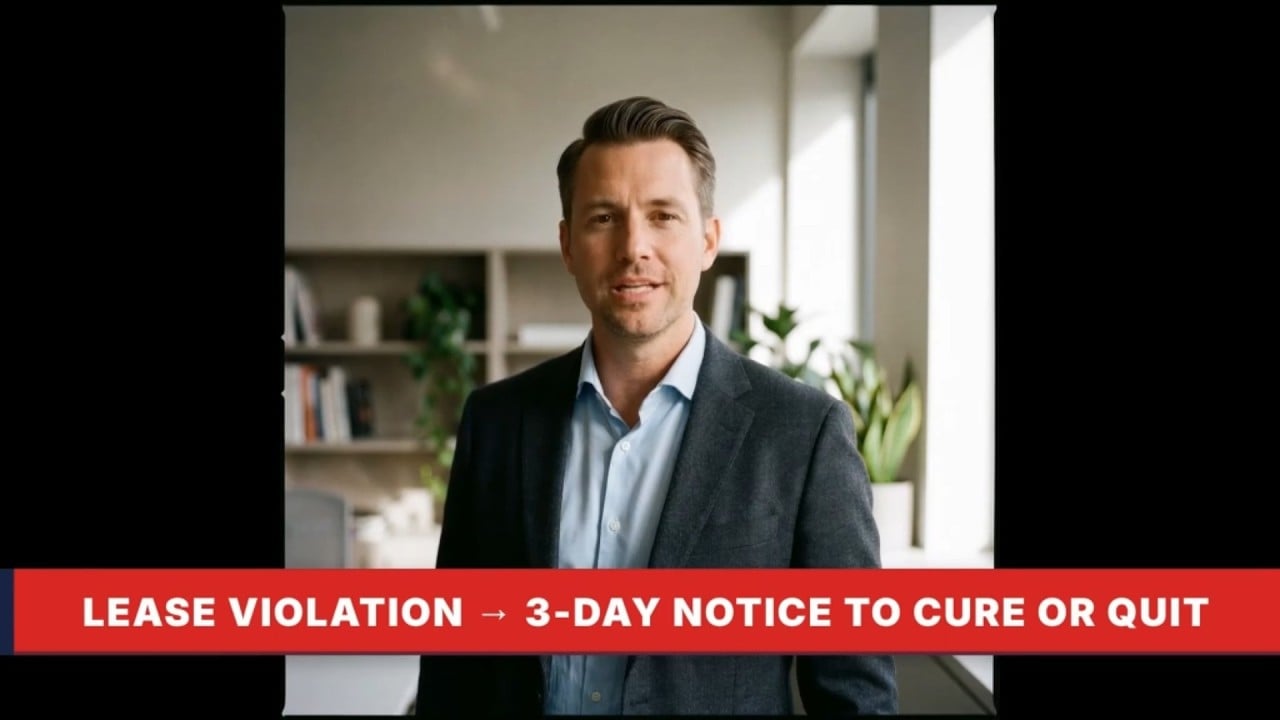
If the tenant is violating the lease — an unauthorized pet, an unauthorized roommate — you serve a 3-Day Notice to Cure or Quit. Three business days to fix the problem or leave. The notice must describe the specific violation. Vague language like “you’re in violation of your lease” is not enough.
And if the conduct can’t be fixed — criminal activity, serious nuisance — you serve a 3-Day Notice to Quit with no cure option. No second chance. Document the conduct thoroughly before you serve this one.
One wrong choice here and the case is dismissed before it’s even heard.
California law gives you three ways to serve a notice. And they must be tried in order.
First: personal service. Hand it directly to the tenant. If they refuse to take it, leaving it in their presence is enough. The notice period starts the same day.
If the tenant isn’t home, you can give the notice to an adult household member. But — and this is where most landlords make a mistake — you also have to mail a copy to the tenant on the same day. Both steps. Same day. If you skip the mailing, the service is defective.
If no one’s home after reasonable attempts, you can tape the notice to the front door and mail a copy the same day.
But here’s the critical part — and this trips up a lot of experienced landlords. Post-and-mail service adds five calendar days to the notice period. Your three-day notice is now effectively an eight-day notice. File your unlawful detainer before those eight days are up — even by one day — and the case is automatically dismissed.
Here’s the third most common cause of dismissal — and it’s completely avoidable.
The date on the notice must match the date you actually served it. Not the day you wrote it. Not the day you printed it. The day you served it.
We see this all the time with self-managing landlords. They prepare the notice at their desk on a Tuesday, track the tenant down on Thursday, hand it over — and the notice is dated Tuesday. Dismissed.
The fix is simple: leave the date blank when you prepare the notice. Fill it in by hand the moment you serve it.
At All East Bay Properties, we treat notice preparation as a legal document review — not paperwork. Every notice is checked against current California law and the applicable local ordinance — Oakland and Berkeley both have additional requirements on top of state law — before anything goes out the door.
If you’ve got a tenant situation right now and you’re not sure which notice applies, or you want to make sure your service method will hold up in Alameda County Superior Court — don’t guess. A ten-minute review before you serve is worth more than weeks of restarting.
Visit alleastbayproperties.com or click the link below to schedule a free consultation. The full written guide — with notice type tables, a pre-service checklist, and Oakland and Berkeley-specific requirements — is linked in the description. Thanks for watching.