
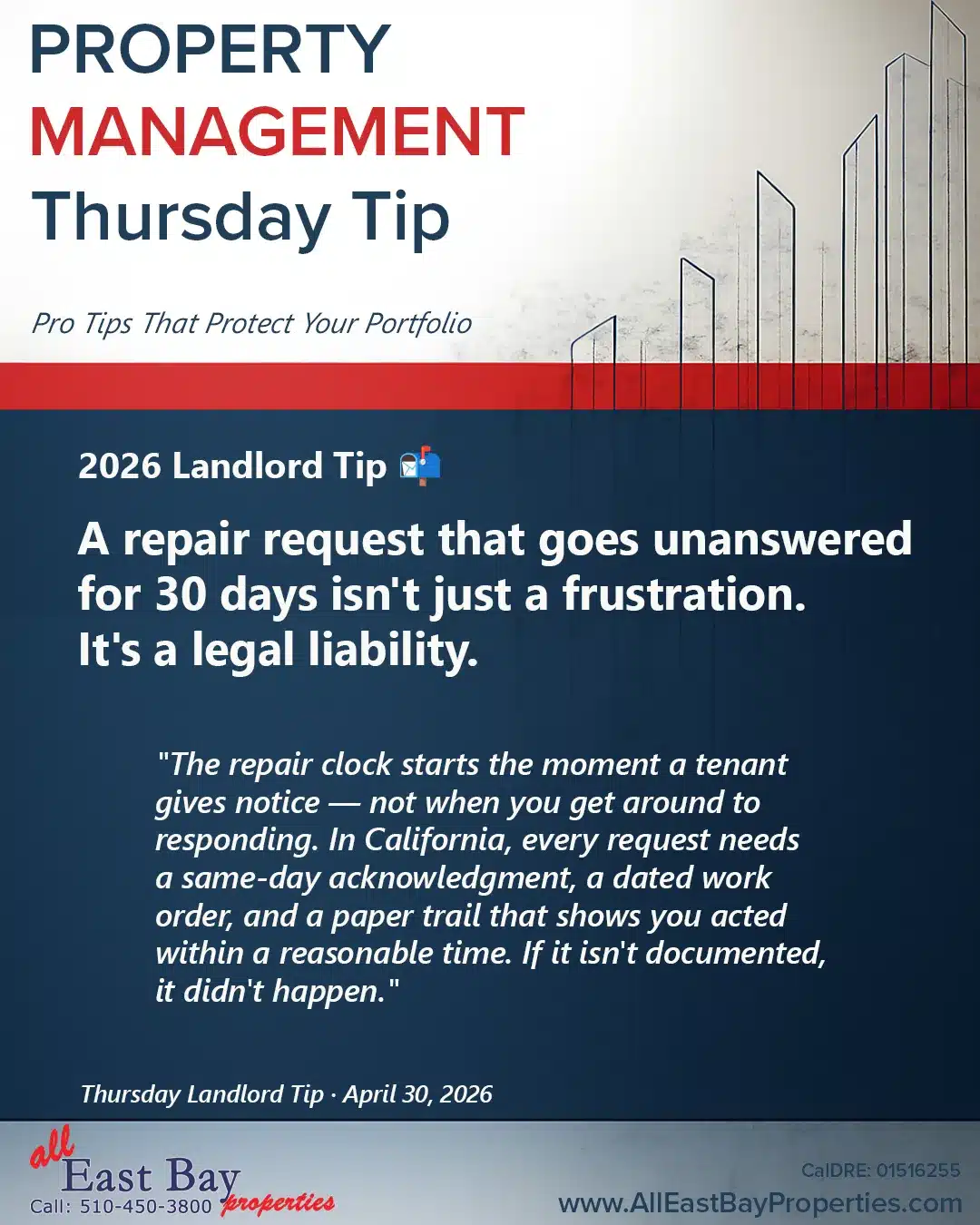
💡 Thursday Landlord Tip
“A maintenance request that goes unanswered for 30 days isn’t just a tenant frustration — it’s a documented habitability complaint. Set up a system that timestamps every request and tracks every response. In California, your paper trail is your protection.”
— Jason Crouch, Founder · All East Bay Properties · CA DRE #01295378
Most habitability disputes that reach a rent board or housing court don’t start with a landlord who refused to make repairs. They start with a landlord who didn’t respond fast enough — and didn’t have documentation to prove otherwise.
In 20+ years managing properties across Oakland, Berkeley, Emeryville, and the East Bay, the pattern is consistent: the disputes that escalate almost always share one thing in common. No written record of the landlord’s initial response to the repair request. A same-day acknowledgment — even a brief one — changes the legal picture entirely.
What California Law Actually Expects
The repair clock in California starts the moment a tenant gives notice of a habitability issue — in any format. A text, an email, a voicemail, a maintenance platform request. All of them count. Once you have notice, the law evaluates your response based on the severity of the condition:
| Category | Examples | Response Window |
|---|---|---|
| Emergency | No heat, burst pipe, sewage backup, gas leak | 24–48 hours |
| Urgent | Broken exterior lock, active leak, pest infestation | 7–14 days |
| Routine | Dripping faucet, minor appliance issue, weatherstripping | Up to 30 days |
These windows come from case law, not statute — but they represent the standard courts and rent boards apply when evaluating whether a landlord acted reasonably. The most common mistake isn’t refusing to repair. It’s misjudging the category. A heating failure in January is an emergency. Treating it as a routine repair — and responding accordingly — is where the legal exposure begins.
The Oakland and Berkeley Reality
In Oakland and Berkeley, the stakes are higher than in most California jurisdictions. Both cities have active rent boards — the Oakland Rent Adjustment Program and the Berkeley Rent Stabilization Board — with well-resourced tenant legal aid networks that lower the barrier for formal complaint filing significantly.
An unresolved repair request can become an official rent board record within days of the tenant deciding to act. Once that record exists, every subsequent landlord action — a rent increase, a lease non-renewal, an eviction notice — is evaluated for retaliatory intent for up to 180 days under California Civil Code §1942.5. The burden shifts to the landlord to prove the action was legitimate and unrelated to the complaint.
A landlord with a documented history of prompt, good-faith repair responses is in an entirely different legal position than one whose first documented action after a complaint was a notice to vacate.
💡 This Week’s Takeaway
The Seven-Step Paper Trail
Responding fast is only half the requirement. What you document matters just as much as when you act.
- Written acknowledgment to tenant — same day as receipt
- Dated work order created in your property management system — not the day of repair, the day of notice
- Vendor scheduled within the appropriate window for the repair category
- Written 24-hour entry notice to tenant before any maintenance visit (Civil Code §1954)
- Dated photos before and after the repair
- Vendor invoice filed by property address and date of service
- Written confirmation to tenant that repair is complete
If any of those steps is missing, you’re relying on memory to reconstruct a timeline — and courts and rent boards don’t accept reconstructed timelines as primary evidence. If it isn’t documented, it didn’t happen.
📘 Read the Full Guide
This tip is drawn from this week’s full blog post, which covers the complete legal framework: what triggers the repair clock, the repair-and-deduct remedy, rent withholding rules, retaliatory eviction protections, and how a proper documentation system protects you before a dispute ever reaches adjudication.
California Landlord Repair Timelines: How Fast You Must Fix Tenant Requests (2026 Guide) →
April Series Wrap-Up
This is the final Thursday tip of April’s maintenance, habitability, and inspections series. Over the past four weeks we covered:
- The implied warranty of habitability — what landlords must legally maintain
- California landlord entry rules — inspections, notice, and what you can and can’t do
- The East Bay spring maintenance checklist — what to inspect, fix, and document
- This week — tenant repair request timelines and the documentation that protects you
In May we shift to the other side of the conversation: legal notices, just cause eviction requirements in Oakland and Berkeley, and the landlord protections that matter most when a tenancy goes wrong. Content designed to give you the legal framework before you ever need it.
This tip is part of our ongoing education series for Bay Area landlords focused on compliance, risk reduction, and smarter property management. 📋 Browse all Thursday Landlord Tips →
