💡 The 3 Questions That Actually Tell You Who You’re Hiring
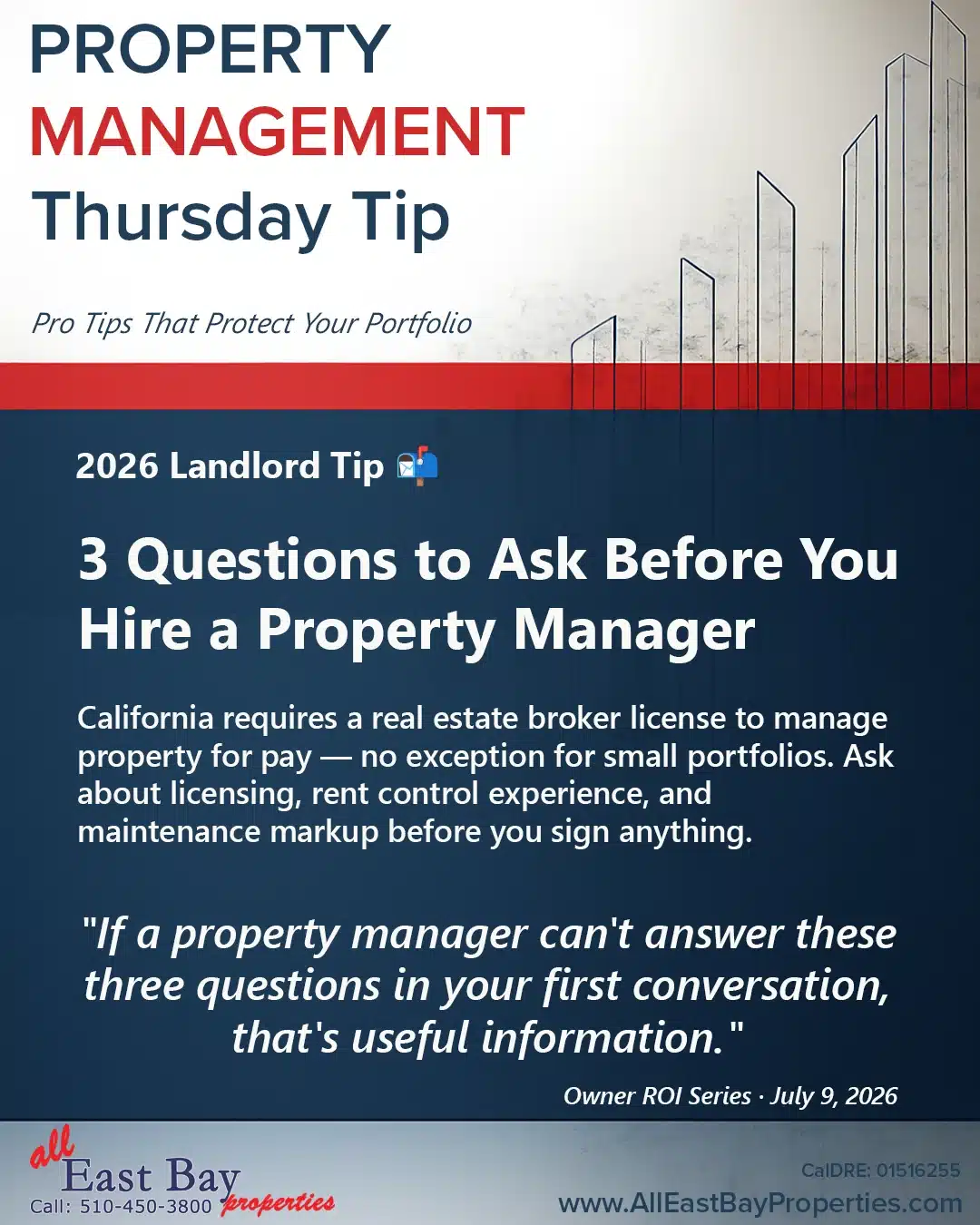
Most landlords interviewing an East Bay property manager ask about pricing first. Here’s why that’s the wrong starting point: California requires anyone who manages property for someone else, for compensation, to hold a real estate broker license — or work under one — with no exception for small portfolios or part-time management (Business & Professions Code §10131). Skip that question and everything else you’re told — the fee, the rent cap advice, the maintenance policy — is coming from someone who may not be legally authorized to act on your behalf in the first place.
Three questions, asked in the first conversation, tell you almost everything you need to know before you sign anything.
Why Licensing Isn’t Just a Formality
Trust fund handling — holding a tenant’s deposit or rent on an owner’s behalf — is one of the most commonly cited categories in DRE enforcement actions, with violations ranging from commingling funds with personal or business accounts to failing to reconcile trust accounts regularly. Under Business & Professions Code §10145, a broker must deposit trust funds promptly into the correct account — mishandling it can lead to license suspension, revocation, or worse.
A licensed broker operates under that scrutiny — recordkeeping requirements, audits, and a regulator that can pull their license. An unlicensed manager operates under none of it: no required trust-accounting training, no audit trail, and no license for the DRE to revoke if something goes wrong. That gap in oversight is exactly what the license requirement exists to close.
Verifying a license takes thirty seconds on the DRE’s public lookup — before you sign, not after something goes wrong.
If a property manager can’t clear these three questions in your first conversation, that’s useful information — just a reason to keep interviewing.
Run This Check Before You Sign
- “Are you a licensed broker, or do you work under one?” Look up the answer yourself on the DRE’s public license lookup — don’t take a verbal answer at face value.
- “What’s your experience with rent control here specifically?” Oakland’s RAP, Berkeley’s AGA, and state AB 1482 are three different sets of rules on three different schedules. A manager who quotes one flat number for all of them doesn’t know your city’s ordinance.
- “Do you markup maintenance costs?” Ask for it in writing either way. A markup isn’t automatically a red flag — an undisclosed one is.
| Question | Good answer | Red flag |
|---|---|---|
| Are you licensed? | Shows you the license, unprompted | “We don’t need one for what we do” |
| Rent control experience? | Explains your specific city’s rule without looking it up | Quotes one number for every property |
| Maintenance markup? | Discloses it in writing, either way | “We handle it” with no invoice detail |
💡 This week’s takeaway
An unlicensed property manager isn’t just a liability for them — it’s a liability for you. Three questions in your first conversation, verified independently rather than taken on faith, tell you whether you’re hiring a professional or inheriting a problem. Ten minutes spent asking them before you sign can prevent years of expensive surprises afterward.
📘 Learn more
→ What Does a Property Manager Actually Do? An East Bay Landlord’s Guide — the full day-to-day breakdown, the licensing question, and the good-PM-vs-bad-PM checklist
→ East Bay Property Management Fees: What You Pay, What You Get — AEBP’s fee structure with no hidden line items
This tip is part of our ongoing education series for Bay Area landlords focused on compliance, risk reduction, and smarter property management. 📋 Browse all Thursday Landlord Tips →