
Share this post
Quick Answer
Emeryville has no local rent-control ordinance, so California’s AB 1482 sets the annual cap on covered units — 8.8% for August 1, 2026 through July 31, 2027, up from 6.3%. But “no rent control” is not “no rules.” Emeryville’s own Residential Landlord and Tenant Relations Ordinance requires a valid residential landlord business license, a tenant-rights notice, a qualifying just cause from the first day of the tenancy (AB 1482 waits 12 months), a copy of every termination notice filed with the City Clerk within 10 days, and relocation assistance for no-fault terminations — scaled by landlord size (the small-landlord tier is four or fewer covered Emeryville units, or a group residential facility of any size). Miss most preconditions and the notice can be invalidated; the City filing is still mandatory, but failing to show City service alone does not invalidate the notice.
Key Facts: Emeryville Rental Laws at a Glance
| Requirement | What It Is | Deadline / Detail |
|---|---|---|
| Local rent cap | None — no Emeryville rent-control ordinance, no rent board | AB 1482 (Civil Code §1947.12) governs covered units |
| Current AB 1482 cap | 8.8% (5% + 3.8% regional CPI) | Aug 1, 2026 – Jul 31, 2027; up from 6.3%. Up to two increments per 12 months, combined total within the cap |
| Just cause for termination | Required from day one of a covered tenancy | AB 1482’s statewide just-cause protection waits until 12 months of occupancy |
| Business license | Valid residential landlord license required before any termination of a covered tenancy | Tax is 0.10% of prior-year gross receipts ($25 minimum) per the City’s FAQ; expires Dec 31, delinquent after Mar 1 |
| Tenant rights notice | City-required notice of tenant rights | At lease signing, at renewal, and with any termination notice |
| City Clerk filing | Copy of the termination notice and the rental agreement | Within 10 calendar days of delivery to the tenant |
| No-fault relocation | Small landlord (4 or fewer covered Emeryville units, or any group residential facility): greater of 1× HUD FMR or 1× monthly rent. Large landlord (more than 4 covered units): greater of 5× FMR or 4× monthly rent | Due by the last day of the tenancy for which rent was received |
| Rent registry / rent board | None | The business license is the closest thing the city has to a registry |
| Inclusionary (BMR) rules | Apply to developers of new rental projects of 10+ units | Not a rule for owners of ordinary existing buildings |
This guide goes deep on Emeryville specifically. For how Emeryville compares to Oakland, Berkeley, and Richmond, see our East Bay Rent Control Comparison.
Video Transcript
Emeryville has no rent control. So does that mean fewer rules? Not even close. Here’s what actually applies.
Start with the rent cap. Because Emeryville has no local ordinance, California’s AB 1482 sets the limit on most units — five percent plus regional inflation, capped at ten. On August first, that number moved. It’s now eight point eight percent, up from six point three. And here’s a detail worth knowing: when we checked the City of Emeryville’s own tenant page in September, it still listed the old six point three.
Now the part that catches owners. Under AB 1482, just cause protection kicks in after twelve months. Emeryville’s own ordinance doesn’t wait. It applies from day one of the tenancy. Every termination of a covered tenancy needs a qualifying reason — either for cause, like nonpayment or a lease violation, or no-fault, like an owner or family move-in.
And before you can serve any termination notice on a covered tenancy, there’s a chain to complete. You need a valid Emeryville residential landlord business license. The tenant needs the city’s rights notice. You use a notice in substantially the city’s prescribed form. And you file a copy with the City Clerk within ten calendar days after delivering the notice. Miss most of these preconditions, and the notice can be invalidated — with attorney’s fees on the line if the tenant challenges it. Failing to show City service alone doesn’t invalidate the notice, but the filing is still required.
If it’s a no-fault termination, relocation assistance applies, and it scales with how many units you own. Four or fewer covered Emeryville units, or a group residential facility of any size: the greater of one month of HUD fair market rent, or one month of the tenant’s rent. More than four covered units: the greater of five times fair market rent, or four times the tenant’s monthly rent. There’s no relocation payment when the cause is a natural disaster beyond your control.
Here’s what we see at AEBP. We’ve been headquartered in Emeryville since 2005, and license renewal sits on our compliance calendar. Emeryville doesn’t have a rent board or a registry to remind you, so the calendar is the reminder. The license runs on a December thirty-first cycle, and the City treats renewals after March first as delinquent.
What about inclusionary housing? That program targets developers of new rental projects with ten or more units. It doesn’t reach ordinary existing buildings — but if you’re buying, check for a recorded affordability agreement.
The bottom line: Emeryville isn’t the easy city. It’s the one where the rules live in a different place. Check the current cap, check your license, and run the full checklist before you serve anything. The complete written guide is linked below.
Why “No Rent Control” Misleads Emeryville Owners
Emeryville has no rent-control ordinance, no rent board, and no rental registry of the kind Oakland, Berkeley, and Richmond each run. Owners who manage across those cities often conclude Emeryville is the easy one. It isn’t easier — it’s structured differently. The rent-increase side is governed by the state. The termination side is governed by a city ordinance, the Residential Landlord and Tenant Relations Ordinance (Emeryville Municipal Code Chapter 5-40, effective April 1, 2017 and amended since, including in 2020), that applies from the first day of a tenancy.
The gap between those two — a state cap that resets every August and a local termination process that doesn’t wait for anything — is where Emeryville owners get caught. The rate is the easy part to look up. What the city requires before you act on a tenancy is the part that’s easy to miss.
The Rent Cap That Applies: AB 1482’s 8.8%
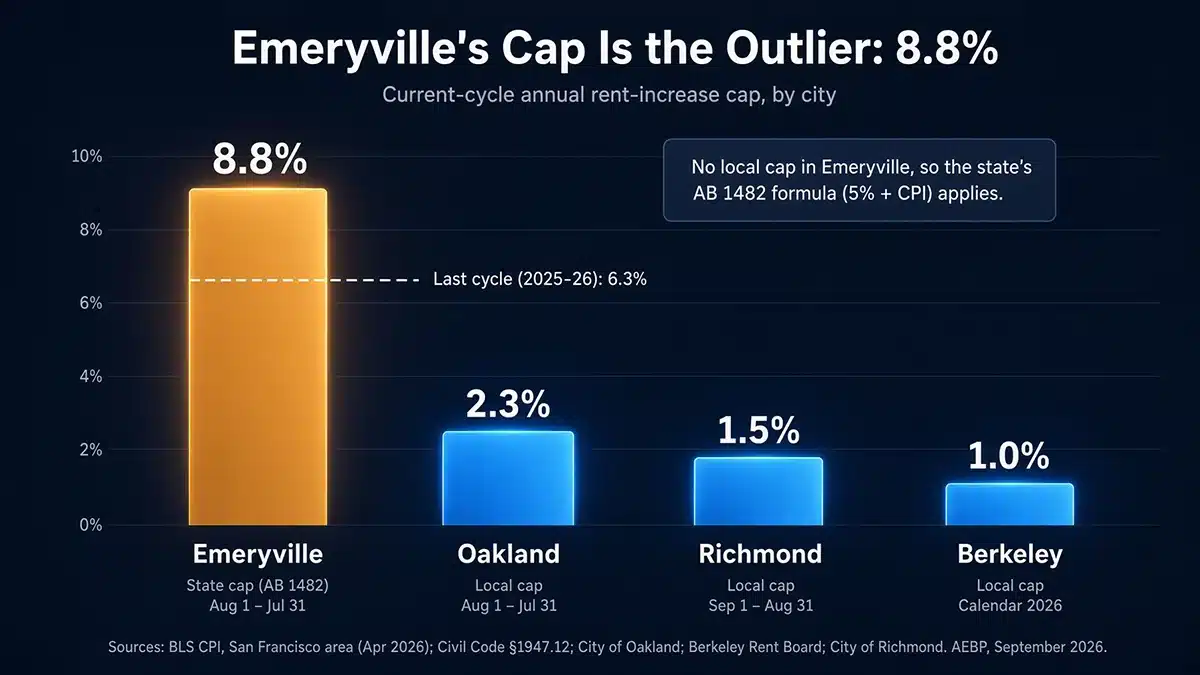
Because Emeryville has no local cap, most units are governed by AB 1482 (Civil Code §1947.12): 5% plus regional CPI, never more than 10%. What changed in 2026: the cap is recalculated each August 1 from the prior April’s CPI. The San Francisco-area CPI rose 3.8% for the 12 months ending April 2026 (BLS), so the cap for August 1, 2026 through July 31, 2027 is 8.8% — up from 6.3% for the 2025–26 period (1.3% CPI + 5%). That’s the freshness fact behind this guide: the number that was correct all last year is now wrong.
The City of Emeryville’s own Tenant Protection Resources page still listed the old 6.3% figure, labeled August 1, 2025 – July 31, 2026, when we checked it on September 19, 2026 — seven weeks after the change. That isn’t a criticism of the City so much as a reminder that a rent cap is a number to confirm against its effective date, not one to copy from a page.
Two mechanics worth keeping straight. First, AB 1482 permits up to two increments in a 12-month period, as long as their combined total stays within the cap (§1947.12(a)(2)). Second, notice length depends on the total increase over the trailing 12 months: generally 30 days if it totals 10% or less, 90 days if more (Civil Code §827(b)). If the notice is served by mail, additional time applies under Code of Civil Procedure §1013, and any longer notice requirement that governs your tenancy controls.
Not every Emeryville unit is covered by AB 1482. Housing that received a certificate of occupancy within the previous 15 years is exempt (Civil Code §1947.12(d)(4)), as are certain single-unit properties such as single-family homes and condominiums, but only if the owner is not a REIT, a corporation, or an LLC with a corporate member and the tenant received the statute’s exact written exemption notice (§1947.12(d)(5)), and deed-restricted affordable housing (§1947.12(d)(1)). Emeryville has a lot of newer construction, so this check matters. An exempt unit is not subject to AB 1482’s cap, but affordability restrictions, recorded agreements, and other applicable limits still need checking. Coverage under Emeryville’s termination ordinance is a separate question: its own exemptions (certain owner-occupied residences, hotels, motels and short-term rentals where the tenant does not reside more than 30 consecutive days, nonprofit co-ops, government-owned housing, and a few others) don’t include newer construction, and terminating a tenancy early to avoid the ordinance is prohibited.
Just Cause From Day One
Under AB 1482, just-cause protection generally applies after a tenant has lived in a unit for 12 months (24 in some situations where a tenant was added). Emeryville’s ordinance has no such waiting period: a landlord may terminate a covered tenancy only by showing a qualifying cause, and the requirement applies from the outset (Municipal Code §5-40.03). The ordinance recognizes two categories.
For-cause grounds:
- Failure to pay rent (after the 3-day notice California law requires)
- Breach of the rental agreement
- Illegal activity on the premises (controlled substances, weapons)
- Health or safety code violations by the tenant
- Refusal to allow the landlord access
- Refusal to sign a lease extension on substantially identical terms
- Occupancy above two persons per bedroom plus one
- The landlord returning from a sabbatical to reoccupy the unit
- The landlord returning from military deployment
- Condominium conversion, with relocation assistance provided
No-fault grounds:
- Demolition of the unit or permanent removal from the rental market
- Move-in by the owner or the owner’s parent or child as a permanent residence
- Temporary unfitness for habitation, with repair and return planned
- Substantial renovation for which the landlord already holds the required permits
The list follows §5-40.03(e) of the Municipal Code as currently published on eCode360 (code current through June 2, 2026); the nonpayment ground carries additional repayment-plan protections for affected tenants. Verify a specific ground against the current text before relying on it for a particular tenancy. This is general education, not advice on any individual notice.
Before Any Termination Notice: The Five Steps
The City’s Tenant Protection Resources page and the ordinance text describe a sequence a landlord must complete before a termination is valid:
- Hold a valid residential landlord business license (Emeryville Municipal Code Title 3, Chapter 1). No license, no valid termination — for any ground.
- Give the tenant the required notice of tenant rights — at lease signing, at renewal, and with the termination notice itself.
- Serve the notice in substantially the City’s prescribed form, stating the reason, including the tenant-rights notice, and the rent history for the tenancy.
- Deliver a copy of the termination notice and the rental agreement to the City Clerk (1333 Park Avenue, Emeryville) within 10 calendar days of delivering it to the tenant.
- Don’t accept rent for any period after the termination date.
The consequences of a missed step are real. Under §5-40.06(b), a landlord’s failure to demonstrate compliance with the preconditions can invalidate the notice — with one express exception: failing to demonstrate service to the City does not by itself invalidate the notice, although the City filing remains mandatory. A tenant who successfully challenges a notice can recover costs and reasonable attorney fees, and tenants or the City can seek damages or injunctive relief for violations. For a deeper look at the license step specifically, see our Thursday Tip, Your Emeryville Business License Isn’t Just Paperwork.
Relocation Assistance: The Four-Unit Line
Every no-fault termination in Emeryville requires relocation assistance, except where the cause is a disaster beyond the landlord’s control. The amount is a formula, and it depends on how many covered units the landlord owns in Emeryville (Municipal Code §5-40.04):
| Landlord Size | Relocation Payment (the greater of) |
|---|---|
| Small landlord — 4 or fewer covered units in Emeryville, or a group residential facility of any size | One month of the current HUD Fair Market Rent (Oakland-Fremont area), or one month of the tenant’s rent |
| Large landlord — more than 4 covered units | Five times the current HUD Fair Market Rent (Oakland-Fremont area), or four times the tenant’s monthly rent |
Payment is due by the last day of the tenancy for which the landlord has received rent — not tied to the date of the notice the way AB 1482’s 15-day rule is. These are Emeryville’s own formulas, not AB 1482’s flat one-month default.
Illustration (hypothetical arithmetic, not a client case): a large landlord ending a no-fault tenancy at $3,000 per month owes at least $12,000 (4 × $3,000), and more if five times the current HUD figure is higher. A small landlord owes at least one month — $3,000 — or one month of the HUD figure if that is higher. HUD updates its Fair Market Rents annually, so confirm the current Oakland-Fremont figure before calculating a real payment.
Tenants terminated on a no-fault ground also have a right to return: if the unit comes back to the rental market within two years, the landlord must offer it back on substantially the same material terms, at a monthly rent no higher than the tenant’s last month of the tenancy, subject to any notice provided in accordance with Civil Code §827, provided the tenant kept a current mailing address on file and delivers a written acceptance within 30 days of the offer. The right survives a change of ownership.
The Business License: Cost, Calendar, and What a Lapse Really Costs
The license is Emeryville’s gatekeeper document, so its mechanics are worth knowing. Per the City’s Business License FAQ (updated July 31, 2025), the property owner holds the license for a residential rental. The tax is calculated on prior-year gross receipts at 0.10%, with a $25 minimum, and no deductions for overhead. Annual licenses expire December 31 and renewal is due January 1; the Municipal Code treats business tax as delinquent if not paid by March 1 (§§3-1.107, 3-1.116), with a penalty of 5% per month up to 25% and interest of 1.5% per month (§3-1.119). The 0.10% residential rate and $25 minimum come from the City’s FAQ; we did not find a residential rate stated in the code chapter itself. Confirm current rates with the City’s Business License Processing Center before relying on these figures.
The penalty isn’t the expensive part. The expensive part is that a lapsed license means you cannot validly terminate a tenancy until it’s fixed — and renewal isn’t instant.
What About Emeryville’s Inclusionary Housing Rules?
Emeryville’s Below-Market-Rate (BMR) rental program guidelines apply to developers of rental projects of 10 or more units, who must either rent 12% of the units at below-market rates (8% affordable to low-income and 4% to very-low-income households) or pay fees, and who report to the City annually. The guidelines are aimed at new development, not at owners of ordinary existing market-rate buildings — unless a recorded affordability agreement already attaches to the property. If you’re buying in Emeryville, checking the title for a recorded affordable-housing agreement is the practical step; you can find the City’s guidelines in our Sources below.
What We See at AEBP
We’ve been headquartered in Emeryville since 2005, and license renewal sits on our own compliance calendar alongside the registration deadlines we track for Oakland, Berkeley, and Richmond. Emeryville has no rent board or registry to send a reminder, so the calendar is the reminder — and the license runs on a December 31 cycle that doesn’t line up with any of those other deadlines.
While preparing this guide on September 19, 2026, we also checked the City’s own Tenant Protection Resources page — the page a landlord is most likely to consult — and its rent-cap list hasn’t been updated for the current cycle. The most recent entry is still 6.3%, for the period that ended July 31, 2026 — an older 8.8% entry from two cycles back sits just below it, and neither is labeled current. An owner who assumes the newest-looking number is current would under-collect. The opposite mistake, carrying a number forward from another cycle or another city, is the one a tenant can challenge. Either way, the habit that works is the same: confirm the cap against its effective date, and confirm the license before you draft a notice.
Emeryville vs. the AB 1482 Defaults
| AB 1482 default | Emeryville ordinance | |
|---|---|---|
| Just cause applies | After 12 months of occupancy (24 in some cases) | From day one of the tenancy |
| Business license as a precondition | Not a statutory requirement | Valid residential landlord license required before any termination |
| City filing | None | Copy to the City Clerk within 10 calendar days |
| No-fault relocation | One month’s rent (or a waiver), due within 15 days of the notice | Formula by landlord size; due by the last day of rent-paid tenancy |
| Rent cap | 8.8% through July 31, 2027 | None of its own — AB 1482 governs |
How Emeryville Compares to Oakland, Berkeley, and Richmond
| Emeryville | Oakland | Berkeley | Richmond | |
|---|---|---|---|---|
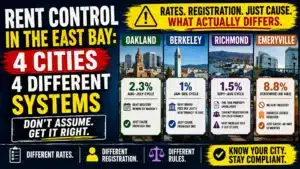
| Rent-increase cap, current cycle | 8.8% (AB 1482, Aug–Jul) | 2.3% (Aug–Jul) | 1.0% (calendar 2026) | 1.5% (Sept–Aug) |
| Rent board / registry | None | Annual registration, due March 1 | Rent Board registration | Property Enrollment + Tenancy Registration |
| Local just cause | Yes, from day one | Yes | Yes, from day one | Yes, eight grounds |
Bottom Line
Of the four cities compared here, Emeryville has the simplest rent-increase picture and one of the more procedural termination pictures. For 2026–27 the number to update is 8.8%, and the assumption to drop is that no rent control means fewer rules. Check the current cap, confirm your license is current before you draft anything, and run the full checklist before serving a notice. If you’re facing a contested termination, a coverage question you can’t resolve, or a tenant challenge, that’s the point to bring in a housing attorney rather than working from a guide like this one.
Before You Raise the Rent or Serve a Notice on an Emeryville Unit
Run through this before acting on any Emeryville tenancy:
- Confirm whether the unit is covered by AB 1482 or exempt (newer construction, qualifying single-family or condo units, deed-restricted housing).
- For an increase, use the cap in effect on the increase’s effective date — 8.8% for increases effective August 1, 2026 through July 31, 2027 — not the outgoing 6.3%.
- Check the total increase over the trailing 12 months to determine whether 30 or 90 days’ notice applies (add time if serving by mail, CCP §1013), and count any prior increment in the same 12-month period.
- Confirm your Emeryville residential landlord business license is current — before you draft anything.
- Confirm you have a qualifying just cause, and whether it’s for cause or no-fault.
- Confirm the tenant received the City’s notice of tenant rights at lease signing and renewal, and include it with the notice.
- Use a notice in substantially the City’s prescribed form, including the reason, the tenant-rights notice, and the rent history.
- Deliver a copy of the notice and the rental agreement to the City Clerk within 10 calendar days.
- For a no-fault termination, calculate relocation assistance using the right landlord-size tier and the current HUD figure, and deliver it by the last day of the rent-paid tenancy.
- Don’t accept rent for any period after the termination date.
Current rule at a glance
Frequently Asked Questions
Does Emeryville have rent control?
No. Emeryville has no local rent-control ordinance and no rent board. Rent increases on covered units are limited by California’s AB 1482 instead — but Emeryville does have its own Residential Landlord and Tenant Relations Ordinance governing terminations, which applies from day one of a tenancy.
What is the maximum rent increase in Emeryville in 2026?
For most covered units, 8.8% for August 1, 2026 through July 31, 2027 — 5% plus a 3.8% regional CPI, up from 6.3% for 2025–26. AB 1482 allows up to two increments in a 12-month period as long as the combined total stays within the cap. Some units, such as those with a certificate of occupancy issued within the previous 15 years, are exempt from the state cap.
Does just cause apply from day one in Emeryville?
Yes, for covered tenancies. Emeryville’s ordinance requires a qualifying for-cause or no-fault ground for any termination from the outset of the tenancy, unlike AB 1482’s statewide protection, which generally applies after 12 months of occupancy. The ordinance’s exemptions include certain owner-occupied residences, hotels, motels and short-term rentals where the tenant does not reside more than 30 consecutive days, nonprofit co-ops, and government-owned housing.
Do I need a business license to rent out property in Emeryville?
Yes. A valid residential landlord business license is required, and the City’s ordinance makes it a precondition to terminating any tenancy. Per the City’s FAQ, the tax is 0.10% of prior-year gross receipts with a $25 minimum, licenses expire December 31, and renewals after March 1 are treated as delinquent, with penalties of 5% per month up to 25% plus interest.
How much relocation assistance do I owe for a no-fault termination in Emeryville?
It depends on landlord size. A small landlord (four or fewer covered units in Emeryville, or a group residential facility of any size) owes the greater of one month of HUD Fair Market Rent or one month of the tenant’s rent. A landlord with more than four covered units owes the greater of five times HUD Fair Market Rent or four times the tenant’s monthly rent. It’s due by the last day of the tenancy for which rent has been received.
Sources
- Emeryville Residential Landlord and Tenant Relations Ordinance (Municipal Code Ch. 5-40): just cause, preconditions, City Clerk filing, relocation, right to return, remedies — Required by local ordinance. Emeryville Municipal Code Chapter 5-40 on eCode360 (code current through June 2, 2026; amended by Ord. 20-006 and 20-009); City of Emeryville — Tenant Protection Resources
- Emeryville business license tax, calendar, and penalties — City-published guidance. City of Emeryville — Business License FAQs (updated July 31, 2025); Municipal Code Ch. 3-1, Business Taxes (§§3-1.107, 3-1.116, 3-1.119)
- AB 1482 rent cap (5% + CPI, max 10%; two increments; exemptions) — Required by law. Civil Code §1947.12
- 2026–27 AB 1482 cap (8.8%) inputs: 3.8% CPI for the 12 months ending April 2026 — Federal statistic. BLS — Consumer Price Index, San Francisco Area, April 2026
- AB 1482 just cause after 12 months and one-month relocation default — Required by law. Civil Code §1946.2
- Notice periods for rent increases — Required by law. Civil Code §827
- Emeryville BMR rental program — City-published guidance. City of Emeryville — BMR Rental Program Guidelines (rev. January 2023)
- Oakland RAP 2.3% — Required by local ordinance. City of Oakland — Allowable Rent Increases. Berkeley AGA 1.0% — Berkeley Rent Board. Richmond AGA 1.5% — City of Richmond — Rent Increase
- AEBP headquarters and license-calendar practice — AEBP documented experience / company policy.
Own Rental Property in Emeryville?
We’re headquartered in Emeryville and have managed East Bay rentals since 2005 — including the license, notice, and City Clerk filings that sit underneath every Emeryville termination. If you’re not sure your property is current, we’ll check.