Share this post
Quick Answer
When you talk with tenants about safety, describe the features the building actually has and the way problems get reported. Don’t describe how safe the building or the neighborhood is. Words like “secure building” or “safe neighborhood” are a promise you can’t keep. A California court has allowed a tenant to sue a landlord who called a complex safe and patrolled while knowing about earlier assaults there. Put three things in writing for every tenant: how to report a broken lock, light or door; your city’s non-emergency police number; and the house rules on packages and entry doors. Then acknowledge every security report quickly, assess it and keep a record. A report of a broken lock or other deficiency covered by Civil Code §1941.3 can put you on notice, and the statute allows a reasonable time to fix it. Other security reports can raise duties under other law, so assess and document each one.
Key Facts: Talking With Tenants About Safety
| What | The fact | Source |
|---|---|---|
| Safety claims can create liability | In O’Hara v. Western Seven Trees (1977), the landlord had told a prospective tenant the complex was safe and patrolled by guards at all times, while knowing about earlier rapes there. The court let both negligence and deceit claims go forward. It called the patrol claim a statement of fact. | O’Hara v. Western Seven Trees Corp. (1977) 75 Cal.App.3d 798 · Case law (ruling on the pleadings, not a final verdict) |
| A tenant report is notice | For a broken required lock, you can be liable if you don’t fix it within a reasonable time after you have actual notice or receive notice. | Civil Code §1941.3(b) · Required by law |
| Protected calls for police or emergency help | Civil Code §1946.8 protects calls made by or on behalf of someone facing abuse, a crime or an emergency who believes help is needed. A lease can’t restrict those calls, and a landlord can’t penalize a tenant or resident for them (fees, eviction, non-renewal or worse terms). No documentation is required to show that belief. | Civil Code §1946.8 · Required by law |
| Required safety-related lease notice | Every covered residential lease must include the Megan’s Law notice pointing tenants to the state’s registered sex offender website. Once it’s given, the landlord doesn’t have to provide more information about where offenders live. | Civil Code §2079.10a · Required by law |
| No automatic duty to provide guards | Hiring guards requires a high degree of foreseeability, which usually means prior similar incidents the owner knew about. | Ann M. v. Pacific Plaza (1993) 6 Cal.4th 666 · Case law |
| Non-emergency police lines | Oakland 510-777-3333 · Berkeley 510-981-5900 · Emeryville 510-596-3700 | Alameda County DA, non-emergency numbers (June 2026); City of Oakland; City of Emeryville |
Prefer video? Watch the 2-minute companion video below, or visit the video page with chapter timestamps and a full transcript.
Video Transcript
What you say about safety can matter as much as what you fix. Here’s how East Bay landlords can talk with tenants about it without promising more than the law requires.
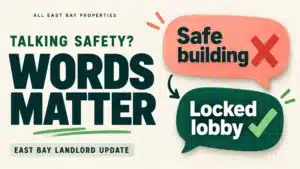
First, describe features, not outcomes. “Locked lobby with a self-closing door” is a fact. “Secure building” or “safe neighborhood” is a promise nobody can keep. In one California case, a landlord told a prospective tenant the complex was safe and patrolled, while knowing about earlier assaults there. The court let her claims for negligence and deceit go forward.
Second, put the basics in writing. Every tenant should know how to report a broken lock, light or door, when to call nine one one, and their city’s non-emergency police line.
Third, don’t discourage calls for help. California Civil Code section 1946.8 protects calls about abuse, crime or an emergency when the caller believes help is needed. A lease can’t restrict those calls, and a landlord can’t penalize a tenant or resident for them.
Fourth, as a best practice, acknowledge security reports promptly, assess the urgency, arrange needed repairs and keep a record. A report about a required lock can give notice under California’s lock statute; other reports may raise different duties.
At AEBP, every new tenant gets a welcome sheet with our 24/7 maintenance line, and a broken entry lock is an emergency, with a vendor sent the same day. Our lease asks tenants to research the neighborhood themselves. We describe the building, and how to reach us.
The full guide, with a words-to-avoid table and five common questions, is linked below.
The Short Answer: Describe Features, Not Outcomes
The safest way to talk about safety is to stick to facts a tenant can check. “The lobby door has a self-closing hinge and a lock” is a feature. “This is a secure building” is an outcome, and no landlord can guarantee it.
This matters because of how California courts look at landlord liability for crime. Our landlord security duties guide covers it in detail. The short version: you aren’t an insurer of tenant safety. But what you knew, what you said, and what you did after you were told about a problem all count. Of the three, what you say is the one most fully in your control.
Words to Avoid, and What to Say Instead
Best practice, based on O’Hara and common fair housing advertising guidance. This is not a legal list of banned words.
Two problems come with outcome words. The first is liability: in O’Hara, the court treated “patrolled at all times” as a statement of fact and “safe” as “at least an opinion made by one with presumed expert knowledge.” Both could support a deceit claim when the landlord knew otherwise. The second is fair housing. Industry advertising word lists flag “safe neighborhood” as language to avoid, because describing a neighborhood’s character can read as a statement about who lives there.
| Instead of | Say | Why |
|---|---|---|
| “Secure building” | “Locked lobby entry with a self-closing door” | Describes hardware a tenant can see, not a result |
| “Safe neighborhood” / “safe area” | Describe the unit and the building. Point to public sources if asked (for example, your city’s crime map). | Avoids an implied guarantee and fair housing risk |
| “24/7 security” / “patrolled” | Say only what exists: “Camera at the main entry” or “On-site manager weekdays” | O’Hara treated “patrolled at all times” as a factual claim |
| “Cameras protect your packages” | “There’s a camera at the mail area” | A camera records; it doesn’t prevent theft |
| “You’ll never have a problem here” | “Here’s how to report a problem, and how fast we respond to lock reports” | Points to a process you control |
| “Don’t call the police for every little thing” | “For emergencies call 911. For anything else, your city’s non-emergency line. Please let us know too.” | Civil Code §1946.8 protects calls for help about abuse, a crime or an emergency |
The same rule applies to listings, leases, showings, emails and texts. Leasing conversations are where people slip most, because “it’s a really safe building” feels like a friendly thing to say.
What to Put in a Move-In Packet
A short written safety section does two jobs. It tells tenants exactly how to reach you when something breaks, and it creates a record that you told them. Keep it to one page.
| Item | What to include | Label |
|---|---|---|
| How to report a broken lock, door or light | The maintenance line, the portal, and a plain statement that lock and entry-door problems should be reported right away | Best practice; supports the notice process in §1941.3 |
| Emergency vs. non-emergency | 911 for emergencies and crimes in progress; your city’s non-emergency line for everything else | Best practice |
| Local non-emergency numbers | Oakland 510-777-3333, Berkeley 510-981-5900, Emeryville 510-596-3700 | Verified 2026-10-18 |
| Entry-door rules | Don’t prop secured doors or gates; don’t buzz in people you don’t know | Best practice |
| Package guidance | Pick up promptly, use pickup lockers or delivery instructions for valuables. Be careful with “I have a delivery” at the buzzer. | Best practice; see our package theft guide |
| Megan’s Law notice | The statutory notice language | Required by law (Civil Code §2079.10a), usually in the lease itself |
| Lock-change rights for protected tenants | That tenants who qualify under Civil Code §1941.5/§1941.6 can request a lock change | Best practice to mention; the 24-hour duty itself is required by law |
What to leave out: unsupported safety ratings, crime statistics you’ve pulled together yourself, and promises about outcomes. That doesn’t mean holding back known safety information. When you know about a specific incident or hazard, get legal advice about whether to warn or disclose. The standard California Association of REALTORS® lease already advises tenants to research neighborhood conditions themselves, including crime statistics and law enforcement. Your packet doesn’t need to do that research for them.
How to Handle a Tenant’s Security Complaint
Treat every security report the same way, whether it’s a broken lock, a dark walkway or a stranger in the hallway. Best practice, built around the notice rule in §1941.3(b) and the foreseeability cases:
| Step | What to do | What to record |
|---|---|---|
| 1. Acknowledge | Reply the same day, even if it’s just “Got it, we’re sending someone” | Date and time of the report and of your reply |
| 2. Triage | Treat entry locks and doors that won’t latch as urgent. Treat lighting in entries, walkways and mail areas as next. | The priority you assigned |
| 3. Fix | Send a vendor; photograph before and after | Vendor, date fixed, photos |
| 4. Close the loop | Tell the tenant it’s fixed | The message |
| 5. Watch for a pattern | Several reports of the same kind (strangers inside, repeated break-ins at one door) need a closer look | Running log by property |
Step 5 is the one owners skip. Don’t wait for a second incident before assessing a known hazard. The duty depends on how foreseeable the risk is and how burdensome the precaution would be, and hiring guards takes a higher level of foreseeability than simpler fixes. A pattern you’ve been told about is the kind of record that, in a case like Kwaitkowski v. Superior Trading Co. (1981), helped create a duty: the landlord had a broken lobby lock, complaints about strangers getting in, and an earlier attack.
Should you tell other tenants about an incident at the building? Whether an incident calls for a warning depends on the facts and the duties that apply, so ask an attorney about a specific incident or known hazard. O’Hara rested partly on a landlord who knew about repeated assaults and said nothing to a prospective tenant. Professional opinion: a short factual notice after an incident in a common area (what happened, where, what you’re doing about it, and how to report anything else) is usually the better choice. Leave out names or details that would identify a victim. Ask an attorney about anything involving a specific person.
When to Upgrade, and When It’s the Tenant’s Part
Not every complaint calls for new equipment. A general guide, not legal advice for a specific property:
| Situation | Usually your job | Usually the tenant’s part | Worth a closer look |
|---|---|---|---|
| Broken entry lock or lobby door | Fix it fast (§1941.3) | Reporting it | Repeat failures of the same door |
| Dark walkway or entry | Replace the bulb, reset the timer | Reporting it | Incidents already reported in that spot |
| Doors propped open | Keep closers working, remind tenants in writing | Not propping secured doors | Repeated propping at one door, which may mean the door is hard to use |
| Package theft | Honor written commitments, and assess reasonable measures for known risks in common areas you control | Picking up promptly, using lockers or delivery options | Repeated thefts from an area you control |
| Unit-door lock change request | Change it if they qualify under §1941.5/§1941.6 | Paying for a convenience change otherwise, if your lease says so | Any request mentioning abuse or a restraining order: take it seriously right away |
| “Can you add cameras or a guard?” | Explain what exists today | — | Prior similar incidents you know about (Ann M.) |
What We See at AEBP
AEBP practice: every new AEBP tenant gets a short welcome sheet on top of the lease documents. It explains how to report problems: routine repairs go through the tenant portal as a work order, and urgent problems go to our 24/7 maintenance line at (510) 450-3815, with a note to save the number. Company policy: a broken entry or lobby lock counts as urgent, and we send a vendor the same day.
The lease itself is the California Association of REALTORS® residential lease form. Its “Neighborhood Conditions” paragraph advises tenants to satisfy themselves about the area, including crime statistics, the proximity and adequacy of law enforcement, and the proximity of registered offenders. The lease also carries the Megan’s Law notice that Civil Code §2079.10a requires. The package includes C.A.R.’s Fair Housing and Discrimination Advisory too, which lists steering and “blockbusting” based on fears of rising crime as examples of unlawful conduct. Together they set the division we try to follow in conversation as well: tenants research the neighborhood, and we describe the building and how to reach us. Professional opinion: that lease paragraph doesn’t cancel anything said out loud at a showing. It’s a reason not to fill the silence with “it’s a safe area.”
Between leases, we use the tenant newsletter. Our October issue went to every resident. It asked them to report lights that are out and doors that won’t latch, because “we can only fix what we know about.” It listed the Oakland, Berkeley and Emeryville non-emergency police numbers and asked residents to “let us know too so we can follow up on the property side.”
Bottom Line
Talk about safety the way you’d want it read back to you in a deposition: specific features, a clear way to report problems, and a record that you responded. Skip the adjectives. With Halloween here and the holiday shipping rush starting, now is a good time to check your listings for “safe” and “secure,” add a one-page safety section to your move-in packet, and confirm every tenant knows how to report a broken lock.
Before You Talk With Tenants About Safety
- Check that every security feature you mention exists and works
- Replace “safe” and “secure” in listings, leases and scripts with factual descriptions
- Give tenants current maintenance and police contact information in writing
- Log every security report, assess its urgency and document the follow-up
- Ask an attorney about known hazards, incident warnings and protected lock-change requests
Frequently Asked Questions
Can a landlord be liable for failing to warn tenants about known crime?
In some circumstances, yes. In O’Hara v. Western Seven Trees (1977), a California appeals court allowed a tenant’s negligence and deceit claims to proceed against a landlord who knew about repeated sexual assaults at the complex, didn’t warn her, and told her the property was safe and patrolled. The court said this liability rested on the landlord’s “position of superior knowledge” and its misrepresentations. It was a ruling on the pleadings, not a final verdict, and how it applies to any specific property is a question for an attorney.
Can I describe my building as “secure” in a rental listing?
It’s better not to. Describe the actual features instead: a locked lobby, a self-closing gate, lighting at the entry. In O’Hara, the court treated a claim that the complex was patrolled as a statement of fact and “safe” as an expert-style opinion, and both could support a deceit claim. “Safe neighborhood” also shows up on fair housing advertising word lists as language to avoid.
Do I have to tell tenants about registered sex offenders nearby?
You have to include the Megan’s Law notice in the lease. Civil Code §2079.10a requires it in covered residential leases and rental agreements, and the notice points tenants to the California Department of Justice’s public website. Once the notice is given, the statute says the landlord isn’t required to provide more information about where registered offenders live. Other duties under other laws aren’t changed.
Can my lease limit tenants’ calls to the police?
Not for protected calls. Under Civil Code §1946.8, a lease term that limits the right to call law enforcement or emergency help is void when the call is made by or on behalf of someone facing abuse, a crime or an emergency who believes help is needed. A landlord can’t fine, evict, refuse to renew or otherwise penalize a tenant or resident for those calls, and no documentation is required to show that belief.
What should go in a tenant safety sheet?
How to report a broken lock, door or light, and a note that those reports are urgent. Then 911 for emergencies, the city non-emergency line for everything else (Oakland 510-777-3333, Berkeley 510-981-5900, Emeryville 510-596-3700), and the house rules on propped doors, buzzing in strangers and package pickup. Leave out descriptions of the neighborhood and any claim about how safe the building is.
Sources
- Safety misrepresentations and failure to warn: O’Hara v. Western Seven Trees Corp. (1977) 75 Cal.App.3d 798
- Required locks and notice: Civil Code §1941.3
- Lock changes for protected tenants: Civil Code §1941.5; §1941.6
- Right to summon police and emergency help: Civil Code §1946.8
- Megan’s Law lease notice: Civil Code §2079.10a
- Foreseeability and guards: Ann M. v. Pacific Plaza Shopping Center (1993) 6 Cal.4th 666
- Broken lobby lock and prior complaints: Kwaitkowski v. Superior Trading Co. (1981) 123 Cal.App.3d 324
- Non-emergency numbers: Alameda County District Attorney (June 2026); City of Oakland; City of Emeryville
- Fair housing advertising word list: Fair Housing Institute (best-practice guidance, not law)
- AEBP lock-report handling and tenant communication: AEBP company policy and the October 2026 AEBP tenant newsletter
Want Tenant Communication That Doesn’t Overpromise?
We manage 600+ East Bay rental units with a 24/7 bilingual maintenance line. Let’s talk about how your building handles safety questions, security reports and the paperwork behind them.