
💡 The Report Starts the Clock
A tenant texts that the lobby door won’t lock. It’s easy to file that next to the dripping faucet and the squeaky cabinet. It doesn’t belong there.
Under Civil Code §1941.3(b), a landlord can be liable for a lock violation if it isn’t corrected within a reasonable time after the landlord has actual notice of it or receives notice of it. That tenant text is notice. From that moment, the property is on the clock, and “we were planning to get to it” is a weak position if someone gets in through that door before the repair.
Courts have treated this exact situation seriously. In Kwaitkowski v. Superior Trading Co. (1981), a tenant was assaulted in a building lobby with a defective front-door lock, after tenants had complained about strangers getting in and another tenant had been attacked in a common area about two months earlier. The court found a duty. A known broken entry lock is the clearest picture of what “on notice” looks like.
What We Do at AEBP
Company policy: when a tenant reports a broken entry door lock or a lobby door that won’t lock, we treat it as an emergency on our 24/7 maintenance line, not a routine work order, and we send a vendor the same day. The work order goes into AppFolio the day the report comes in, so the record shows when we were told and when it was fixed.
Why same day? The statute says “reasonable time,” not a number of hours. We don’t try to find out where the edge of “reasonable” is on a door that lets strangers into the building. Our view is that a lock repair is one of the cheapest risks an owner will ever close, so there’s no reason to let it sit.
Not every report is a door lock, though. Here’s a quick way to sort what comes in (general guidance, not legal advice for a specific property):
| The tenant reports… | Listed in §1941.3? | Why it matters |
|---|---|---|
| Deadbolt on a unit’s main entry door won’t lock | Yes, §1941.3(a)(1) | A required lock on the door into someone’s home |
| Lobby or common-area exterior door won’t lock | Yes, §1941.3(a)(3) | Affects every unit with access from that common area |
| Lock on a window that opens is broken | Yes, §1941.3(a)(2), with exceptions | Louvered, casement and high windows are exempt |
| Entry door doesn’t close and latch on its own | Not by name | A door that won’t latch quietly undoes the common-area lock (professional opinion) |
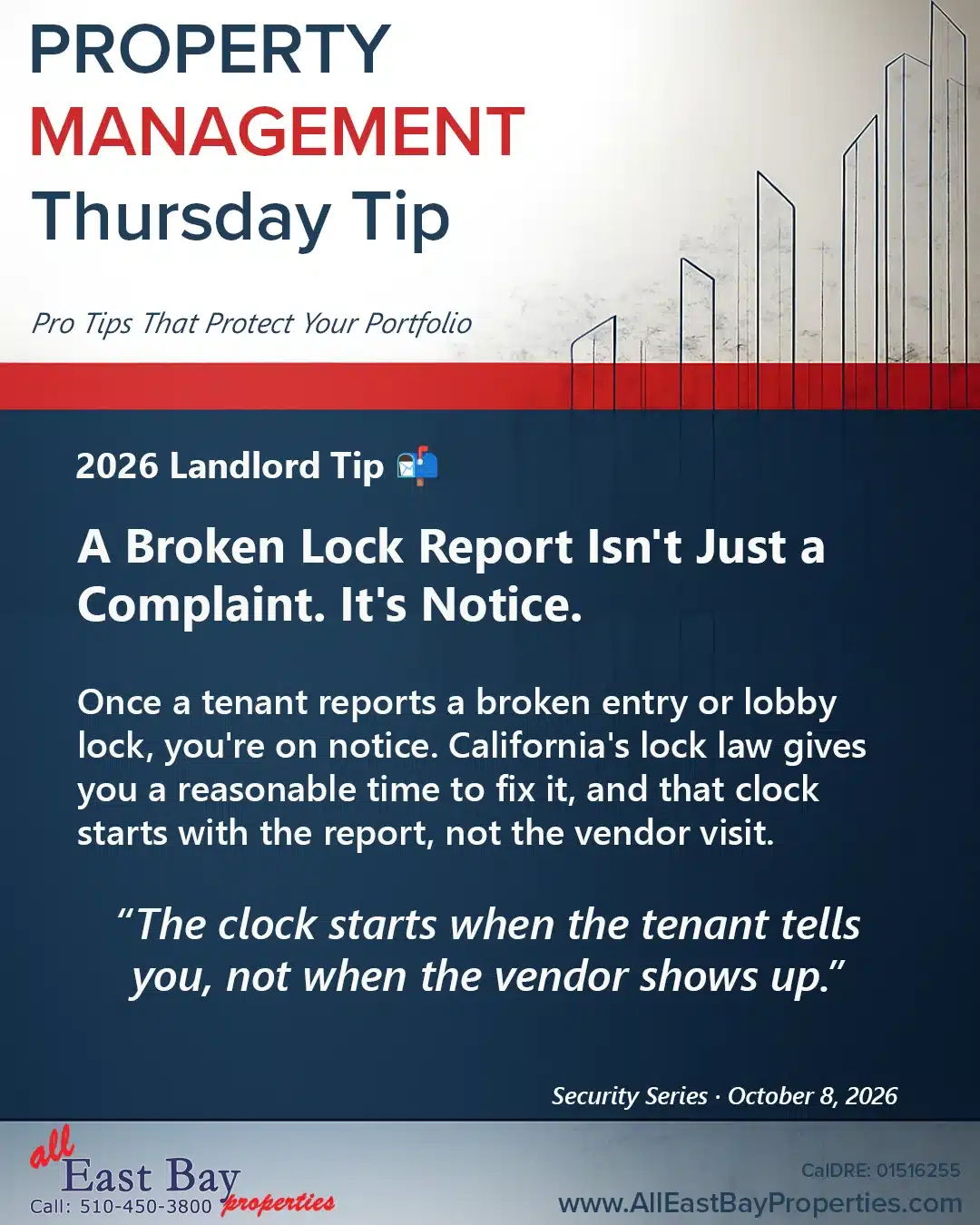
The clock starts when the tenant tells you, not when the vendor shows up.
What to Do When a Lock Report Comes In
- Classify it as urgent, not routine: make sure whoever answers your calls, texts and email knows that entry and lobby lock reports skip the regular repair queue.
- Log the date reported and the date fixed: open the work order the day the report arrives, not after the repair. That timestamp is your record of when you acted on notice.
- Photograph the repair: a dated photo of the working lock, plus the vendor invoice, filed by property address.
- Close the loop in writing: a short message to the tenant who reported it, confirming the fix and the date.
- Recheck entry and garage doors monthly: try each lock and watch each door close. Worn closers and latches fail gradually, so you want to find them before a tenant does.
💡 This week’s takeaway
A broken lock report isn’t just a complaint. It’s notice. California gives you a reasonable time to fix a required lock, and that time starts when you’re told. Treat entry and lobby lock reports as urgent, log the dates, and keep proof of the fix.
📘 Learn more
This tip comes from Monday’s full guide to building security duties:
→ Landlord Security Duties in California: What You’re Liable For (and What You’re Not) — the §1941.3 lock list, how foreseeability works, and what you don’t automatically owe
→ California Landlord Repair Timelines — how fast California expects other repairs to be handled
→ Thursday Tip: Your Repairs Are Only as Good as Your Documentation — the paper trail that proves you acted
This tip is part of our ongoing education series for Bay Area landlords focused on compliance, risk reduction, and smarter property management. 📋 Browse all Thursday Landlord Tips →