
Share this post
Quick Answer
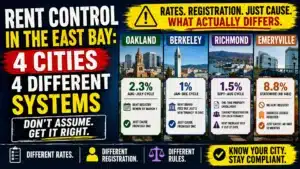
Four East Bay cities, four different rent control systems, and none of them run on the same clock. For 2026–2027, the allowable rent increase is 8.8% under AB 1482 (the SF-Oakland-Hayward regional figure under the statewide formula), 2.3% in Oakland, 1.0% in Berkeley, and 1.5% in Richmond. Emeryville has no local rent-control ordinance at all — for units covered by AB 1482, its 8.8% statewide-formula rate applies there directly. The rate is the easy part. Registration requirements, just-cause eviction timing, and what counts as a “covered unit” are where cross-city owners actually get tripped up, because each city built its system independently and none of them match Oakland’s model, even though Oakland is usually the one people assume is the template.
Key Facts: 2026–2027 East Bay Rent Caps at a Glance
| Jurisdiction | 2026–27 Rate | Effective Window |
|---|---|---|
| AB 1482 (East Bay region) | 8.8% | Aug 1, 2026 – Jul 31, 2027 |
| Oakland RAP | 2.3% | Aug 1, 2026 – Jul 31, 2027 |
| Berkeley AGA | 1.0% | Jan 1 – Dec 31, 2026 (calendar year) |
| Richmond AGA | 1.5% | Sept 1, 2026 – Aug 31, 2027 |
| Emeryville | No local cap; AB 1482’s 8.8% applies to covered units | Aug 1, 2026 – Jul 31, 2027 |
For the full story on how these four rates were calculated this cycle — including why Richmond’s actually went down while the other three went up — see our East Bay Rent Cap Update. This guide covers what those rates mean in practice: coverage, registration, and eviction timing.
Video Transcript
Quick test: if you manage rental property in more than one East Bay city, do you actually know all four rent-control systems — or just the rate for each one? A lot of owners know the second one and get tripped up by the first. Four East Bay cities, four independently built compliance systems, and mixing up their mechanics is one of the more common mistakes we see. Let’s walk through what actually differs, city by city.
There’s no single “East Bay rent control law.” AB 1482, the statewide Tenant Protection Act, sets a baseline for the units it covers, but Oakland, Berkeley, and Richmond each layer their own, stricter ordinance on top of that baseline — and each one was written by a different city council or ballot measure, on a different timeline, with different mechanics. Emeryville never adopted a local rent-control ordinance at all, so AB 1482 governs the rate directly there for units it covers — though Emeryville does have its own separate landlord-tenant ordinance for evictions and notices, which is easy to conflate with a rent cap but isn’t one.
For the cycle running now, the rate itself isn’t the hard part. AB 1482’s regional figure is 8.8 percent. Oakland’s local cap is 2.3 percent, on the same August-to-July cycle as the statewide rate. Berkeley’s is 1 percent, but on a calendar-year cycle instead — January through December. Richmond’s is 1.5 percent, on a September-to-August cycle of its own. And Emeryville, with no local ordinance, falls back to that same 8.8 percent regional figure for units AB 1482 covers.
Where owners actually get tripped up is registration, and each city runs a completely different system. Oakland requires an annual renewal by March 1 through the city’s Rent Registry. Berkeley runs ongoing annual registration and fees with the Rent Board — FY 2026-27 fees were due July 2nd, with a full 100 percent penalty for paying late, and any new tenancy has to be registered within 15 days of move-in. Richmond doesn’t use an annual renewal at all — it’s a one-time Property Enrollment per property, plus a separate Tenancy Registration filed for each individual tenancy, and a rent increase issued while either one is out of date is void. Emeryville has no rent registry, but a landlord there needs a valid business license just to legally terminate a tenancy — that license functions as Emeryville’s version of a registry.
Just-cause eviction timing is the other place these systems diverge. AB 1482’s own statewide just-cause backstop requires 12 months of continuous occupancy before it kicks in. But we checked the actual ordinance text for Berkeley — BMC 13.76.130 — directly, and it applies from day one of a covered tenancy, no waiting period at all. We didn’t find an equivalent 12-month wait in Oakland’s or Richmond’s own ordinance materials for their covered units either. So that statewide 12-month rule is a default for the units it actually governs — it doesn’t automatically carry over into a city’s own local ordinance.
We manage 600-plus units across the East Bay, including Oakland, Berkeley, Emeryville, and Richmond, and the paperwork surprises we actually see rarely come from the rent-increase math — owners usually know to check the rate. They come from assuming one city’s system, not just its number, travels to the next city. We onboarded a Berkeley owner whose properties had never been registered with the Rent Board at all; the city was willing to reduce the penalty owed, but the deal came with a firm, in-person deadline. Separately, a client who’d just closed on a Richmond property got a letter directly from the city within weeks of the purchase, reminding him a business license is required to operate there — Richmond tracks ownership changes against the public record and follows up. Neither owner was careless. Both assumed that handling registration correctly in one East Bay city meant they’d covered the requirement everywhere.
Emeryville deserves its own callout, because “no rent cap” doesn’t mean “no local rules.” Its Residential Landlord and Tenant Relations Ordinance requires a valid business license, a tenant rights notice, a qualifying cause, and a copy of any termination notice filed with the City Clerk within 10 days. Before sending any rent increase or termination notice anywhere in the East Bay, the same checks apply: confirm which ordinance actually covers the specific unit, verify registration or license status is current, check the tenancy’s start date against that city’s new-tenancy rules, and confirm the current rate and notice period — not last year’s numbers from memory.
If you want the full jurisdiction-by-jurisdiction table, the source citations, and the complete compliance checklist, the written guide is linked below. We track all four systems, and every registration and notice requirement that comes with them, for our own 600-plus units across the East Bay.
If this was useful, subscribe — we cover this every week. See you in the next one.
Why East Bay Rent Control Is a Patchwork — and Why That Matters

There is no single “East Bay rent control law.” AB 1482 (the statewide Tenant Protection Act) sets a statewide baseline for the units it covers — it is not a blanket rule for every rental in California, since it carries its own exemptions (certain single-family homes, newer construction, and more). Oakland, Berkeley, and Richmond each layer a stricter local ordinance on top of that baseline for units their ordinance covers, and each of those three ordinances was written by a different city council or ballot initiative, on a different timeline, with different mechanics. Emeryville never adopted a local rent-control ordinance at all, so AB 1482 governs the rate directly for units it covers there — but Emeryville does have its own separate landlord-tenant ordinance covering eviction and notice rules, which is a different thing from a rent cap and easy to conflate.
The result is a real patchwork, not four flavors of the same rule: different rates, different fiscal-year calendars, different registration systems, and — this is the one that catches even experienced owners — different rules for when just-cause eviction protection actually starts.
Side-by-Side: Rate, Registration & Just Cause
| AB 1482 (statewide formula) | Oakland RAP | Berkeley AGA | Richmond AGA | Emeryville | |
|---|---|---|---|---|---|
| 2026–27 rate | 8.8% | 2.3% | 1.0% | 1.5% | No local cap; AB 1482’s 8.8% applies to covered units |
| Cycle | Aug 1 – Jul 31 | Aug 1 – Jul 31 | Calendar year | Sept 1 – Aug 31 | Aug 1 – Jul 31 |
| Registration | None (statewide law, no local registry) | Annual, due March 1 via the city’s Rent Registry | Annual registration/fees; FY 2026–27 fees were due July 2, 2026 (100% penalty on late payment). New tenancies must be registered with the Rent Board within 15 days. | Property Enrollment once per property, plus Tenancy Registration filed for each individual tenancy — not an annual renewal | No rent registry; a valid residential landlord business license is required to terminate a tenancy |
| Just cause for covered units | 12 months’ continuous occupancy required before protection applies | No AB-1482-style 12-month waiting period identified in Oakland’s local ordinance for covered units | Applies from day one of a covered tenancy — no waiting period under BMC 13.76, confirmed directly against the ordinance text | No AB-1482-style 12-month waiting period identified in Richmond’s local ordinance for covered units | Its own ordinance’s just-cause list applies (with unusual grounds like a landlord returning from sabbatical or military deployment) |
| Local quirk | Statewide baseline for covered units; a stricter applicable local rent cap generally controls the allowable increase | New tenancies also can’t take their first rent increase until 12 months after move-in — a separate rule from just cause, easy to conflate with it | AGA capped at 5% by 2024’s Measure BB, which also tightened just-cause and nonpayment-eviction rules (banked AGAs can still push an actual increase above 5%, up to the lawful rent ceiling) | Banked increases use an additive formula (current AGA + up to 5 points of deferred AGAs) — not Oakland’s multiplier | Relocation payments scale by landlord size: greater of one month’s fair market rent or one month’s rent for owners of 4 units or fewer; greater of five months’ fair market rent or four months’ rent for larger owners |
A note on the Berkeley just-cause cell above: an earlier version of this page (and of our Berkeley property management page) attributed a 12-month waiting period to “Measure MM.” We checked the actual ordinance text (BMC 13.76.130) directly — it has no blanket occupancy minimum before just-cause protection applies. A few specific enhanced protections within it (extra relocation assistance, protections for families with minor children or for seniors/disabled tenants) do carry their own 1–5 year residency thresholds, but those are add-on safeguards, not a condition on baseline just-cause eligibility. Measure MM (2020) is about registration for partially-covered units and reclassifying pandemic-era back rent, not eviction timing. Both pages have been corrected accordingly.
Oakland: The Established Model — But Not the Template for the Others
Oakland’s Rent Adjustment Program (RAP) is the East Bay’s longest-running local system, and it’s what most owners picture when they hear “East Bay rent control.” The 2.3% AGA applies August 1, 2026 through July 31, 2027, and registration renews annually by March 1. We found no AB-1482-style 12-month waiting period for just-cause protection itself in Oakland’s own ordinance materials — but the first rent increase on a new tenancy can’t take effect until 12 months after the tenant’s actual move-in date, a separate rule that’s easy to confuse with the just-cause timing question, and worth confirming directly with the Rent Adjustment Program for a specific unit. For the full ground list and notice mechanics, see our Oakland Rent Control guide and Oakland Just Cause Eviction guide. Our Oakland property management page lists the annual RAP and business tax deadlines we track for Oakland owners.
Berkeley: The Most Layered System, After Measure BB
Berkeley runs on a calendar-year AGA cycle (not Oakland’s August–July window), which is the single most common scheduling mistake we see from owners who manage in both cities. The 1.0% rate has been in effect since January 1, 2026, but Berkeley’s own framework changed underneath that rate in November 2024, when voters passed Measure BB. Measure BB didn’t set the 1.0% figure — that comes from the ordinance’s CPI formula (65% of the regional CPI change), which the Rent Stabilization Board publishes each fall — but it capped the AGA at 5% going forward (there was previously no statutory ceiling; banked AGAs can still push an actual increase above 5%, up to the lawful rent ceiling), tightened several just-cause and nonpayment-eviction rules, and expanded registration requirements to more government-subsidized units. Registration itself runs on a firm annual calendar, not an open-ended cycle: FY 2026–27 registration fees were due July 2, 2026, with a 100% penalty for late payment, and any new tenancy must be registered with the Rent Board within 15 days of move-in. A brand-new Berkeley tenancy also can’t see its first AGA increase until the rest of the year it started, plus one full additional calendar year — the longest new-tenancy delay of any city in AEBP’s territory. For the full detail, see our Berkeley Rent Control Compliance Guide. Our Berkeley property management page covers the current compliance calendar.
Richmond: Easy to Underestimate, Increasingly Not
Richmond’s 1.5% AGA (down from 1.62% the prior cycle) takes effect September 1, 2026 — the day after this post publishes, which makes it the one rate on this page that’s about to change rather than one that already has. Richmond is also the city where registration mechanics differ most from what an Oakland- or Berkeley-trained owner expects: instead of an annual renewal, Richmond requires a one-time Property Enrollment per property plus a Tenancy Registration filed for each individual tenancy, and a rent increase issued while either is out of date is void. Richmond’s banked-increase formula is additive (current AGA plus up to 5 percentage points of deferred AGAs) rather than Oakland’s multiplier-based approach — the two land in a similar range some years by coincidence, not because the underlying math matches. See our Richmond property management page for the fuller compliance calendar, including the March 1 Business License Tax deadline.
Emeryville: No Rent Cap Doesn’t Mean No Local Rules
Emeryville is the one city on this list with no local rent-control ordinance — for units it covers, AB 1482’s 8.8% rate governs directly, with no city-specific AGA to track. But “no rent control” isn’t the same as “no local rules.” Emeryville has its own Residential Landlord and Tenant Relations Ordinance: to terminate a covered tenancy, a landlord must hold a valid residential business license, give tenants the required rights notice, use a qualifying cause, and file a copy of the termination notice with the City Clerk within 10 days. Its just-cause list includes a few unusual grounds not found in Oakland, Berkeley, or Richmond’s ordinances, like a landlord returning from sabbatical or military deployment. No-fault terminations also carry relocation payments that scale by landlord size — the greater of one month’s fair market rent or one month’s rent for owners of 4 units or fewer, and the greater of five months’ fair market rent or four months’ rent for larger owners. See our Emeryville property management page for the fuller compliance picture, and our Emeryville Rental Laws guide for the ordinance in full.
Bottom Line
If you own in one East Bay city, learn that city’s system once and you’re set for the year. If you own across more than one, the rate is the thing you’re least likely to get wrong — everyone knows to look it up. The registration deadline, the just-cause waiting period, and which calendar governs your renewal notice are the details that don’t transfer from one city to the next, and they’re the ones that turn a technically-correct rent increase into a void one.
The Mistake We See Most in Multi-City Portfolios
We manage 600+ units across the East Bay, including properties in Oakland, Berkeley, Emeryville, and Richmond, and the paperwork surprises rarely come from the rent-increase math — owners usually know to check the rate. They come from assuming one city’s system — not just its number — travels to the next city.
Two examples from the last few months, on two different pieces of that system: We onboarded a Berkeley owner whose multi-unit properties had never been registered with the Rent Board at all. The city was willing to reduce the penalties owed, but the reduced-penalty deal came with a firm, in-person deadline, and the Rent Board wasn’t sympathetic to the fact that the owner hadn’t known the requirement existed. Separately, a client who had just closed on a Richmond property received a letter directly from the city within weeks of the purchase, reminding him that a business license is required to operate a rental there — suggesting the city actively monitors ownership changes and follows up with new owners, which catches new owners off guard because nothing about the purchase itself flagged it.
Neither owner was careless. Both assumed that if they’d handled registration correctly in one East Bay city, they’d covered the requirement everywhere. Oakland’s March 1 annual renewal, Berkeley’s annual Rent Board registration (with its own July 2 fee deadline and a 15-day window for new tenancies), and Richmond’s one-time property enrollment plus per-tenancy registration are three different systems, not three versions of the same form — and the just-cause timing question above is the same story: AB 1482’s 12-month wait is a statewide default, not a rule that automatically applies inside Oakland, Berkeley, or Richmond’s own covered units.
Before You Send a Rent Increase or Termination Notice
- Confirm which ordinance covers the specific unit, not merely the city — coverage rules, not the address, decide which rate and rules apply.
- Verify the unit’s registration, enrollment, or business-license status is current before serving any notice.
- Check when the tenancy began, and against which jurisdiction’s new-tenancy rules (Oakland’s 12-month first-increase delay, Berkeley’s 15-day registration window, etc.).
- Confirm the jurisdiction’s current allowable increase and effective window — not last year’s figure from memory.
- Check whether prior AGAs have been banked, and recalculate the banked-increase cap if so.
- Confirm the required notice period and any city filing requirements (e.g., Emeryville’s 10-day City Clerk filing).
- When eviction or termination is involved, verify the applicable just-cause ground and any city-specific relocation-payment requirement before serving anything.
Current rules at a glance
Frequently Asked Questions
Which East Bay city has the highest allowable rent increase for 2026–2027?
Emeryville does, indirectly — it has no local rent cap, so for units covered by AB 1482, its 8.8% rate applies there directly. Among the three cities with their own rent boards, Oakland’s 2.3% is the highest local cap, ahead of Richmond’s 1.5% and Berkeley’s 1.0%.
Do I need to register my rental property in every East Bay city I own in?
Not in the same way. Oakland, Berkeley, and Richmond each have registration requirements, but the mechanics differ: Oakland requires an annual renewal by March 1; Berkeley requires annual registration and fee payment (FY 2026–27 fees were due July 2, 2026, with a 100% penalty for late payment) plus registering each new tenancy within 15 days; and Richmond requires a one-time Property Enrollment plus a Tenancy Registration for each tenancy. Emeryville has no rent registry — instead, residential landlords there must maintain a valid business license, among other local requirements.
If my property is in Oakland or Berkeley, does the statewide AB 1482 rate ever apply instead of the local rate?
Only if a specific unit is exempt from the local ordinance but still covered by AB 1482 — for example, certain newer construction. For units actually covered by Oakland’s or Berkeley’s ordinance, the local rate controls, and it’s stricter than AB 1482 in every case on this list.
Does just-cause eviction protection start on day one of a tenancy, or is there a waiting period?
It depends on which ordinance covers the unit. AB 1482’s statewide just-cause backstop requires 12 months of continuous occupancy. Berkeley’s local just-cause ordinance (BMC 13.76.130, confirmed directly against the ordinance text) applies from day one of a covered tenancy, with no blanket occupancy minimum. We found no AB-1482-style 12-month waiting period in Oakland’s or Richmond’s own just-cause ordinance materials for covered units, though it’s still worth confirming coverage for a specific unit with the relevant rent board, since coverage rules — not timing — are where real nuance exists.
Is Richmond’s rent control ordinance actually less strict than Oakland’s or Berkeley’s?
Not in a way we’d characterize as “less enforced” — Richmond’s registration and business-license requirements are real and actively followed up on. It’s more accurate to say Richmond’s system runs on different mechanics (a September cycle, enrollment-based registration) than that it runs more loosely.
Sources
- AB 1482 8.8% (SF-Oakland-Hayward region) — Required by law. Civil Code §1947.12; BLS CPI release, San Francisco Area, April 2026
- Oakland RAP 2.3%, March 1 registration — Required by local ordinance. City of Oakland — Allowable Rent Increases
- Oakland just-cause coverage — Required by local ordinance (O.M.C. 8.22.300). City of Oakland — Just Cause for Eviction Ordinance
- Berkeley AGA 1.0%, Measure BB — Required by local ordinance. Berkeley Rent Board — 2026 AGA Published; Measure BB Changes to Berkeley’s Rent Ordinance
- Berkeley just cause, no waiting period — Required by local ordinance. Confirmed directly against BMC 13.76.130 (“Just cause required for eviction”), corroborated by Berkeley Rent Board — Just Cause & Other Local Requirements
- Berkeley registration deadlines (FY 2026–27 fees, 15-day new-tenancy registration) — Required by local ordinance. Berkeley Rent Board — Registration Fees, FY 2026-2027; Berkeley Rent Board — Partially Covered Unit Registration
- Richmond AGA 1.5%, enrollment/registration structure — Required by local ordinance (Regulation 615; RMC 11.100). City of Richmond — Rent Increase / Annual General Adjustment
- Emeryville ordinance summary (business license, City Clerk filing, relocation payments) — Required by local ordinance. City of Emeryville — Tenant Protection Resources; City of Emeryville — Eviction Ordinance overview
- AEBP portfolio anecdotes (Berkeley registration, Richmond business license) — AEBP documented experience. Examples anonymized to protect client privacy.
Not Sure Which Rules Actually Apply to Your Units?
We track all four systems, and every registration and notice requirement that comes with them, for 600+ units across the East Bay, including Oakland, Berkeley, Emeryville, and Richmond.