
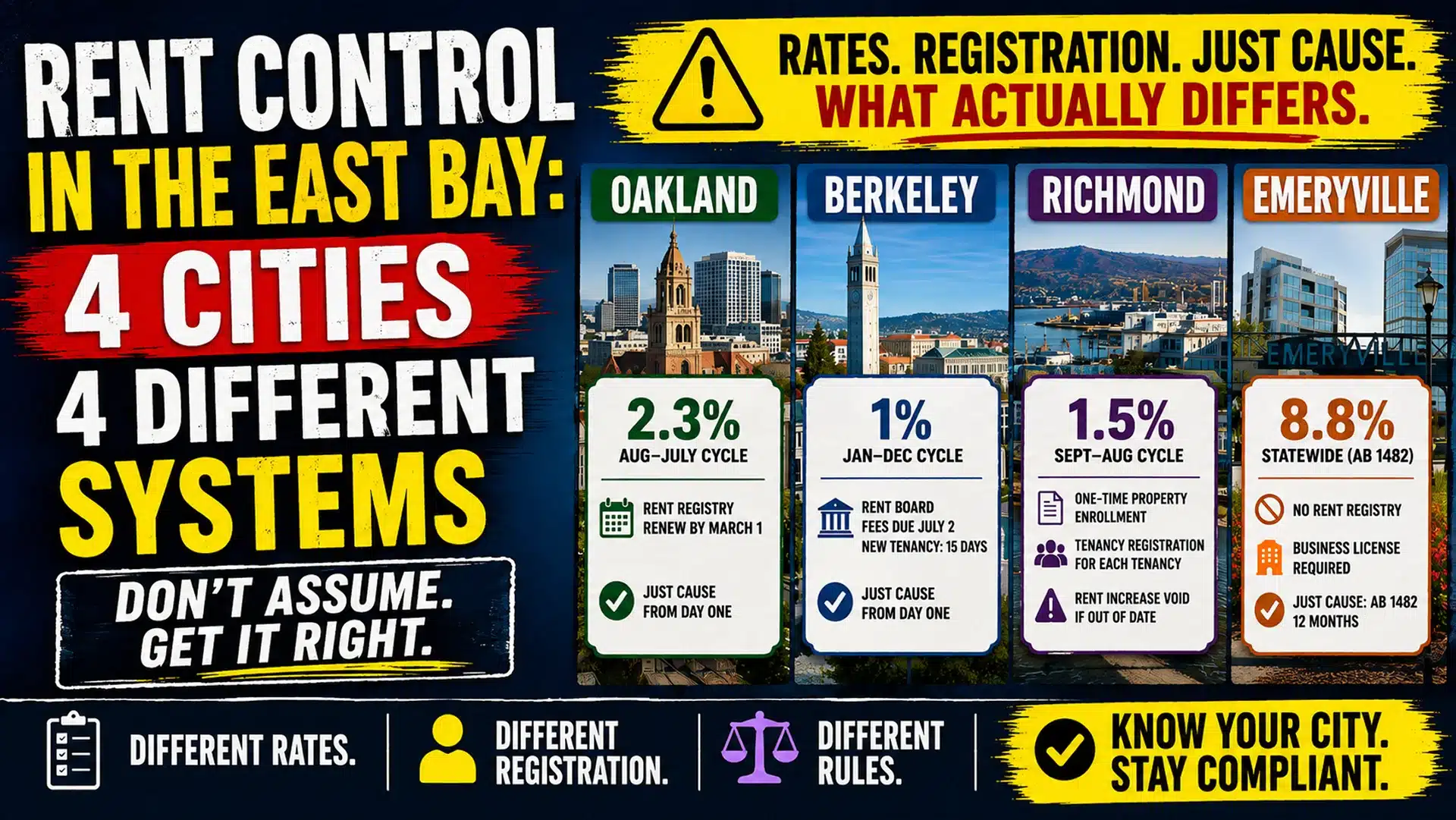
East Bay rent control isn’t one system with four numbers — it’s four independently built systems that only share a common statewide floor. In this video, we walk through the 2026–2027 rate in each jurisdiction, how registration works differently in Oakland, Berkeley, Richmond, and Emeryville, and where just-cause eviction timing actually starts in each one.
What This Video Covers
- Why there’s no single “East Bay rent control law” — and what that means for owners in more than one city
- The 2026–2027 rent caps for AB 1482 statewide, Oakland, Berkeley, Richmond, and Emeryville
- How registration works differently in each city — and why Richmond’s system looks nothing like Oakland’s or Berkeley’s
- Where just-cause eviction timing actually starts in each jurisdiction
- Emeryville’s landlord-tenant ordinance, and why “no rent cap” isn’t “no local rules”
- The real mistake AEBP sees most in multi-city portfolios — and how to check for it before serving a notice
In This Video
AB 1482 sets a statewide baseline — 8.8% (SF East Bay Region) for the cycle running August 2026 through July 2027 — but Oakland, Berkeley, and Richmond each layer a stricter, independently built local ordinance on top of it for the units that ordinance covers. Oakland’s rate is 2.3%, running the same August–July cycle. Berkeley’s is 1.0%, on a calendar-year cycle instead. Richmond’s is 1.5%, on its own September–August cycle. Emeryville never adopted a local rent-control ordinance, so AB 1482’s 8.8% applies directly to units it covers there.
The rate is rarely where multi-city owners actually get tripped up — registration is. Oakland requires an annual renewal by March 1. Berkeley runs ongoing annual registration and fees with the Rent Board, with FY 2026–27 fees due July 2 and a 100% penalty for late payment, plus a 15-day window to register any new tenancy. Richmond skips the annual model entirely in favor of a one-time Property Enrollment per property and a separate Tenancy Registration for each tenancy — and a rent increase issued while either has lapsed is void. Emeryville has no rent registry, but requires a valid business license to legally terminate a tenancy there.
Just-cause eviction timing follows the same pattern of quiet divergence. AB 1482’s own statewide backstop requires 12 months of continuous occupancy before just-cause protection applies. Checked directly against the ordinance text, Berkeley’s BMC 13.76.130 applies from day one of a covered tenancy with no waiting period, and we found no equivalent 12-month wait in Oakland’s or Richmond’s own ordinance materials for their covered units either — a statewide default that doesn’t automatically travel into a city’s own local rules.
We manage 600+ units across Oakland, Berkeley, Emeryville, and Richmond, and the compliance surprises we actually see come from assuming one city’s system — not just its rate — carries over to the next city. A Berkeley owner whose properties had never been registered with the Rent Board, and a new Richmond owner who received a business-license reminder letter directly from the city within weeks of closing, are both real examples of that same assumption going wrong.
Key Takeaways
- No single “East Bay rent control law” exists — AB 1482 sets a statewide baseline, and Oakland, Berkeley, and Richmond each layer a stricter, independently built ordinance on top of it for covered units
- 2026–2027 rates: 8.8% regional (AB 1482), 2.3% Oakland, 1.0% Berkeley, 1.5% Richmond — Emeryville has no local cap, so AB 1482’s 8.8% applies to covered units there
- Registration is a different system in every city: Oakland’s annual March 1 renewal, Berkeley’s ongoing Rent Board registration with a July 2 fee deadline, Richmond’s one-time Property Enrollment plus per-tenancy registration, and Emeryville’s business-license requirement in place of a registry
- AB 1482’s 12-month just-cause waiting period is a statewide default — Berkeley’s own ordinance applies from day one with no waiting period, and neither Oakland’s nor Richmond’s ordinance materials show an equivalent wait for their covered units
- Emeryville has no rent-control ordinance, but its own landlord-tenant ordinance still requires a business license, a tenant rights notice, a qualifying cause, and a 10-day City Clerk filing
- The most common multi-city mistake isn’t the rent-increase math — it’s assuming one city’s registration or notice system automatically covers another city’s requirement
Resources Mentioned
Not sure which rules actually apply to your units?
We track all four systems, and every registration and notice requirement that comes with them, for 600+ units across Oakland, Berkeley, Emeryville, and Richmond.
Every registration deadline, every just-cause timing rule, every city’s own quirks — this is what we track so you don’t have to.
Video Transcript
Quick test: if you manage rental property in more than one East Bay city, do you actually know all four rent-control systems — or just the rate for each one? A lot of owners know the second one and get tripped up by the first. Four East Bay cities, four independently built compliance systems, and mixing up their mechanics is one of the more common mistakes we see. Let’s walk through what actually differs, city by city.
There’s no single “East Bay rent control law.” AB 1482, the statewide Tenant Protection Act, sets a baseline for the units it covers, but Oakland, Berkeley, and Richmond each layer their own, stricter ordinance on top of that baseline — and each one was written by a different city council or ballot measure, on a different timeline, with different mechanics. Emeryville never adopted a local rent-control ordinance at all, so AB 1482 governs the rate directly there for units it covers — though Emeryville does have its own separate landlord-tenant ordinance for evictions and notices, which is easy to conflate with a rent cap but isn’t one.
For the cycle running now, the rate itself isn’t the hard part. AB 1482’s regional figure is 8.8 percent. Oakland’s local cap is 2.3 percent, on the same August-to-July cycle as the statewide rate. Berkeley’s is 1 percent, but on a calendar-year cycle instead — January through December. Richmond’s is 1.5 percent, on a September-to-August cycle of its own. And Emeryville, with no local ordinance, falls back to that same 8.8 percent regional figure for units AB 1482 covers.
Where owners actually get tripped up is registration, and each city runs a completely different system. Oakland requires an annual renewal by March 1 through the city’s Rent Registry. Berkeley runs ongoing annual registration and fees with the Rent Board — FY 2026-27 fees were due July 2nd, with a full 100 percent penalty for paying late, and any new tenancy has to be registered within 15 days of move-in. Richmond doesn’t use an annual renewal at all — it’s a one-time Property Enrollment per property, plus a separate Tenancy Registration filed for each individual tenancy, and a rent increase issued while either one is out of date is void. Emeryville has no rent registry, but a landlord there needs a valid business license just to legally terminate a tenancy — that license functions as Emeryville’s version of a registry.
Just-cause eviction timing is the other place these systems diverge. AB 1482’s own statewide just-cause backstop requires 12 months of continuous occupancy before it kicks in. But we checked the actual ordinance text for Berkeley — BMC 13.76.130 — directly, and it applies from day one of a covered tenancy, no waiting period at all. We didn’t find an equivalent 12-month wait in Oakland’s or Richmond’s own ordinance materials for their covered units either. So that statewide 12-month rule is a default for the units it actually governs — it doesn’t automatically carry over into a city’s own local ordinance.
We manage 600-plus units across the East Bay, including Oakland, Berkeley, Emeryville, and Richmond, and the paperwork surprises we actually see rarely come from the rent-increase math — owners usually know to check the rate. They come from assuming one city’s system, not just its number, travels to the next city. We onboarded a Berkeley owner whose properties had never been registered with the Rent Board at all; the city was willing to reduce the penalty owed, but the deal came with a firm, in-person deadline. Separately, a client who’d just closed on a Richmond property got a letter directly from the city within weeks of the purchase, reminding him a business license is required to operate there — Richmond tracks ownership changes against the public record and follows up. Neither owner was careless. Both assumed that handling registration correctly in one East Bay city meant they’d covered the requirement everywhere.
Emeryville deserves its own callout, because “no rent cap” doesn’t mean “no local rules.” Its Residential Landlord and Tenant Relations Ordinance requires a valid business license, a tenant rights notice, a qualifying cause, and a copy of any termination notice filed with the City Clerk within 10 days. Before sending any rent increase or termination notice anywhere in the East Bay, the same checks apply: confirm which ordinance actually covers the specific unit, verify registration or license status is current, check the tenancy’s start date against that city’s new-tenancy rules, and confirm the current rate and notice period — not last year’s numbers from memory.
If you want the full jurisdiction-by-jurisdiction table, the source citations, and the complete compliance checklist, the written guide is linked below. We track all four systems, and every registration and notice requirement that comes with them, for our own 600-plus units across the East Bay.
If this was useful, subscribe — we cover this every week. See you in the next one.