

Share this post
Last updated August 2026 — reflects the AB 1482 statewide cap rising to 8.8% and Oakland’s local cap rising to 2.3%, both effective August 1, 2026.
In Short
A California lease doesn’t automatically “renew” into a new fixed term — and a fixed-term lease reaching its stated end date isn’t itself governed by the 30/60-day notice rule that applies to ending a month-to-month tenancy (that rule, Civil Code §1946.1, only applies once a periodic tenancy already exists). If your tenant stays past the end date and you accept rent, Civil Code §1945 converts the tenancy to month-to-month on the same terms automatically. Before assuming you can simply decline to renew, check whether the property carries just-cause protection — under AB 1482 (generally after 12 months, sometimes 24) or, in Oakland and Berkeley, from day one of the tenancy. Where just cause applies, lease expiration by itself is not a valid reason to end the tenancy. Raising the rent runs on its own, separate notice clock: 30 days for increases of 10% or less, 90 days for anything higher, capped at 8.8% statewide beginning August 1, 2026 (lower in Oakland and Berkeley).
Key Facts — Lease Renewals in California (2026)
| Situation | Rule | Confidence |
|---|---|---|
| Fixed-term lease reaches its stated end date | Not itself governed by the 30/60-day periodic-tenancy notice rule below — see “What Happens When a Fixed-Term Lease Ends” | Required by law |
| Fixed-term lease ends, tenant stays, landlord accepts rent | Converts to month-to-month automatically, same terms (Civil Code §1945) | Required by law |
| Landlord ends an existing month-to-month tenancy, no cause, tenant < 1 year | 30 days’ written notice (Civil Code §1946.1) — only where no just-cause protection applies | Required by law |
| Landlord ends an existing month-to-month tenancy, no cause, tenant ≥ 1 year | 60 days’ written notice (Civil Code §1946.1) — only where no just-cause protection applies | Required by law |
| Rent increase of 10% or less in a rolling 12 months | 30 days’ written notice (Civil Code §827(b)) | Required by law |
| Rent increase of more than 10% in a rolling 12 months | 90 days’ written notice (Civil Code §827(b)) | Required by law |
| Just-cause eviction protection kicks in, statewide (AB 1482) | After 12 continuous months of tenancy — or after 24 months if an additional adult tenant was added before the 12-month mark (Civil Code §1946.2) | Required by law |
| Just-cause protection in Oakland (covered units) | From day one of tenancy — no 12-month wait, and lease expiration alone is not a valid ground | Required by local ordinance |
| Just-cause protection in Berkeley (covered units) | From the start of the tenancy for units under the Rent Stabilization Ordinance — lease expiration alone is not valid cause | Required by local ordinance |
| AB 1482 statewide rent cap, Aug 1, 2026 – Jul 31, 2027 | 8.8% (5% + 3.8% regional CPI) | Required by law |
| Oakland RAP cap, Aug 1, 2026 – Jul 31, 2027 | 2.3% | Required by local ordinance |
| Berkeley AGA, calendar year 2026 | 1.0% | Required by local ordinance |
| Richmond AGA, Sept 1, 2026 – Aug 31, 2027 | 1.5% | Required by local ordinance |
For units subject to Oakland’s or Berkeley’s local rent ceilings, the applicable local limit is lower than the AB 1482 ceiling. Other units in those cities may still be governed by AB 1482 or may be exempt, depending on the property and tenancy — local rent-ceiling coverage and just-cause coverage aren’t always identical. See our full AB 1482 rent cap guide and the 2026–2027 East Bay rate update for the complete jurisdiction breakdown.
Video Transcript
If you own rental property in California, here’s a question worth testing yourself on: when a fixed-term lease reaches its end date, how much notice do you have to give? A lot of landlords answer “30 or 60 days” — and that’s actually wrong. That notice rule doesn’t even apply yet at that point. Let’s walk through what actually happens.
Civil Code section 1946.1 — the law everyone reaches for first — governs ending a month-to-month tenancy. It doesn’t, on its own, create any notice requirement for a fixed-term lease simply running out its already-agreed term. So what does control what happens at lease end? Three things: whether your tenant stays, whether you accept rent afterward, and — this is the one people skip — whether the property is protected by just cause.
Here’s the mechanic. If your tenant stays past the end date and you accept a rent payment, California law — Civil Code section 1945 — automatically converts the tenancy to month-to-month, on the same terms, no new lease required. It just happens. Now, if you don’t accept that rent, you avoid the conversion — but that alone doesn’t mean you can recover the property. Before you assume a tenant has to leave just because the lease ended, you need to check just-cause coverage.
Statewide, AB 1482 requires a qualifying reason to end a covered tenancy once the tenant’s been there 12 months — sometimes 24, if a new adult tenant was added to the lease along the way. But if your property’s in Oakland or Berkeley, the local rules are stricter — just-cause protection can apply from day one of the tenancy. Lease expiration, by itself, isn’t a valid reason to end a just-cause-protected tenancy in either city. That’s the check to run first, before you touch a notice-period calendar at all.
Once you’ve confirmed the tenancy is periodic and not just-cause protected, that’s when the 30-or-60-day rule actually applies: 30 days if the tenant’s been there less than a year, 60 days if longer.
Now, raising the rent runs on a completely separate clock. Civil Code section 827 requires 30 days’ notice for an increase of 10 percent or less, and 90 days for anything above that — and that clock counts backward from the increase’s effective date, not the lease’s end date. That distinction matters this year specifically, because AB 1482’s statewide cap jumps from 6.3 to 8.8 percent on August first. Oakland’s local cap climbs to 2.3 percent the same day. Berkeley holds at 1 percent. The rate that applies is whichever one governs the date your increase actually takes effect — not when you happened to serve the notice.
One more thing, from our own experience managing renewals across the East Bay. We don’t push a new fixed-term lease at every renewal date as a default. When a lease term ends, we let it do exactly what the law already provides for — convert to month-to-month — unless the owner or the tenant specifically wants a new fixed term. That’s deliberate, not an oversight. It means we’re not re-signing paperwork every year that would say the same thing, and it keeps our renewal-season effort where it actually matters: getting the just-cause check, the notice, and the rate right.
If you want the full breakdown — the exact notice-period rules, the effective-date timing trap, and the Oakland and Berkeley specifics — the complete guide is linked below. We manage 600-plus units across Emeryville, Oakland, Berkeley, and Richmond, and this is exactly what we walk through every renewal season.
If this was useful, subscribe — we cover this every week. See you in the next one.
What Actually Happens When a Fixed-Term Lease Ends
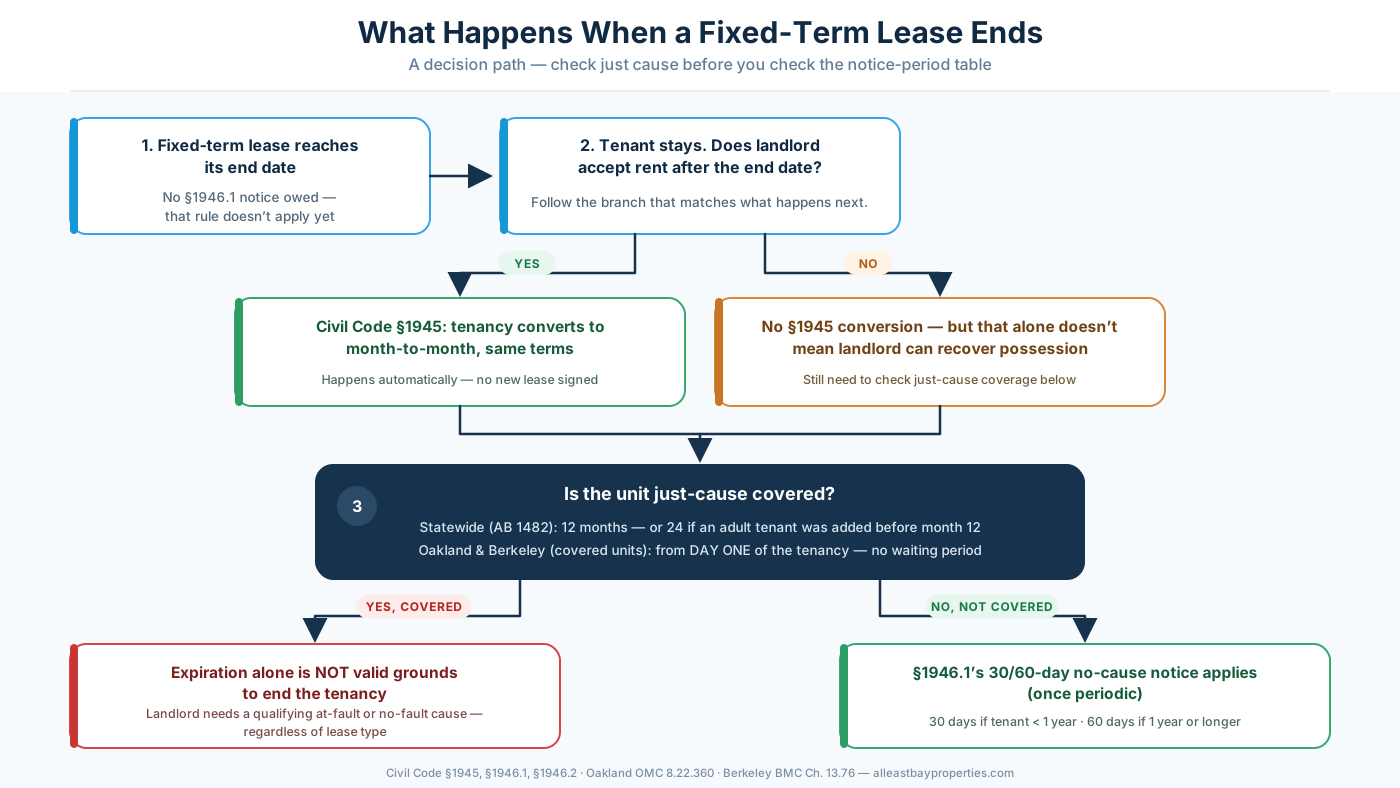
Most landlords assume a lease either gets “renewed” with new paperwork or the tenant simply has to move out. Neither is automatic — and neither is governed by the notice rule most landlords reach for first. Civil Code §1946.1’s 30/60-day notice requirement applies to ending an existing month-to-month tenancy. It does not, on its own, create a 30/60-day notice requirement for a fixed-term lease that is simply reaching its already-agreed end date.
What actually governs a fixed-term lease’s expiration is a combination of three things: whether the tenant stays and the landlord accepts rent afterward, whether a lease clause addresses what happens at term end, and — critically — whether the property carries just-cause eviction protection.
Under Civil Code §1945, if a tenant stays in possession after the lease term ends and the landlord accepts rent, the law presumes the parties renewed the tenancy on the same terms — as a month-to-month tenancy, not a new fixed term, when rent is paid monthly. No new lease has to be signed for this to happen; it happens by operation of law the moment the landlord accepts a rent payment after the end date.
Not accepting rent after the term ends avoids the §1945 conversion — but it does not, by itself, establish that the landlord can recover possession. Before deciding a tenant must leave at the end of a fixed term, determine whether state or local just-cause protection applies to the unit. Under AB 1482 (Civil Code §1946.2), once the statutory occupancy threshold is met, mere expiration of the lease term is not a qualifying just cause — the landlord still needs one of the recognized at-fault or no-fault grounds. Oakland’s Just Cause for Eviction Ordinance and Berkeley’s Rent Stabilization Ordinance go further: for covered units, lease expiration is not a valid ground for recovering possession at all, and that protection can apply from day one of the tenancy, not just after 12 months. If the unit is exempt from just-cause coverage, a landlord can generally decline to sign a new fixed term and let the tenancy end — but written notice of non-renewal, given well ahead of the end date, is still the safer, better-documented approach even where it isn’t independently required by §1946.1.
Ending an Existing Month-to-Month Tenancy vs. Raising the Rent: Two Different Clocks
Once a tenancy is on a month-to-month basis — whether it started that way or converted under §1945 — two separate notice requirements come into play. Landlords frequently conflate them. They’re governed by different statutes, triggered by different actions, and run on different clocks.
Ending the tenancy (no cause, no just-cause protection)
Under Civil Code §1946.1, a landlord ending a month-to-month tenancy without cause owes 30 days’ written notice if the tenant has lived there less than a year, and 60 days’ notice if the tenant has lived there a year or longer. This route is only available where the tenancy isn’t already covered by just cause — for a just-cause-protected tenant, a no-cause notice under §1946.1 isn’t a lawful basis for ending the tenancy at all.
Raising the rent
Under Civil Code §827(b), the notice period for a rent increase depends on the size of the increase, not how long the tenant has lived there: 30 days’ written notice for an increase of 10% or less in any rolling 12-month period, and 90 days’ notice if the increase — alone or combined with other increases in the trailing 12 months — exceeds 10%. If the notice is mailed rather than delivered in person, add 5 calendar days.
Combining a Rent Increase With a Renewal: The Timing Rule That Trips People Up
Since a rate change like AB 1482’s annual CPI adjustment lands on a fixed date (August 1), landlords often ask whether they can serve a rent-increase notice ahead of that date and still capture the new, higher cap — or whether serving early locks them into the old, lower one.
The rate that governs is determined by the increase’s effective date — not the date the notice was served. A notice served before August 1, 2026 can still use the incoming 8.8% statewide cap (or the applicable local rate), as long as the increase itself doesn’t take effect until on or after August 1, and the required 30- or 90-day notice period is met. Conversely, an increase effective before August 1 has to use the outgoing, lower rate — no matter how early or late the notice was served.
Practically, this means a landlord who wants to combine a rent increase with the lease-end conversion should count backward from the increase’s intended effective date, using the 30- or 90-day window that applies to that increase’s size — not from the lease’s expiration date itself. The two dates often don’t line up, and assuming they do is one of the more common timing mistakes we see.
Just-Cause Protections at Renewal — Oakland and Berkeley Are Stricter Than State Law
Converting a lease to month-to-month doesn’t reset the clock on a tenant’s eviction protections — and depending on the city, those protections may already be in force well before the conversion happens.
Statewide, Civil Code §1946.2 (part of AB 1482) requires just cause to end a covered tenancy once all tenants have continuously and lawfully occupied the unit for 12 months — or, if an additional adult tenant was added to the lease before that 12-month mark, once at least one original tenant has occupied it for 24 months. Before that threshold is met, a no-cause termination with proper notice is still permitted for AB 1482 purposes. Once it is met, lease expiration alone is not a qualifying just cause — the landlord needs one of the recognized at-fault or no-fault grounds.
Oakland and Berkeley don’t follow the 12-month rule. Oakland’s Just Cause for Eviction Ordinance applies to covered units from day one of the tenancy — a tenant who moved in a month ago has the same just-cause protection as one who’s been there ten years, and lease expiration is not one of the ordinance’s permitted grounds. See our Oakland Just Cause Eviction guide for the full list of permitted grounds under OMC 8.22.360. Berkeley’s Rent Stabilization Ordinance works similarly for covered units — just-cause protection attaches at the start of the tenancy, and expiration of the lease term is not, by itself, good cause to end it.
What this means at renewal: if your property is in Oakland or Berkeley, don’t assume a tenant who’s been on a fixed-term lease for less than a year lacks just-cause protection once that lease converts to month-to-month, or that the lease simply ending gives you a basis to end the tenancy. In those cities, the protection was very likely already there — check coverage before treating expiration as an exit option.
How AEBP Handles Lease End — By Design, Not By Accident
Across our managed portfolio, we don’t push a new fixed-term lease at every renewal date as a default. When a lease term ends, our standard practice is to let it do exactly what Civil Code §1945 already provides for: it converts to a month-to-month tenancy on the same terms, and stays that way unless the owner or the tenant specifically asks for a new fixed term.
That’s a deliberate operating choice, not an oversight. It means we’re not re-executing a full lease document for every unit every single year just to restate terms that haven’t changed. It keeps the door open for the owner to adjust rent on the proper notice schedule without being boxed into another 12-month commitment on a unit where circumstances might change. And it lets our renewal-season effort go where it actually matters: confirming just-cause coverage, getting the rent-increase notice and the jurisdiction’s rate cap right, and timing it to the correct effective date — rather than re-signing paperwork that would say the same thing a new fixed term already says.
A new fixed-term lease still happens when it’s the right call — an owner planning a sale, a tenant who wants the rent-stability guarantee a fixed term provides, or a unit where a defined end date matters for another reason. It’s just not the default we reach for automatically.
Fixed-Term Renewal vs. Letting It Convert to Month-to-Month
| New Fixed-Term Lease | Converts to Month-to-Month | |
|---|---|---|
| Paperwork required | New lease document, signed by both parties | None — happens automatically under Civil Code §1945 |
| Rent predictability for the term | Locked for the new term | Can be adjusted with proper notice (30/90 days per §827(b)) |
| Ending the tenancy | Generally can’t end early without cause or a lease clause | 30/60-day no-cause notice available under §1946.1 — unless just cause already applies, in which case neither lease type lets you end it without a qualifying reason |
| Just-cause exposure | Same as before — doesn’t change with lease type | Same as before — converting the lease type doesn’t reset or remove just-cause protection |
| Best fit | Owner wants term certainty, or tenant wants rent locked in | Owner wants flexibility on rent-adjustment timing, understanding that ending the tenancy may still be restricted by just-cause protections regardless of lease type |
Common Mistakes Landlords Make at Renewal
- Assuming §1946.1’s 30/60-day rule governs a fixed-term lease’s expiration — it governs ending an already-existing month-to-month tenancy, not the natural end of a fixed term
- Treating lease expiration as automatic grounds for possession without first checking just-cause coverage — where AB 1482 or a local ordinance applies, expiration alone usually isn’t a valid reason
- Counting the rent-increase notice from the lease’s end date instead of from the increase’s intended effective date
- Applying the statewide AB 1482 cap to an Oakland or Berkeley unit instead of the lower local rate
- Assuming a tenant on a “new” month-to-month tenancy has no just-cause protection — in Oakland and Berkeley, that protection may have already existed since day one of the original lease
- Serving a rent increase and a non-renewal notice with the same notice period — they’re governed by different statutes and often require different notice lengths
Before Your Lease Converts: A Quick Checklist
Run through these before deciding what to do at a fixed-term lease’s end date:
- Check just-cause coverage first. Is the unit subject to AB 1482 (and has the 12- or 24-month threshold been met), or is it in Oakland or Berkeley, where coverage may already apply from day one?
- Decide whether you’re ending the tenancy or letting it convert. If you don’t want a month-to-month conversion, don’t accept rent past the end date, and put the non-renewal in writing regardless.
- If raising rent, confirm the correct jurisdiction’s cap (statewide AB 1482 vs. Oakland, Berkeley, or Richmond’s local rate) before calculating the increase.
- Work backward from the increase’s intended effective date — not the lease’s end date — to find the correct 30- or 90-day notice deadline.
- Put every notice in writing and keep proof of service — even where a specific notice period isn’t independently required, documentation protects you if the timeline is ever disputed.
Should You Push the Full Increase at Renewal?
Getting the notice and the rate right only answers whether you can raise the rent — not whether you should, on this particular tenant, right now. A rent bump that pushes a reliable tenant out can cost more in vacancy and turnover than the increase would have earned. We’ll walk through that break-even math — and how to run it for your own unit — in next week’s guide.
Frequently Asked Questions About California Lease Renewals
Does a lease in California automatically renew?
Not into a new fixed term. Under Civil Code §1945, if the tenant stays after the lease ends and the landlord accepts rent, the tenancy is presumed renewed on the same terms as a month-to-month tenancy — not automatically re-signed into another fixed-term lease. A fixed-term lease reaching its end date, on its own, doesn’t trigger any additional notice requirement beyond what the lease and applicable just-cause laws already require.
How much notice does a landlord need to end a month-to-month tenancy in California?
For a no-cause termination of an already-existing month-to-month tenancy under Civil Code §1946.1, 30 days if the tenant has lived there less than a year, and 60 days if a year or longer. This only applies where the tenancy isn’t already protected by just cause — where AB 1482 or a local just-cause ordinance applies, a no-cause notice isn’t a lawful basis for ending the tenancy.
How much notice is required to raise rent in California?
Under Civil Code §827(b), 30 days for an increase of 10% or less in a rolling 12-month period, and 90 days for anything above 10%. This is separate from — and often on a different timeline than — the notice required to end a tenancy.
Do just-cause eviction protections apply once a lease converts to month-to-month?
Yes — converting the lease type doesn’t reset or remove just-cause protection. Statewide, AB 1482’s just-cause requirement attaches once all tenants have occupied the unit for 12 continuous months (or once one tenant has occupied it for 24 months, if an additional adult tenant was added before the 12-month mark) — Civil Code §1946.2. In Oakland and Berkeley, local just-cause ordinances apply to covered units from the start of the tenancy, regardless of lease type or how long the tenant has lived there, and lease expiration alone is not a qualifying ground in either city.
Can a landlord combine a rent increase with a lease-renewal or non-renewal notice?
Yes, but they’re governed by separate statutes with separate notice-length rules, and the rent increase’s notice period runs from its own intended effective date — not the lease’s end date. Confirm both notice periods independently rather than assuming one date works for both.
Sources
- Civil Code §1945 — holdover tenancy presumed renewed month-to-month on acceptance of rent
- Civil Code §1946.1 — 30/60-day notice to end a periodic (month-to-month) tenancy
- Civil Code §827(b) — 30/90-day rent-increase notice requirements
- Civil Code §1946.2 — AB 1482 statewide just-cause eviction requirements, including the 12-/24-month occupancy thresholds
- Civil Code §1947.12 — AB 1482 rent-cap formula and effective-date mechanics
- City of Oakland — Allowable Rent Increases
- City of Oakland — Just Cause for Eviction Ordinance
- Berkeley Rent Board — AB 1482 / Tenant Protection Act
- Berkeley Rent Board — 2026 AGA Published
- City of Richmond — Rent Increase / Rent Program
- U.S. Bureau of Labor Statistics — San Francisco-Oakland-Hayward CPI release
Want your renewals handled without the guesswork?
We track every East Bay jurisdiction’s notice periods and rate caps, confirm just-cause coverage before a renewal decision gets made, and time the rent-increase notice against the correct effective date — before it becomes a problem, not after.
We manage 600+ units across Emeryville, Oakland, Berkeley, and Richmond — this is what we do every renewal season.
Related Articles: