

30 vs. 90 Day Rules Explained
(And How to Raise Rent Without Creating Problems)
Share this post
At a Glance — What You Need to Know
- 30-day notice for increases of 10% or less within a 12-month period. (Civil Code §827)
- (Subject to AB 1482 caps of 5% + CPI, where applicable)
- 90-day notice when the cumulative increase over the past 12 months exceeds 10% — regardless of how long the tenant has lived there.
- Local ordinances (Oakland, SF, LA, etc.) may impose additional requirements on top of state minimums.
- The clock starts on the date of delivery — NOT when you wrote the notice.
- First-class mail adds 5 days to the notice period. (CCP §1013)
- Errors invalidate the notice entirely — you must restart the timeline from scratch.
Raising rent is one of the most common — and most legally exposed — actions a California landlord can take. The rules aren’t complicated, but they’re unforgiving. A notice with the wrong timeline, the wrong delivery method, or the wrong framing doesn’t just create friction with your tenant. It creates a legally invalid notice that can be challenged, dismissed, or used as the basis for a retaliation claim.
If you’re wondering how much notice is required for a rent increase in California, the answer depends on two things: the size of the cumulative increase over the past 12 months, and whether local rent control rules apply.
This guide covers everything you need to know about California rent increase notice requirements in 2026: when to use 30-day vs. 90-day notices, how the legal clock starts, delivery method requirements, and how to communicate increases in a way that protects the landlord-tenant relationship — and your investment.
This is the final post in our California rent increase series. If you haven’t already, we recommend reviewing our California rent increase laws guide, our AB 1482 coverage and exemptions breakdown, and our Oakland rent increase rules guide — all of which inform when and how these notice rules apply.
30-Day vs. 90-Day Notice: Which One Do You Need?
California Civil Code §827 sets the baseline: landlords must provide written notice before changing any rental term, including rent. The required notice period depends on one variable — the size of the cumulative increase over the past 12 months.
| Notice Period | When It Applies | Key Trigger |
|---|---|---|
| 30 Days | Cumulative increase is 10% or less within a rolling 12-month window | Total of all increases in last 12 months ≤ 10% |
| 90 Days | Cumulative increase exceeds 10% within a rolling 12-month window | Total of all increases in last 12 months > 10% |
| Local rules | Oakland, SF, LA, and other cities with rent ordinances may impose additional requirements on top of state minimums | Always check local ordinance for your city |
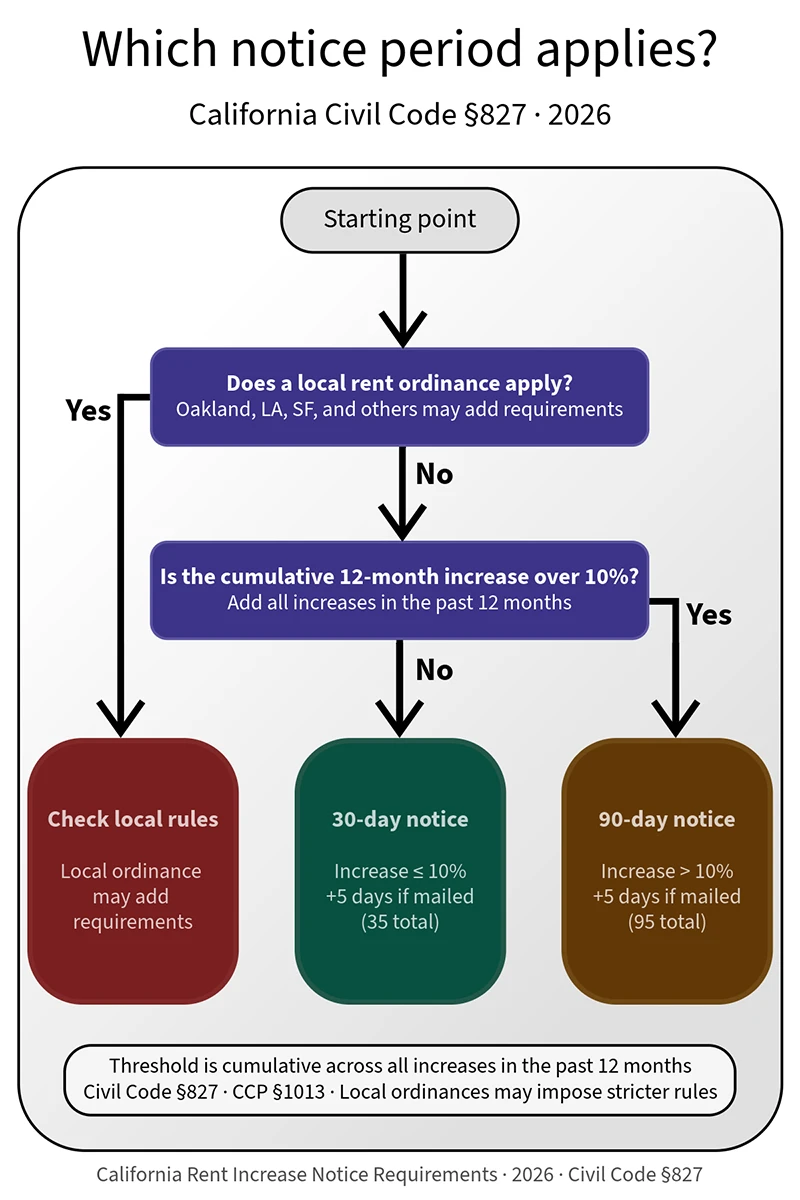
⚠️ Important: The tenancy length does not determine which notice period applies under California state law. The 30-day vs. 90-day rule is based solely on the size of the cumulative increase. (Source: CA AG Office)
The 10% Threshold: It’s Cumulative, Not Per Increase
One of the most common landlord mistakes is treating each rent increase in isolation. Civil Code §827 looks at the total increase across a rolling 12-month period. If you raised rent 6% in March and want to raise it another 6% in November, you’ve crossed the 10% threshold — and you now owe 90 days’ notice, not 30.
This is especially important for properties covered under AB 1482, where the allowable increase is already capped at 5% + local CPI (or 10%, whichever is lower). Even if your increases are legally permitted under the cap, tracking the cumulative total is essential to determining the correct notice window. For a full breakdown of how the caps work, see our AB 1482 coverage and exemptions breakdown.
Month-to-Month vs. Fixed-Term Leases
The 30/90-day rules apply to month-to-month tenancies. For fixed-term leases, you generally cannot raise rent mid-term unless the lease explicitly allows it. Rent increases for fixed-term tenancies typically take effect upon renewal or conversion to month-to-month. Always review the lease terms before issuing any notice.
When the Legal Clock Starts
This is where many landlords lose a week or more — and don’t realize it until a tenant challenges the notice.
The notice period begins on the date of delivery, not the date you wrote the letter, not the date you signed it, and not the date you dropped it in the mail. The effective date of the rent increase is calculated forward from delivery. If delivery is ambiguous or disputed, the clock may not have started at all.
Notice Timeline at a Glance
| Step | What Happens |
|---|---|
| Day 0 | Notice personally served or left with a responsible adult at the rental unit. Clock starts immediately. |
| Day 0 + 5 | If mailed (first-class), add 5 calendar days before the notice period begins. (CCP §1013) 30-day notice becomes 35 days; 90-day becomes 95 days. |
| Day 0 + 5 | If posted on door AND mailed (substituted service), the same +5 days applies. |
| Day 30 | Earliest effective date for a personally served notice (≤10% increase). |
| Day 35 | Earliest effective date if mailed (≤10% increase). |
| Day 90 | Earliest effective date for a personally served notice (>10% increase). |
| Day 95 | Earliest effective date if mailed (>10% increase). |
| Oakland/local | Check your city’s ordinance — some cities require additional filings with a local rent board. See our Oakland rent increase rules guide. |
Delivery Method Requirements
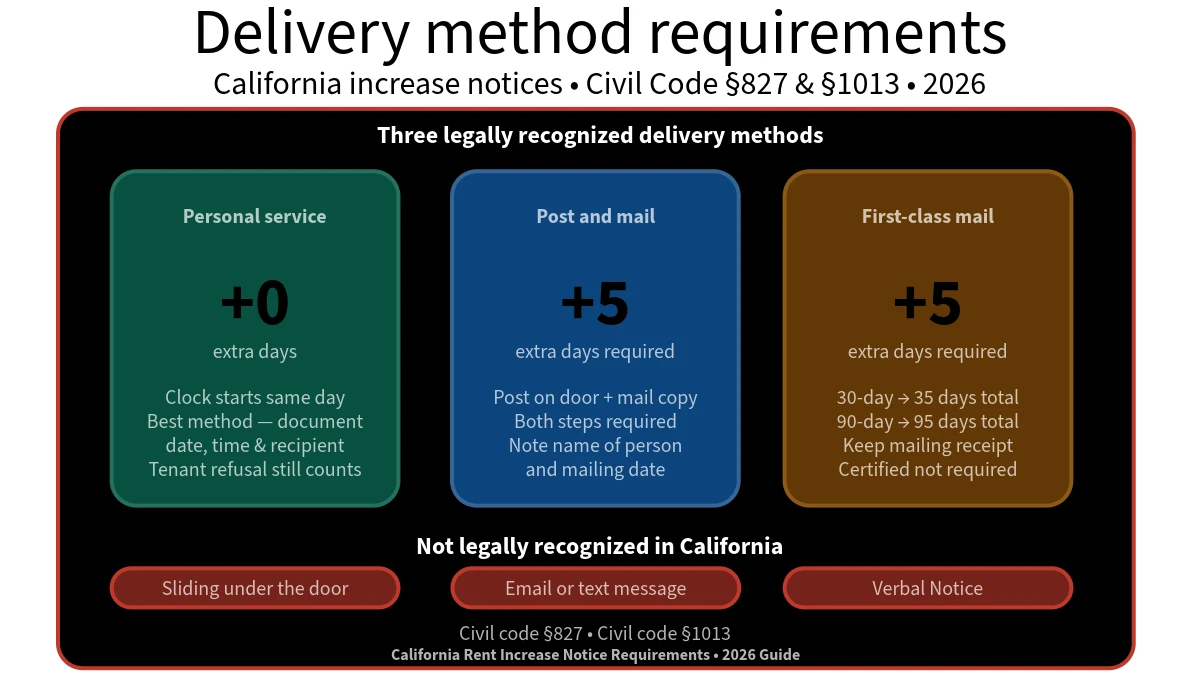
California law requires that rent increase notices be delivered in one of three legally recognized ways. Using the wrong method — or failing to document the method you used — can invalidate the entire notice.
1. Personal Service
Personally handing the notice directly to the tenant is the most reliable method. The clock starts immediately on the date of delivery. Note the date, time, and name of the person who received the notice. If the tenant refuses to accept it, document the attempt — it still counts.
2. Substituted Service (Post and Mail)
If the tenant is unavailable, you may leave the notice with a person of suitable age and discretion at the rental unit AND mail a copy to the tenant at the same address. Both steps are required. This method adds 5 calendar days to the notice period. Document the name of the person you left the notice with and the date you mailed the copy.
3. First-Class Mail
Mailing via first-class mail is permitted but adds 5 calendar days (CCP §1013). A 30-day notice becomes 35 days; a 90-day notice becomes 95 days. Certified mail is not legally required, but it creates a useful record. Keep a copy of the envelope and your mailing receipt.
What NOT to Do
- Do not slide the notice under the door alone — this is not legally recognized delivery in California.
- Do not send notice only by email or text — digital delivery does not satisfy the legal requirement unless your lease specifically provides for it and complies with state e-signature law.
- Do not use a verbal notice — rent increases must always be in writing.
- Do not assume the postmark date starts the clock — the +5 days applies from expected arrival, not drop-off.
📌 Pro Tip: Most notice errors happen at the delivery stage — not the calculation. If you’re managing multiple units, this is exactly where things tend to break down fast.
This is the part of the process we handle for clients — ensuring notices are delivered correctly, documented, and enforceable. Nothing falls through the cracks.
What Should a California Rent Increase Letter Include?
A compliant rent increase notice isn’t just about timing — the content of the letter matters too. A properly written notice should be professional, clear, and unambiguous. It does not need to apologize or over-explain, but it should never feel punitive or informal.
Your rent increase letter should include:
- The tenant’s full name and rental address
- The current rent amount
- The new rent amount (stated as an exact dollar figure — not a percentage)
- The effective date of the increase
- Your name and contact information
- Date the notice was prepared (for your records)
What to leave out:
- Vague language like “rent will be adjusted” — state the exact new amount
- Lengthy justifications or apologies — keep it businesslike
- Other notices combined in the same document (repair requests, lease violations — serve those separately)
- Any language that could be read as threatening or conditioned on the tenant’s behavior
⚠️ What Happens If You Get This Wrong?
Rent increase notices fail all the time — not because the increase is illegal, but because the notice was done incorrectly. Here’s what’s at stake:
| Risk | What It Means for You |
|---|---|
| Notice deemed legally invalid | You must restart the entire process from scratch — losing weeks or months of potential increased revenue. |
| Tenant grounds to challenge | A tenant who knows the law can simply refuse to pay the higher amount and force you to re-serve a corrected notice. |
| Retaliation claim exposure | Under Civil Code §1942.5, a landlord cannot increase rent within 180 days of a tenant’s protected activity (complaints to an agency, habitability notices, etc.). If the timing is bad, the law presumes retaliation — the burden shifts to you to prove otherwise. |
| Oakland RAP review triggered | An invalid notice for a rent-controlled property can trigger administrative review, formal hearings, and potential rollback of the increase. (Oakland RAP) |
| Unlawful detainer complications | If the tenant doesn’t pay and you proceed to eviction, a defective notice can undermine your entire unlawful detainer case. |
When NOT to Raise Rent
Knowing when not to raise rent is just as important as knowing how.
Maximizing rent revenue is a legitimate goal — but there are moments when the right strategic move is to hold the line. Consider waiting if:
- The unit has unresolved habitability issues or open repair requests — a rent increase in this context is legally and relationally hazardous, and risks triggering the 180-day retaliation presumption under Civil Code §1942.5
- The tenant has recently filed a complaint with a local housing authority or rent board
- You are in the middle of a lease renewal negotiation — bundling a rent increase into a renewal conversation creates leverage for the tenant
- The increase would push the tenant over the threshold that triggers relocation assistance obligations under AB 1482 or local law
- The local rental market is soft — a vacancy and turnover will cost more than a modest concession
- You have a long-term, low-maintenance tenant with a clean payment history — aggressive annual increases on reliable tenants accelerate voluntary turnover
The best landlords treat rent increases as a business decision, not an annual reflex. Understanding the full cost of turnover — lost rent during vacancy, leasing costs, unit preparation, and the risk of a less reliable replacement tenant — changes the calculus for many increases. risk of a less reliable replacement tenant — changes the calculus for many increases.
Managing a Multi-City Portfolio: Where Compliance Gets Complicated
The same rent increase that is perfectly legal in one city can be completely invalid in another — even within the same county.
If you own properties across multiple California cities, you are not managing one set of rules — you are managing several. Oakland and other cities with local rent ordinances each have their own notice periods, allowable increase calculations, exemption criteria, and procedural requirements.
The baseline state rules (Civil Code §827, AB 1482) apply to properties not covered by local ordinances. But for properties that are covered, local law governs — and local law is almost always stricter. Oakland, for example, requires landlords to include a RAP Notice with every rent increase notice, and as of 2025 requires a current Business Tax Certificate with certain notices. See our Oakland rent increase rules guide for the full breakdown. (Oakland RAP Program)
A notice that is valid for your Fresno property may be legally deficient for your Oakland property. Applying the same template across your portfolio without adjusting for local requirements is one of the most common — and most costly — compliance errors in California property management.
Common Mistakes in Notice Delivery
These are the errors we see most frequently:
| The Mistake | Why It’s a Problem |
|---|---|
| Using 30-day notice when 90 days is required | The entire notice is invalid if cumulative increases over the past 12 months exceed 10%. You must restart the timeline. (Civil Code §827) |
| Failing to add 5 days for mailed notices | A notice mailed with only 30 or 90 days before the effective date is legally short. (CCP §1013) |
| Not tracking cumulative increases over 12 months | A second increase that pushes the 12-month total over 10% requires 90 days’ notice — even if the first notice was correctly served with 30 days. |
| Sliding notice under the door | Not legally recognized as delivery. The clock never starts. |
| Using a state-law template for a rent-controlled city | Oakland requires a RAP Notice attachment, specific timelines, and in some cases board filing. State templates don’t include these. |
| Combining rent increase with other notices | Serving a notice to cure alongside a rent increase muddies both documents and increases retaliation claim risk. |
| Serving a notice within 180 days of a tenant complaint | Triggers a legal presumption of retaliation under Civil Code §1942.5. Burden shifts to the landlord. |
| No written record of delivery method | If the tenant disputes receipt and you have no documentation, your delivery date is effectively unprovable. |
Frequently Asked Questions
Can I give more notice than required?
Yes — you can always give more notice than the law requires. Some landlords provide 90 days even when 30 is sufficient, to reduce tenant friction and allow more planning time. There is no legal downside to additional notice.
Does the notice period change for a fixed-term lease?
Generally, you cannot raise rent during a fixed-term lease unless the lease explicitly allows it. The 30/90-day notice rules apply to month-to-month tenancies or upon lease renewal. Review your lease carefully before issuing any increase notice during a fixed term.
What if my tenant ignores the notice?
A properly served rent increase notice is legally binding whether or not the tenant acknowledges it. If the tenant continues paying the old amount after the effective date, the unpaid balance accumulates as a rent deficiency. Document everything — this record will be essential if you later need to pursue an unlawful detainer action.
Do I need to file the notice with any government agency?
For most properties subject only to state law, no filing is required. However, in Oakland, certain rent increases must be reported to the local Rent Adjustment Program (RAP). Failure to comply with local filing requirements is a separate compliance issue from proper tenant notice. See our Oakland rent increase rules guide for specifics.
What’s the difference between a rent increase notice and a notice to change terms of tenancy?
In California, a rent increase is technically a change in the terms of tenancy — and the required notice under Civil Code §827 covers both. The same 30/90-day timeline and delivery rules apply. A notice to change terms may address other lease provisions beyond rent, but the procedural requirements are the same.
Can I raise rent on a tenant I’m trying to move out?
This is legally sensitive territory. Issuing a rent increase to a tenant you simultaneously want to vacate — especially one who has complained about conditions or exercised a legal right — creates serious retaliation exposure under Civil Code §1942.5. The 180-day presumption window is long. Consult a property management professional or attorney before proceeding.
Does AB 1482 change the notice requirement?
AB 1482 caps the allowable rent increase for covered properties but does not change the notice period itself. The 30/90-day rules still apply. What AB 1482 changes is the maximum amount you can increase — and the paperwork requirements for exempt properties. For a full breakdown, see our AB 1482 coverage and exemptions breakdown.
What is the 180-day retaliation window?
Under Civil Code §1942.5, if you increase rent within 180 days of a tenant’s protected activity — including filing a habitability complaint with an agency, using the repair-and-deduct remedy, or participating in a tenant organization — the law presumes the increase is retaliatory. The burden shifts to you as the landlord to prove otherwise. This is not a hypothetical risk. Time your increases carefully.
Work With a Property Manager Who Gets This Right the First Time
We handle the entire rent increase process for our clients — from calculating the legally allowed increase to preparing compliant notices and confirming delivery.
No guesswork. No missed timelines. No invalid notices.
If you want to raise rent the right way — and avoid costly mistakes — let’s talk.
This Post Is Part of Our California Rent Increase Series
This is the final article in our four-part series on California rent increase law:
- Week 1 — California Rent Increase Laws: What Every Landlord Needs to Know (see our California rent increase laws guide)
- Week 2 — AB 1482: Who Is Covered, What the Caps Are, and How Exemptions Work (see our AB 1482 coverage and exemptions breakdown)
- Week 3 — Oakland Rent Increase Rules: RAP Filing, Local Caps, and What’s Changed (see our Oakland rent increase rules guide)
- Week 4 — California Rent Increase Notice Requirements (this article)
Each article links back to the others. We recommend bookmarking the cornerstone guide as your primary reference and returning to the Oakland guide whenever you’re preparing a notice for a rent-controlled property.
Related video: California Rent Increase Notice Requirements: The 30 vs. 90 Day Rules Explained
Key sources used in this article:
- California Civil Code §827 — Notice requirements (Justia)
- California Civil Code §827 — Notice requirements (FindLaw)
- California Code of Civil Procedure §1013 — Mailing rule
- California Civil Code §1942.5 — Retaliation prohibition
- California Attorney General — Tenant Rights: Rent Increases
- City of Oakland Rent Adjustment Program
