
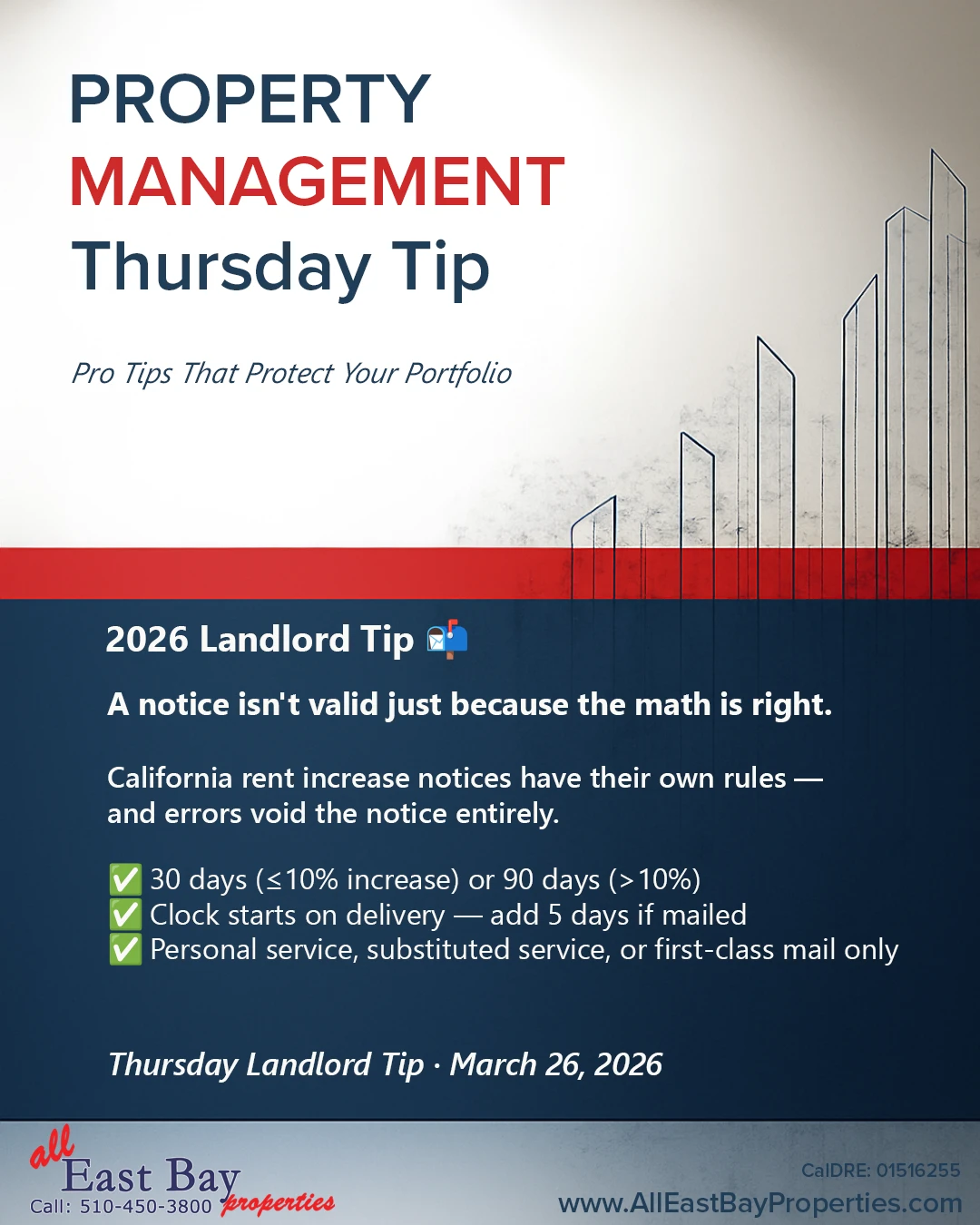
💡 Thursday Landlord Tip
Most California landlords spend time calculating whether their rent increase is within the legal cap. Fewer spend time checking whether the notice itself is valid — and that’s where the compliance exposure actually lives.
Under Civil Code §827, a rent increase notice has two separate requirements: the amount must be legal, and the notice must be properly served. Getting the dollar amount right doesn’t make a defective notice valid. The notice fails on its own terms — and you start over.
Why This Matters
California law gives landlords two notice windows based on the size of the cumulative increase over the past 12 months:
- 30 days — for increases of 10% or less
- 90 days — for any increase exceeding 10%
That threshold is cumulative, not per notice. Two increases of 6% in the same 12-month period add up to 12% — which requires 90 days’ notice, not 30. The 12 months run from the date of the last increase, not the calendar year.
And the notice period doesn’t start when you write the letter. It starts on the date of delivery. If you mail the notice, add 5 calendar days to either window — CCP §1013. A 30-day notice by mail requires 35 days. A 90-day notice by mail requires 95.
Where Risk Often Appears
Notice errors are the most common reason a legally permissible rent increase gets derailed. The amount is right. The timing is right. The notice fails anyway because of a procedural problem that could have been caught before service.
The most frequent issues we see:
- Wrong notice period. Using 30 days when 90 is required because the cumulative 12-month total exceeded 10%
- Mailing without adding 5 days. A notice mailed with exactly 30 or 90 days to the effective date is legally short
- Invalid delivery method. Sliding the notice under the door, sending it by email, or leaving a verbal message — none of these count as valid service under California law
- Serving within 180 days of a tenant complaint. Civil Code §1942.5 creates a legal presumption of retaliation if a rent increase is served within 180 days of a tenant exercising a protected right — including filing a habitability complaint. The burden shifts to the landlord to prove otherwise
- Using a state-law template for an Oakland property. Oakland requires a current Business Tax Certificate physically attached to every rent increase notice. A notice without it can be voided at a RAP hearing regardless of whether the math is correct
In each case, the result is the same: the notice is void, the increase cannot take effect, and the landlord must re-serve and wait out the full notice period again.
What Valid Service Actually Requires
California law recognizes three delivery methods for rent increase notices:
Personal service — Hand the notice directly to the tenant. The clock starts the same day. Document the date, time, and name of the person who received it.
Substituted service (post and mail) — Leave the notice with a responsible adult at the unit AND mail a copy to the same address. Both steps are required. Add 5 days.
First-class mail — Mail the notice to the tenant’s address. Add 5 days. Certified mail is not required but creates a useful record.
Sliding the notice under the door alone, sending by email, or giving verbal notice does not satisfy the legal requirement.
💡 This Week’s Takeaway
Before serving any rent increase notice, confirm three things:
- The correct notice period — 30 days (≤10% cumulative increase) or 90 days (>10% cumulative increase). Check the 12-month lookback from the date of your last increase.
- The correct effective date — Count forward from the date of delivery. Add 5 days if mailing.
- The correct delivery method — Personal service, substituted service, or first-class mail. Document which method you used and when.
Getting the math right is step one. Getting the notice right is what actually makes the increase enforceable.
📘 Learn More
This tip wraps up our March Rent Increases & Rent Control series, covering the full landscape of rules that govern East Bay landlords across Oakland, Berkeley, Richmond, and Emeryville.
For the complete breakdown — including the 30 vs. 90 day rules, all three delivery methods, the 180-day retaliation window under Civil Code §1942.5, and the most common mistakes that void a notice entirely — read:
👉 California Rent Increase Notice Requirements in 2026 (30 vs. 90 Day Rules Explained)
This tip is part of our ongoing education series for Bay Area landlords focused on compliance, risk reduction, and smarter property management. 📋 Browse all Thursday Landlord Tips →