
Share this post
Last updated August 2026 — reflects Oakland’s RAP allowable increase rising to 2.3% effective August 1, 2026.
In Short
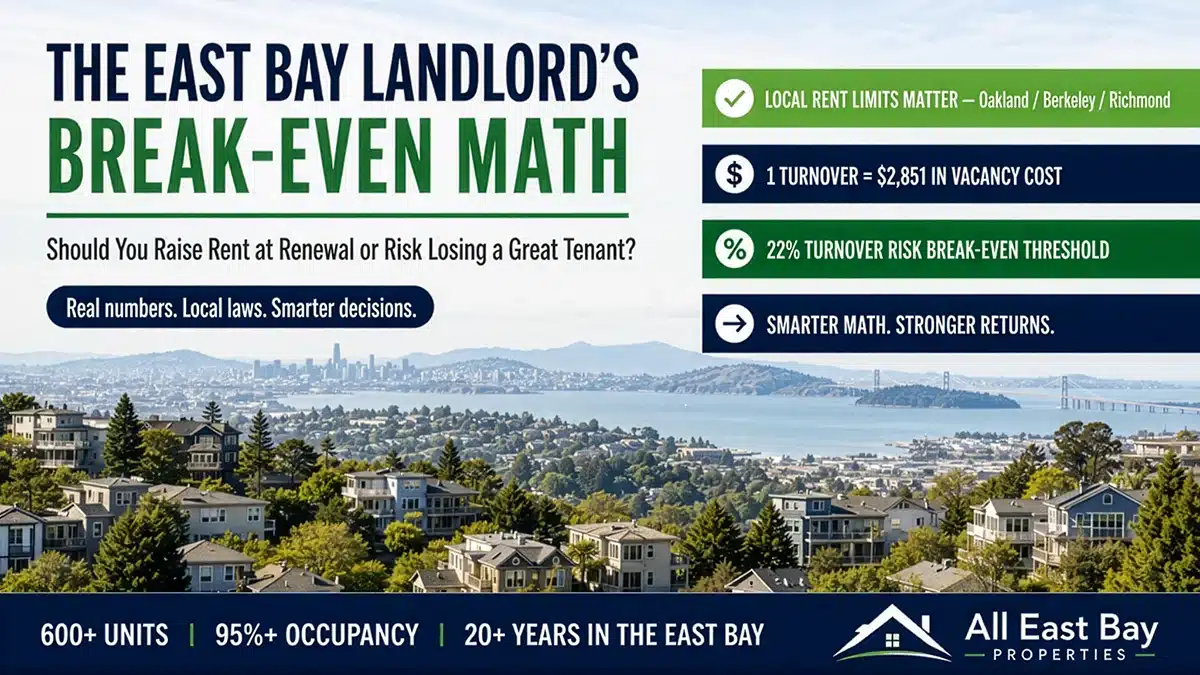
A rent increase you’re legally permitted to charge isn’t automatically worth charging. Where local rent-adjustment limits are small — Oakland’s RAP allows 2.3% for RAP-covered units in 2026–2027, Berkeley’s AGA holds at 1.0% for eligible fully covered units, Richmond’s is 1.5% for covered units — the dollar value of that increase is often smaller than what a single turnover costs in lost rent. Using AEBP’s own East Bay portfolio data, the average turnover’s vacancy-rent cost alone runs roughly $2,851 on a typical Oakland unit — about 4.6 years’ worth of the Oakland increase, or a roughly 22-percentage-point rise in turnover risk on an expected-value basis. That doesn’t mean you should never raise rent at renewal. It means the decision should be run as math, tenant by tenant, not applied as a default.
Key Facts — The Renewal Break-Even Math
| Figure | Value | Source |
|---|---|---|
| Oakland RAP — 2026–27 allowable annual increase, RAP-covered units | 2.3% | City of Oakland (required by local ordinance, covered units only) |
| Berkeley AGA — 2026, eligible fully covered units | 1.0% | Berkeley Rent Board (required by local ordinance, covered units only) |
| Richmond AGA — Sept 1, 2026–Aug 31, 2027, covered units | 1.5% | City of Richmond (required by local ordinance, covered units only) |
| AB 1482 — statewide rent-increase cap, covered units, Aug 1, 2026–Jul 31, 2027 | 8.8% | Civil Code §1947.12 — applies to units covered by the statute; statutory exemptions apply (required by law) |
| Average East Bay turnover cycle (AEBP portfolio, trailing 12 months) | 37.8 days | AEBP AppFolio vacancy data — 79 completed turnovers, Aug 2025–Jul 2026 (AEBP documented experience) |
| Average Oakland unit rent (AEBP portfolio) | $2,263/mo | AEBP AppFolio rent roll, 149 occupied Oakland units (AEBP documented experience) |
| Estimated vacancy-rent cost of one average turnover, Oakland unit | ~$2,851 | Calculated: 37.8 days × $75.42/day — vacancy rent only, before make-ready, repairs, or leasing costs |
| One year of Oakland’s 2.3% increase on that unit | $624 | Calculated |
| Time to recoup one turnover’s vacancy-rent cost at Oakland’s 2.3% increase | ~4.6 years | Calculated (cost-equivalence illustration) |
| Turnover-probability increase needed to break even (Oakland, expected value) | ~22 percentage points | Calculated: $624 ÷ $2,851 |
A note on the 37.8-day figure: this is different from the “25–30 days average to lease” figure we cite elsewhere on this site. That number measures how long a unit sits actively listed once it’s on the market. The 37.8-day figure measures the full cycle — move-out to move-in, including make-ready, repairs, and listing lag — because that’s the number that actually determines what a turnover costs, not just how fast a listing fills once it’s live. A note on coverage: not every unit in Oakland, Berkeley, or Richmond is covered by that city’s local rent-adjustment program. If a unit isn’t locally rent-controlled, determine separately whether it’s covered by AB 1482 or qualifies for a state-law exemption before calculating an allowable increase — exemption from one program never automatically establishes coverage under the other.
Video Transcript
Here’s a number worth knowing before you send your next renewal notice: on a typical Oakland rental, taking the full 2.3 percent rent increase gets you about 52 dollars a month. A single tenant turnover can wipe out more than four years of that gain. So when is a rent increase actually worth the risk of losing a good tenant? Let’s run the math — using our own portfolio data, not a guess.
First, the caps themselves. For the period running August 2026 through July 2027, Oakland’s Rent Adjustment Program allows a 2.3 percent increase on RAP-covered units. Berkeley’s Annual General Adjustment holds at 1 percent for eligible fully covered units this calendar year. Richmond’s is 1.5 percent starting in September. And the statewide cap under AB 1482 is 8.8 percent for covered units — but here’s the part landlords get wrong most often: if a unit isn’t covered by one of those local programs, that doesn’t automatically mean it falls under the state cap instead. AB 1482 has its own separate exemptions. You check local coverage and state coverage independently — never assume one gives you the other.
Now here’s why the size of that local number actually matters. On Oakland’s 2.3 percent, you’re gaining about 52 dollars a month, or 624 dollars a year. On Berkeley’s 1 percent, it’s closer to 23 dollars a month — under 300 dollars a year. Those are small numbers. And a turnover isn’t small.
We track every move-out and move-in across our own managed portfolio, and over the past 12 months, we completed 79 turnovers — averaging 37.8 days from move-out to move-in. Cleaning, repairs, photography, listing, showings, screening — the whole cycle, not just the days a listing sat active. On a typical Oakland unit renting around 2,263 dollars a month, that vacancy alone costs about 2,851 dollars — and that’s before counting make-ready repairs or a leasing fee.
Put those two numbers side by side: 624 dollars a year from the increase, against 2,851 dollars for one turnover. That’s about four and a half years of increases to equal one vacancy. That comparison shows you the scale of what’s at stake — but it’s not quite the right question, because a turnover isn’t guaranteed just because you raise the rent.
The sharper question is: how much does the increase actually need to raise your tenant’s odds of leaving before it stops being worth it? Run it as expected value: 624 dollars divided by 2,851 dollars is about 22 percent. That means the increase breaks even if taking it raises your tenant’s chance of leaving by roughly 22 percentage points — say, from a 5 percent baseline up to around 27 percent. If you think a modest, capped increase moves that needle from 5 to 10 percent, it’s an easy win. If you think it moves it from 5 to 35 percent — a genuinely upset tenant — the math flips the other way.
None of this means you should hold rent flat as a default either. There are real situations where pushing the full increase is still the right call: if a turnover is already likely for reasons that have nothing to do with the increase — say, a payment or compliance issue already in play — or if a lawful turnover is already underway, like a planned renovation or a tenant who’s already given notice. In those cases, the retention premium from holding rent flat is smaller, because you were probably losing that tenant anyway.
Here’s how we actually run this at renewal time. Before we recommend a number to an owner, we check three things: whether the unit is covered by a local rent program and which limit applies, the tenant’s payment and compliance history, and how the increase compares to what a turnover would realistically cost on that specific unit. On a rent-controlled property with a reliable tenant, that math usually favors taking the increase — a small number, taken consistently, still beats risking a 2,851-dollar vacancy to chase a slightly higher one later. But it’s a calculation we run property by property, not a policy we apply across the board.
If you want the full breakdown — the exact figures, the break-even formula you can run on your own unit, and when holding rent flat actually makes sense — the complete guide is linked below. We manage 600-plus units across Emeryville, Oakland, Berkeley, and Richmond, and this is the exact math we run every renewal season.
If this was useful, subscribe — we cover this every week. See you in the next one.
Why This Math Matters Most Where the Local Limit Is Small
AB 1482’s statewide rent-increase cap for covered units this cycle is 8.8% — big enough that, on a $2,263 unit, a full year of the increase ($199/mo, ~$2,390/yr) comes close to covering an average turnover on its own. Oakland, Berkeley, and Richmond each run their own local rent-adjustment programs, and where a unit is covered by one of those programs, the applicable limit is typically well below the statewide cap: Oakland’s RAP allows 2.3% for RAP-covered units in 2026–27, Berkeley’s AGA allows 1.0% for eligible fully covered units in 2026, and Richmond’s AGA allows 1.5% for covered units beginning September 2026. If a unit isn’t covered by the local program, the next question is whether AB 1482 applies — some locally exempt units are still covered by the state cap, while others may also qualify for their own AB 1482 exemption. Coverage under one program is never automatic just because a unit is exempt from the other; the two have to be checked independently.
On a 2.3% Oakland increase, you’re gaining about $52 a month. A single turnover wipes out more than four years of that gain before you’re ahead. On Berkeley’s 1.0% AGA, it’s worse: a full year of the increase is worth about $22.63 a month, or roughly $272 a year — a turnover costs closer to ten and a half years of that increase to recoup.
This isn’t an argument against raising rent where you’re legally permitted to. It’s a reason to check the math — and confirm which limit actually applies to your unit — before deciding how much of the allowed increase to actually push on a given renewal, especially on a rent-controlled unit where the ceiling is already low.
What a Turnover Actually Costs
Landlords tend to price a rent increase against the visible number — the extra $50 or $75 a month — without pricing the alternative against what happens if the increase costs them the tenant. Thursday Tip 7928 already covered the general shape of this: self-managing landlords typically underestimate vacancy duration because they track “days the listing was up,” not the full move-out-to-move-in cycle.
We can go a step further with our own numbers, since we track the full cycle across our managed portfolio as a matter of course. Over the trailing 12 months (August 2025–July 2026), AEBP completed 79 turnovers portfolio-wide, averaging 37.8 days from move-out to move-in — cleaning, repairs, photography, listing, showings, and screening, all included. At roughly $75/day in rent value on a typical Oakland unit, that’s about $2,851 in lost rent per turnover, before counting the extra cost of turnover-specific repairs, cleaning, or a leasing fee on the replacement tenant.
That’s the number a rent increase has to outrun to be worth the risk on a tenant who might leave over it.
The Real Break-Even Question: How Much Turnover Risk Does the Increase Need to Justify?
The comparison above — 4.6 years of increases to equal one turnover — is a useful way to see the size of the stakes, but a turnover isn’t guaranteed just because you raise the rent. The sharper question is how much the increase actually raises the odds your tenant leaves.
Run it as expected value instead: $624 (one year of Oakland’s 2.3% increase) ÷ $2,851 (the cost of one turnover) ≈ 21.9%. That means the increase breaks even, on a one-year expected-value basis, if taking it raises your tenant’s probability of leaving by roughly 22 percentage points — for example, from a 5% baseline chance of turnover to somewhere around 27%.
If you think a modest, capped increase moves that probability from 5% to 10%, the expected cost is a small fraction of $2,851, and the increase clearly wins. If you think it moves the probability from 5% to 35% — a genuinely upset, price-sensitive tenant — the math flips the other way. The 4.6-year comparison shows you what’s at stake; this calculation is the actual decision threshold.
This 22-percentage-point threshold uses vacancy loss alone — it doesn’t count make-ready, repairs, or a leasing fee. Adding those in would lower the threshold further, so the real break-even point is likely an even smaller probability shift than 22 points. Vacancy loss alone is a conservative floor for this calculation, not an inflated one.

When Raising the Rent Is Still the Right Call
None of this means holding rent flat is automatically correct either. The math above assumes a turnover actually happens — and the point of running it per-tenant is to weigh how likely that is, not to assume it. A few situations where pushing the increase is still the better call:
- A turnover is already reasonably likely for reasons unrelated to the proposed increase. If the tenancy already has significant payment or compliance issues, the increase may have little effect on the underlying probability of turnover — the retention premium from holding rent flat is smaller when a turnover was already likely.
- A lawful turnover is already underway for reasons independent of the rent increase. A planned renovation that requires the unit be vacant, a tenant who has already given notice, or another legally valid tenancy-ending event already in motion — the increase decision is secondary to a decision that’s already been made, not a way to manufacture one.
- The unit is meaningfully under market and the tenant has said they’re flexible. Not every tenant will leave over a modest, legally permitted increase — some expect it and stay regardless.
- You need the increase for cash flow, not to maximize return. Rising insurance, taxes, or a mortgage reset are real reasons to raise rent that this break-even framing doesn’t capture — the math above measures return-maximizing logic, not cash-flow-necessity logic.
Push the Increase vs. Hold the Rent: A Quick Comparison
| Push the Full Allowable Increase | Hold Flat (or Increase Partially) | |
|---|---|---|
| Immediate gain | Full permitted increase (2.3% Oakland / 1.0% Berkeley / 1.5% Richmond, for covered units) | None, or a smaller partial increase |
| Risk | Tenant leaves; turnover cost likely exceeds 1+ years of the increase | Tenant stays; opportunity cost is the increase not taken |
| Best fit | Turnover is already likely for other reasons, or a lawful turnover is already underway | Reliable tenant, low turnover risk, small local limit |
| What it doesn’t account for | Whether you need the cash flow now | Whether the unit is significantly under market, or whether the foregone increase can be banked |
A note on banking: in jurisdictions that permit it — including Oakland and Richmond — some or all of an increase you don’t take this year may be preserved for a future year, subject to that city’s banking rules and documentation requirements. Holding below the maximum isn’t necessarily the same as forfeiting it permanently. See our AB 1482 rent cap guide for jurisdiction-specific banking rules.
How AEBP Approaches This at Renewal
We don’t skip rent increases as a default any more than we push them as a default — both are guesses without the numbers behind them. What we actually do every renewal season is check three things before recommending an amount to an owner: whether the unit is covered by a local rent-adjustment program and which limit actually applies, the tenant’s payment and compliance history, and how the increase compares to what a turnover would realistically cost on that specific unit. On a rent-controlled property with a reliable tenant, that math usually favors a modest or full increase within the applicable limit rather than risking a turnover to chase a slightly higher number later — but it’s a calculation we run per property, not a policy we apply across the board.
Frequently Asked Questions About Rent Increases at Renewal
Is it ever worth not raising rent at renewal in California?
Yes, situationally. Where the applicable local limit is small (Oakland’s 2.3%, Berkeley’s 1.0%, Richmond’s 1.5%, all for covered units), the annual dollar value of the increase can be worth less than a single turnover costs in lost rent — particularly with a reliable, long-term tenant. This isn’t a legal requirement to hold rent flat; it’s a financial calculation worth running before deciding how much of the permitted increase to actually take.
How much does a rental turnover actually cost, beyond the vacancy days?
Lost rent during the vacancy is the largest and most measurable piece, but a full turnover also typically includes make-ready cleaning and repairs, photography, and — if a third party is involved — a leasing or placement fee. The vacancy-days figure alone (used in the math above) is a conservative floor, not the full cost.
What’s the maximum I can raise rent at renewal in Oakland, Berkeley, or Richmond right now?
It depends on whether the unit is covered by that city’s local rent-adjustment program. For covered units: Oakland’s RAP allows 2.3% for the period running August 1, 2026 through July 31, 2027. Berkeley’s AGA allows 1.0% for eligible fully covered units in calendar year 2026. Richmond’s AGA allows 1.5% for covered units for the period running September 1, 2026 through August 31, 2027. A unit not covered by the local program isn’t automatically subject to the statewide AB 1482 cap either — Civil Code §1947.12 has its own separate exemptions (including some newer construction and certain single-family homes and condos meeting specific ownership and notice requirements). Determine local coverage and AB 1482 coverage independently rather than assuming one follows from the other. See our full lease renewal guide for the complete jurisdiction breakdown.
How do I calculate my own break-even point on a rent increase?
Two ways. The simple version: divide your realistic turnover cost (days vacant ÷ 30, times monthly rent, plus make-ready and leasing costs) by the monthly dollar value of the increase — that tells you how many months of the increase it takes to equal one turnover. The sharper version: divide one year of the increase’s dollar value by the turnover cost — that percentage is how much the increase would need to raise your tenant’s odds of leaving before it stops being worth it on an expected-value basis.
Can I raise rent by less than the maximum, or do I have to use the full increase or nothing?
You can raise rent by any amount up to the applicable limit, including a partial increase or none at all — the figure is a ceiling, not a required amount. A partial increase is a reasonable middle path when the full increase’s turnover risk doesn’t clearly outweigh the gain, and in jurisdictions that allow banking, part of what you don’t take now may be available later.
Sources
- City of Oakland — Rent Adjustment Program (RAP), coverage rules
- City of Oakland — Allowable Rent Increases
- Berkeley Rent Board — 2026 AGA Published
- City of Richmond — Rent Increase / Rent Program
- Civil Code §1947.12 — AB 1482 rent-cap formula
- AEBP AppFolio vacancy and rent-roll data, trailing 12 months (Aug 2025–Jul 2026) — internal, AEBP documented experience
Not sure whether this renewal is worth the risk?
We check the local coverage and limit, the tenant’s history, and the real turnover cost before recommending a number — not after a vacancy shows us the answer the hard way.
We manage 600+ units across Emeryville, Oakland, Berkeley, and Richmond — this is the calculation we run every renewal season.
Related Articles: