
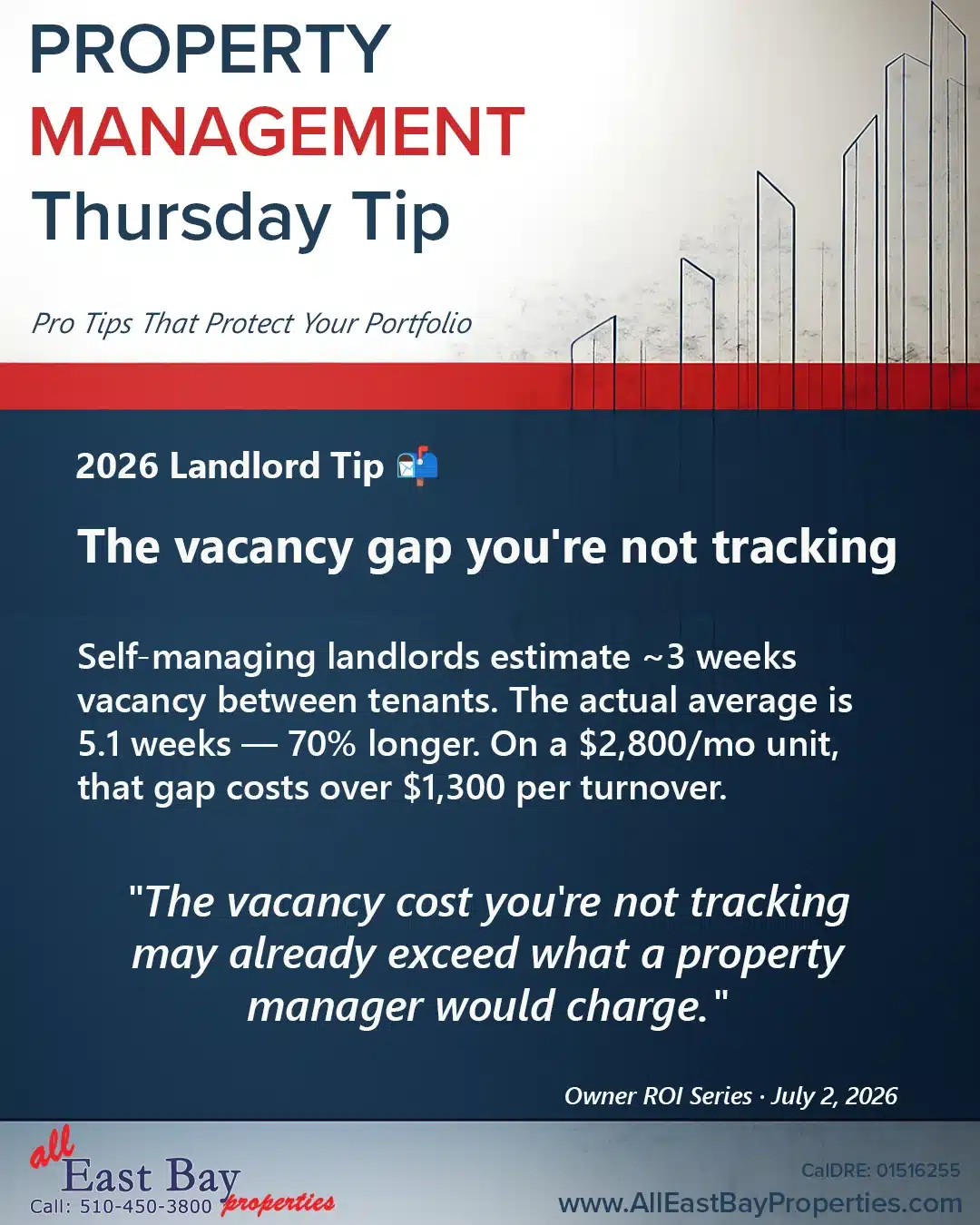
💡 The Vacancy Gap Most Self-Managing Landlords Don’t See Coming
Ask a self-managing landlord how long their unit typically sits vacant between tenants. Most will say two to three weeks. That’s the number they remember — because it’s the time the unit was actively listed.
The data says otherwise. In the PM Trends Report 2026, owners surveyed (Harris Poll, n=500) estimated their typical vacancy at about 3 weeks. But ShowMojo’s 2025 platform data puts the national median time on market at 5.1 weeks, and that’s just the listing period. Add the days before the listing goes up, and the full gap between move-out and move-in is longer still. That gap has a dollar value, and it rarely shows up anywhere on an invoice.
What We See at AEBP
When landlords come to us after years of self-managing, the vacancy conversation is almost always revealing. Most owners track the days their listing was live — not the days between move-out and move-in. Those are different numbers.
The gap between them is where the income disappears: the unit sat empty for three days before the listing went up. The photos weren’t professional, so showings were slow to book. An inquiry came in on a Friday and didn’t get a response until Monday. Screening took an extra week without a system in place.
None of these feel like big mistakes in the moment. But by the end of a turnover, two or three extra weeks of vacancy have quietly accumulated — and the landlord’s mental model of “about three weeks” is never updated, because the real number was never tracked.
Run the Math on Your Last Turnover
You don’t need to take the industry average as your number — calculate your own:
- Monthly rent ÷ 4.3 = weekly rent value
- Your actual vacancy weeks − 3 = avoidable gap
- Avoidable gap × weekly rent value = recoverable income per turnover
| Monthly Rent | Weekly Value | Extra 2 Weeks | Extra 3 Weeks |
|---|---|---|---|
| $2,200 | $512 | $1,023 | $1,535 |
| $2,800 | $651 | $1,302 | $1,953 |
| $3,200 | $744 | $1,488 | $2,233 |
| $3,800 | $884 | $1,767 | $2,651 |
That figure compounds across every turnover. Two turnovers a year at $1,300+ each can exceed the annual cost of professional management on many units — without ever appearing on any statement.
What Drives the Gap
The vacancy gap isn’t usually caused by one big mistake. It’s the accumulation of small delays at every stage of turnover:
- Delayed listing: Cleaning, repairs, and photography are queued after move-out instead of coordinated in advance
- Non-professional photos: Listings with phone photos generate fewer showing requests and sit longer
- Slow inquiry response: A prospect who doesn’t hear back within a few hours often moves on to the next listing
- Screening without a system: Ad hoc screening adds days and increases the risk of a placement that doesn’t work out
A professional property manager addresses all four with systems already in place before move-out begins: pre-leasing inspection, professional photography scheduled at notice, same-day inquiry response, and a structured screening process with consistent criteria.
💡 This week’s takeaway
The vacancy cost you’re not tracking may already exceed what a property manager would charge.
Most landlords calculate their management cost in fees. The real comparison includes vacancy days, after-hours vendor premiums, and compliance time — costs that don’t show up on any invoice, but show up in your annual return. Before deciding whether a property manager is “worth it,” run your actual vacancy number. The answer is often already in the math.
📘 Learn more
→ Is a Property Manager Worth It? The Real Math for East Bay Landlords — full cost comparison with fee breakdown, vacancy math, and compliance risk
→ East Bay Property Management Fees: What You Pay, What You Get — AEBP’s complete fee structure
This tip is part of our ongoing education series for Bay Area landlords focused on compliance, risk reduction, and smarter property management. 📋 Browse all Thursday Landlord Tips →