
Share this post
In short: A California rental move-out has three stages. First, offer the tenant a pre-move-out inspection in writing before they leave. Second, photograph the unit after they vacate and before any cleaning or repairs. Third, send an itemized statement and the remaining deposit within 21 days of the day they move out. The checklist below covers every step, plus the extra Oakland and Berkeley requirements.
Jump to the step-by-step move-out checklist ↓ · Download this guide as a printable PDF
What Changed for California Landlords Recently?
Three law changes have made the California move-out process more document-intensive than it was even two years ago:
- AB 2801 (effective April and July 2025) now requires move-in and move-out photos for security deposits — without them, legitimate damage claims become unenforceable
- AB 12 (effective July 1, 2024) changed deposit limits — most landlords are now capped at one month’s rent with no exceptions for pets or furnished units
- Courts and RAP panels are scrutinizing itemized statements more carefully — vague line items like “cleaning and repairs — $800” are being rejected in Oakland and Berkeley hearings with increasing frequency
- Berkeley enforcement of the annual deposit interest requirement continues to increase, and we are seeing it raised more often in tenant petitions
If your move-out process hasn’t been updated since 2023, some part of it is out of compliance.
Key Facts: California Move-Out at a Glance
| Step | What the Law Requires |
|---|---|
| Pre-move-out inspection | Must be offered within a reasonable time before tenant vacates — skipping it may eliminate certain deduction rights (Civil Code §1950.5(f)) |
| AB 2801 move-in photos | Required before tenant takes possession — effective July 1, 2025, for new tenancies (AB 2801) |
| AB 2801 move-out photos | Required after tenant vacates and before any cleaning or repairs, then again after repairs you deduct for — effective April 1, 2025 |
| 21-day deposit deadline | Clock starts the day tenant vacates — not the lease end date (Civil Code §1950.5(g)) |
| Itemized statement | Required for any deduction; receipts required for items over $125 |
| Normal wear & tear | Never deductible — always the landlord’s cost of doing business |
| Bad faith penalty | Up to 2× the wrongfully withheld amount, plus potential additional court costs (Civil Code §1950.5(l)) |
| Oakland RAP | Rent-controlled unit deposit disputes may be filed with the Rent Adjustment Program in addition to small claims |
| Berkeley interest | Landlords must pay annual interest on deposits held — rate set by Berkeley Rent Board |
Prefer video? Watch the 6-minute video version, with chapter links and a full transcript.
videoid=”MPuSLyHiM80″ title=”California Tenant Move-Out Checklist 2026: What Landlords Must Do (And What It Costs to Skip a Step)”]Video Transcript
If you own a rental property in Oakland, Berkeley, or anywhere in the East Bay, the moment a tenant gives notice to vacate is the moment your financial risk spikes.
Not because move-outs are complicated — but because California law requires a specific sequence of steps. Skip one, or do them in the wrong order, and you can lose deposit deductions you were otherwise entitled to make.
In this video I’m going to walk you through the complete 2026 move-out process — all four stages — and then the seven mistakes we see landlords make most often. There’s a full written checklist linked in the description. This video covers the same ground, but hearing it once before you do it makes a difference. Let’s get into it.
Most landlords don’t know this step exists. That’s why it’s the one that generates the most disputes.
Under California Civil Code Section 1950.5(f), once a tenant gives you notice to vacate — or once you issue a termination notice — you are legally required to offer the tenant a pre-move-out inspection. That offer has to be in writing. The inspection itself requires at least 48 hours written notice. And it has to happen within the final two weeks of the tenancy.
Here’s what the inspection does: you walk the unit, identify anything beyond normal wear and tear that would result in a deposit deduction, and give the tenant a written itemized list. The tenant then has the opportunity to fix those things before they leave. If they fix it — you can’t deduct for it. If they don’t — you can.
And here’s the part that matters most: if you don’t offer the inspection at all, you may lose the right to deduct for those items entirely. Even if the damage is real. The tenant was legally entitled to the chance to fix it first — and you didn’t give them that chance.
One email. That’s all it takes to make the offer. We send it the day notice is received, every time, for every property we manage.
If the tenant declines or doesn’t respond — document that, and your deduction rights are preserved.
AB 2801 is the law change most landlords haven’t fully caught up with. It went into effect in stages — move-out and post-repair photos starting April 1, 2025, and move-in photos for tenancies beginning on or after July 1, 2025.
Before the tenant moves in — before they receive keys — you must photograph the unit’s condition. Not the day after move-in. Before.
After the tenant vacates — before you return the deposit or send the statement, and before anyone enters to clean — you must photograph the unit again.
Both sets of photos are required. And here’s why the move-in photos matter just as much as the move-out photos: move-out photos alone don’t prove anything. If you can’t show what the unit looked like when the tenant moved in, you can’t prove the damage wasn’t already there. A fifteen hundred dollar claim becomes zero recovery.
We’ve onboarded clients who had entirely legitimate damage claims they couldn’t pursue — because they had no compliant move-in photos. The law is clear.
Timestamps matter. Cloud storage or property management software, organized by unit and date. Producible if a dispute arises.
This is the mistake that surprises landlords the most, because it’s a calculation error.
California Civil Code Section 1950.5(g) gives you 21 calendar days to return the deposit. The key word is vacates. Not the last day of the lease. Not the day you receive the keys back. Not the day you finish inspecting the unit. The day the tenant surrenders possession — that’s day one.
Example: tenant moves out June 15th, lease runs to June 30th. Your deposit deadline is July 6th. Not July 21st.
We put the actual vacancy date in our system the moment keys are returned and the reminder goes out at day 14. If you self-manage, put it in your phone right then.
What has to go out within 21 days: either the full deposit, or an itemized statement listing every deduction on its own line — with specific dollar amounts and receipts. A summary line that says “cleaning and repairs — 800 dollars” does not satisfy the requirement.
If work is in progress, send an estimated statement with final costs pending.
Miss the deadline entirely and a court can rule you forfeit all deductions. If they find bad faith — you can be ordered to pay the tenant up to two times the amount.
State law sets the floor.
Oakland: deposit disputes for rent-controlled units can be filed with the Oakland Rent Adjustment Program — the RAP — in addition to or instead of small claims court.
Berkeley: Berkeley requires landlords to pay annual interest on security deposits. The rate is set by the Berkeley Rent Board and updated periodically. This is small in dollar terms. We have seen it used at Rent Board hearings to undermine landlord credibility. Calculate what you owe and include it when you send the deposit accounting.
Let me run through the seven patterns we see most often — both in self-management and in the disputes we track through RAP and Berkeley Rent Board hearings.
One. Using the lease end date instead of the actual vacancy date.
Two. Failing to offer the pre-move-out inspection. Skipping it has cost landlords thousands.
Three. Taking photos after repairs or cleaning begin.
Four. Charging for normal wear and tear — like faded paint or worn carpet. These are the landlord’s cost of business.
Five. Vague itemized statements.
Six. Missing the Berkeley annual interest.
Seven. Losing receipts for deductions over one hundred twenty-five dollars.
The move-out process isn’t complicated — but it has more required steps than most realized. The requirements changed in 2024 and 2025.
If you’re managing your own East Bay rentals, the full checklist is in the description. If you’d rather not run this process yourself, this is exactly what we do. Free consultation link is also in the description.
See you in the next one.
What California Landlords Must Do When a Tenant Moves Out
California landlords must follow a specific legal sequence when a tenant vacates: offer a pre-move-out inspection under Civil Code §1950.5(f), document unit condition with AB 2801-compliant photos, return the security deposit or send a compliant itemized statement within 21 calendar days, and provide receipts for any deduction over $125. Failing to complete any of these steps in the right order can eliminate otherwise valid deduction claims and expose landlords to financial penalties.
Peak rental turnover season in the Bay Area runs June through August. That means right now, thousands of East Bay landlords are managing move-outs, processing deposit claims, and preparing units for new tenants — and the most expensive mistakes of the year tend to happen in this window.
Not because landlords are acting in bad faith. Because this process has more legal requirements than most self-managing landlords realize, and the requirements changed in 2024 and 2025.
Stage 1: The Pre-Move-Out Inspection

Definition
A pre-move-out inspection is a legally required walkthrough offered before the tenancy ends that gives tenants an opportunity to correct issues — before deductions are taken from the security deposit.
California Civil Code §1950.5(f) requires landlords to offer this inspection “within a reasonable time” after receiving a notice to vacate — generally interpreted as sometime during the final two weeks of the tenancy, while the tenant is still in possession of the unit.
What Happens During the Inspection
You walk the unit with the tenant (or they can waive their right to be present) and provide a written itemized statement identifying conditions that, if not corrected before move-out, will result in deductions. The tenant then has the opportunity to fix those items themselves before they leave.
The written statement you provide does not cap your move-out deductions — if additional damage is discovered after the tenant vacates, that’s a separate matter. But you may not later deduct for items that appeared on the pre-move-out list and that the tenant subsequently corrected.
The Consequence of Skipping It
A landlord who fails to offer the pre-move-out inspection may lose the ability to deduct for issues that could reasonably have been identified during the walkthrough. This is not a minor technicality. Tenants who know the system raise this regularly in Oakland RAP hearings and Berkeley Rent Board petitions.
From our practice at AEBP: The pre-move-out inspection is where landlords lose the most money they didn’t have to lose. In 20 years of managing Oakland and Berkeley properties, this is the single most commonly skipped step by self-managing landlords — and the one that generates the most deposit disputes. It takes an hour. It is worth doing.
What If the Tenant Refuses?
Document the offer in writing — email works — and their refusal or non-response. If the tenant waives the inspection or declines to schedule one, your ability to make deductions is preserved. The legal obligation is to offer the inspection, not to force the tenant to participate.
Stage 2: The Move-Out Inspection and AB 2801 Documentation

Conducting the Move-Out Walkthrough
Once the tenant vacates, conduct your move-out inspection immediately. Document the condition of walls, flooring, appliances, fixtures, windows, and any tenant alterations. Compare everything against your move-in documentation.
This inspection is the evidentiary foundation for any deductions you plan to make.
AB 2801: What Changed and When
AB 2801 is the law change most landlords haven’t fully caught up with. It went into effect in stages:
- Move-in photos required: July 1, 2025 (tenancies beginning on or after that date) — landlords must photograph unit condition before the tenant takes possession (before keys are handed over)
- Move-out photos required: April 1, 2025 — landlords must photograph unit condition after the tenant vacates and before any cleaning or repairs, then again after any repairs or cleaning they deduct for
For any rental agreement entered into on or after January 1, 2026, both requirements apply in full.
Why the Move-In Photos Are Just as Critical
This is the piece most landlords miss: move-out photos alone don’t prove anything. Without move-in photos establishing the unit’s baseline condition, a $1,500 carpet replacement claim becomes unenforceable — because you can’t demonstrate the damage wasn’t pre-existing.
We have onboarded clients at AEBP who had entirely legitimate damage claims they couldn’t pursue because they had no compliant move-in photos. The law is clear: if you can’t document what the unit looked like before the tenant moved in, you cannot prove the damage wasn’t already there.
Storage: AB 2801 doesn’t specify file format. Timestamped photos organized by unit and date — in cloud storage or property management software — are best practice. They need to be retrievable and producible if a dispute arises.
Normal Wear and Tear vs. Damage: A Quick Reference
| Item | Wear & Tear — Not Deductible | Damage — Deductible |
|---|---|---|
| Carpet | Worn, matted, or faded after several years | Burns, stains, pet damage, tears |
| Paint | Faded, minor scuffs, small picture-hook holes | Large holes, unauthorized colors, excessive marks |
| Walls | Small nail holes from pictures | Large holes, deep gouges, water damage from tenant negligence |
| Appliances | Normal use wear over time | Broken parts from misuse or abuse |
| Cleaning | Reasonable dust and light dirt | Excessive filth requiring professional remediation |
| Blinds | Fading from sunlight over time | Broken slats, bent mechanisms from mishandling |
The useful life rule: California courts apply a useful-life standard to cosmetic items. Interior paint is generally considered to have a two-year life. If a tenant lived in a unit for four years and the paint is faded, repainting is wear and tear — not a deductible damage claim. The longer the tenancy, the harder it generally becomes to deduct for cosmetic items.
For the complete breakdown, see our standalone reference: California Security Deposit Deductions: What Landlords Can (and Cannot) Charge →
Stage 3: The 21-Day Deposit Return Deadline

When the Clock Starts — and Why Landlords Get This Wrong
An itemized statement is a written document listing each deduction separately, with the specific dollar amount per item, receipts for any deduction over $125, and the remaining deposit balance. A handwritten note listing totals does not satisfy the requirement.
Civil Code §1950.5(g) is unambiguous: the 21 days run from the date the tenant vacates — not the last day of the lease, not the day you receive keys, not the day you complete repairs.
Example: Tenant surrenders possession June 15. Lease end date is June 30. The 21-day deadline runs from June 15 — making the deposit deadline July 6, not July 21.
We track this date automatically in AppFolio for every property we manage and send an internal reminder at day 14. For self-managing landlords: put the actual move-out date in your phone the moment the keys are returned. Not the lease end date.
What Must Be Sent
Within 21 calendar days (weekends count — California Civil Code specifies calendar days):
- The full deposit with no deductions, OR
- An itemized written statement listing each deduction on its own line, with the specific dollar amount, plus receipts for any item over $125, plus the remaining balance
The Contractor Exception
If repair work is actively underway and you don’t have final invoices within 21 days, you may send an estimated itemized statement within 21 days with a written notation that final costs are pending, then provide the final itemized statement within 14 days of receiving the last invoice. This exception exists for work that is genuinely underway — it is not a license to delay beginning repairs.
Consequences of Missing the Deadline
A court can rule that you forfeit the right to any deductions and must return the full deposit. If the court additionally finds bad faith — that you withheld the deposit without legitimate basis — you can be ordered to pay the tenant up to 2× the wrongfully withheld amount, plus potential additional court costs and fees depending on the claims involved.
Simple lateness may cost you your deductions. A bad faith finding means paying the tenant more than the deposit was ever worth.
Oakland and Berkeley: What Goes Beyond State Law
Oakland (Rent Adjustment Program)
The state 21-day deadline applies. For rent-controlled units, a tenant who believes a deposit was wrongfully withheld can file a RAP petition in addition to — or instead of — small claims court. The RAP process is lower-friction than litigation, and tenants who know it use it regularly. Complete documentation is your best defense in either forum.
Berkeley (Rent Stabilization Board)
The 21-day deadline applies identically. What’s different: Berkeley requires landlords to pay annual interest on security deposits held for Berkeley rental units. The rate is set by the Berkeley Rent Stabilization Board and updated periodically — confirm the current rate before each move-out accounting.
This requirement is modest in dollar terms but consequential in disputes. We have watched it used consistently at Rent Board hearings to undermine otherwise valid landlord positions — even when the underlying deduction claims were legitimate. Berkeley landlords who miss it are handing tenants a credibility argument they didn’t need to give them.
Calculate what you owe, and include it when you send the deposit accounting.
The 7 Most Common California Move-Out Mistakes

This section covers the failure patterns we see most frequently — both in properties coming to AEBP from self-management and in the disputes we track through Oakland RAP and Berkeley Rent Board hearings.
1. Using the lease end date instead of the actual vacancy date The 21-day clock starts when the tenant vacates — not when the lease ends. If a tenant leaves early, the deadline is earlier than you expect. If their lease ends the 30th but they hand back keys on the 15th, you have until the 5th of the following month, not the 20th.
2. Failing to offer the pre-move-out inspection Not offering it may eliminate your ability to deduct for issues that could have been identified in a walkthrough. The offer takes one email. Skipping it has cost landlords thousands.
3. Taking photos after repairs begin AB 2801 requires move-out photos before the deposit is returned or the itemized statement is sent — meaning before cleaning crews or contractors enter. Photos taken after the unit is partially cleaned or repaired don’t satisfy the requirement and may not support your damage claims.
4. Charging for normal wear and tear Faded paint after a four-year tenancy. A worn carpet path after five years. These are the landlord’s cost of doing business. Charging for them doesn’t just lose disputes — it can support a bad faith finding.
5. Sending vague itemized statements “Cleaning and repairs — $800” is not a compliant itemized statement. Every deduction needs its own line item with a specific dollar amount. Oakland RAP and Berkeley Rent Board panels reject vague statements regularly.
6. Missing the Berkeley deposit interest requirement Annual interest on deposits is owed to Berkeley tenants by law. It’s small per unit. But we’ve watched this single omission undermine otherwise valid landlord positions in Rent Board hearings more times than we can count.
7. Losing track of receipts for items over $125 Any deduction over $125 requires a receipt or invoice. Without one, the deduction is unsupported. This is one of the simplest requirements and one of the most commonly missed in DIY move-outs.
Bottom Line for California Landlords
If you remember only four things from this checklist:
- Offer the pre-move-out inspection — in writing, while the tenant is still in possession
- Take AB 2801 photos — at move-in before keys are handed over, and at move-out before anything is touched
- Track the actual vacancy date — that’s when the 21-day clock starts
- Send a compliant itemized statement — each deduction on its own line, with receipts for anything over $125
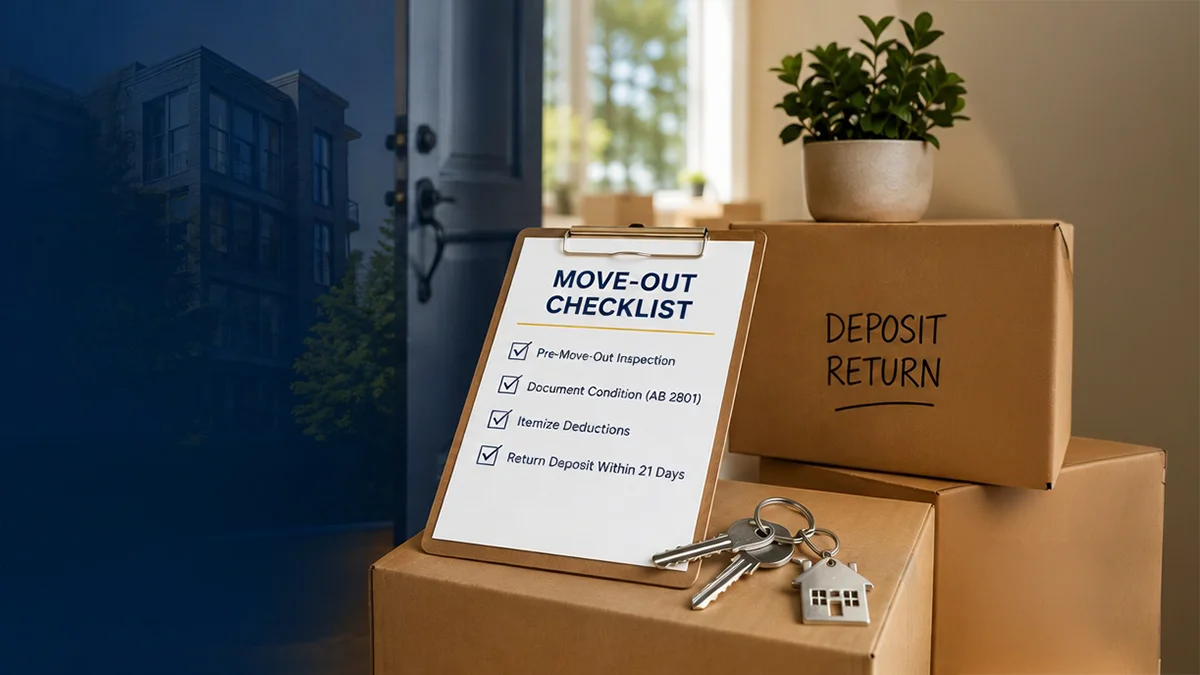
The Complete Move-Out Checklist
Before the Tenant Leaves
- Offer pre-move-out inspection in writing after receiving notice to vacate
- Schedule and conduct the pre-move-out walkthrough (tenant may waive)
- Provide written itemized list of conditions that need correction
- Document the tenant’s response and whether they made corrections
Move-Out Day
- Record the actual move-out date — this starts the 21-day clock
- Collect all keys, fobs, and garage remotes
- Take AB 2801-compliant timestamped photos before anyone enters to clean or repair
- Conduct the full move-out inspection and compare against move-in documentation
- Note every deficiency in writing with photo references
Within 21 Calendar Days of Move-Out
- Compile itemized statement — each deduction on its own line with dollar amount
- Collect receipts for all deductions over $125
- Send itemized statement plus remaining balance (or full deposit if no deductions)
- If work is still in progress: send estimated statement with pending-invoice notation
- Berkeley properties: Calculate and include annual deposit interest owed
For Your Records
- Move-in photos (timestamped, organized by unit)
- Move-out photos (timestamped, taken before any cleaning or repair)
- Signed pre-move-out inspection statement or documentation of offer and waiver
- Copy of itemized statement with proof of delivery
- All contractor invoices and receipts
Current rule at a glance
Frequently Asked Questions
What is a pre-move-out inspection?
A pre-move-out inspection is a legally required walkthrough offered before the tenancy ends, giving the tenant an opportunity to correct issues before deductions are taken from the security deposit. It is governed by Civil Code §1950.5(f) and must be offered within a reasonable time before the tenant vacates.
What is a compliant itemized statement?
An itemized statement is a written document listing each deposit deduction separately, with the specific dollar amount per item, receipts for any deduction over $125, and the remaining deposit balance after all deductions. It must be sent within 21 calendar days of the tenant vacating.
What is bad faith withholding of a security deposit?
Bad faith withholding occurs when a landlord withholds a security deposit — or portion of one — without a legitimate legal basis. If a court makes this finding, the landlord can be ordered to pay up to 2× the wrongfully withheld amount, plus potential additional court costs depending on the claims involved.
Can I keep the full deposit if a tenant breaks the lease early?
Not automatically. You can apply the deposit toward unpaid rent and documented damage costs. But California requires landlords to mitigate damages by making reasonable efforts to re-rent the unit promptly. You can only recover actual losses — not a windfall because the tenant left early.
What if I can’t complete repairs within 21 days?
Send an estimated itemized statement within 21 days with written notation that final costs are pending. Provide the final itemized statement within 14 days of receiving the last contractor invoice. This applies when work is genuinely underway — not as a reason to delay starting it.
Does the 21-day clock include weekends?
Yes. Civil Code §1950.5 specifies calendar days, not business days.
What is the maximum security deposit I can charge in 2026?
Under AB 12 (effective July 1, 2024), most landlords are capped at one month’s rent — with no additional amount permitted for pets, furnished units, or any other reason. A small-landlord exception permits up to two months’ rent for natural persons or all-natural-person LLCs owning no more than two properties with no more than four units total, and not if the tenant is a service member. See our AB 12 guide for full details.
What if the tenant disputes my deductions?
They can file in small claims court (limit: $12,500 for individuals in California) or, for rent-controlled units in Oakland or Berkeley, file a RAP or Rent Board petition. Your best defense is complete documentation: move-in photos, move-out photos, pre-move-out inspection record, itemized receipts — all timestamped and organized. See our California Security Deposit Deductions guide for what landlords need to know about the dispute process.
Laws and Resources Referenced
- California Civil Code §1950.5 — Security deposit return, pre-move-out inspection, itemized statement requirements, bad faith penalty
- AB 2801 — Security Deposit Photo Documentation — Move-in and move-out photo requirements
- AB 12 — Security Deposit Limit — One month’s rent cap (with small-landlord exception)
- Oakland Rent Adjustment Program — Deposit dispute petitions for rent-controlled units
- Berkeley Rent Stabilization Board — Annual deposit interest rate, Rent Board petitions
- Related post: California Security Deposit Deductions: What Landlords Can (and Cannot) Charge
Have Questions About Your East Bay Move-Out?
We manage rent-controlled properties across Oakland, Berkeley, Richmond, and Emeryville — and we handle pre-move-out inspections, AB 2801 photo documentation, deposit accounting, vendor coordination, and the 21-day compliance deadline for every property in our portfolio.