
Share this post
Part of the May 2026 Series: Legal Notices, Evictions & Owner Protections
· May 4 — California Eviction Law 101
· May 11 — Serving the Right Notice the Right Way
· May 18 — The Alameda County UD Timeline
· May 25 — Owner Protections & Self-Help Eviction Risks (this post)
Key Facts for East Bay Landlords
- California gives landlords meaningful legal protections — including AB 1482 exemptions for single-family homes and condos, owner move-in rights, lease forfeiture clauses, and statutory just cause frameworks that courts actually enforce.
- Self-help eviction is illegal in California regardless of what the tenant owes. Changing locks, removing a tenant’s belongings, or shutting off utilities without a court order violates Civil Code §789.3 and exposes landlords to actual damages, punitive damages up to $100 per day, and attorney’s fees.
- AB 1482 expires January 1, 2030 — but its just cause and rent cap protections are still fully in effect as of 2026. Exempt properties must serve the proper exemption notice or risk losing the exemption entirely.
- Owner move-in evictions in Oakland require strict compliance with the Oakland Just Cause for Eviction Ordinance — including relocation assistance, a 60-day notice period, and a requirement that the owner occupy the unit as a full-time primary residence for at least 3 years.
- The lockout scenario plays out the same way every time: an owner changes the locks believing the tenant has abandoned the unit, the tenant calls the police within hours, and a civil claim follows within days. The locksmith’s $150 visit routinely turns into five-figure legal exposure — and that’s before the original eviction case is even filed.
- Your best legal protection as a landlord is the one you set up before the dispute starts — correct lease language, a documented exemption notice, and a property manager who knows when to escalate.
Quick Answer: Is Self-Help Eviction Legal in California?
No. “Self-help eviction” means attempting to remove a tenant without a court order — by changing locks, shutting off utilities, removing belongings, blocking access, or making the unit uninhabitable.
California landlords cannot legally do any of the following, regardless of what the tenant owes:
- Change or add locks to the rental unit
- Remove or dispose of the tenant’s belongings
- Shut off water, gas, or electricity
- Remove doors, windows, or appliances
- Threaten, intimidate, or harass a tenant to induce them to leave
California Civil Code §789.3 prohibits all of these actions — even when the tenant has not paid rent for months and the landlord’s underlying eviction case is solid. The only lawful path to regaining possession of a California rental unit is through the formal unlawful detainer process.

Video Transcript
There are real protections for California landlords. But there are also lines you must never cross — no matter what the tenant owes.
California law gives landlords real tools. You have the right to evict for documented reasons. You may be exempt from rent control. You have lease clauses courts will enforce. The question is whether you’ve set them up correctly — before a dispute starts.
One of the most overlooked protections is the AB 1482 exemption. If you own a single-family home, a condo sold separately, or a property built after 2010 — you may be exempt from California’s rent cap and just cause requirements. But the exemption isn’t automatic. You have to serve a specific written notice to the tenant. If that notice was never served, a court may not let you claim it. This is the single most common documentation gap we see in self-managed properties.
If you need to reclaim your rental for personal use, California law gives you that right. In Oakland: 60 days written notice, relocation assistance per the Rent Adjustment Program, and genuine occupancy as your primary residence for at least three years. Courts scrutinize these cases carefully.
Now — the other side of the line. No matter what the tenant owes. There are actions California law prohibits absolutely. And the penalties are significant.
You cannot change the locks without a court order. You cannot shut off utilities. You cannot remove the tenant’s belongings. These are violations of Civil Code section 789.3. They apply regardless of how many months of rent are owed. There is no exception.
Here’s how it typically plays out. Owner changes the locks. Believes the tenant left. Within hours — the tenant calls police. Within days — a civil claim is filed. Now there are two legal problems instead of one. And the tenant has leverage in both.
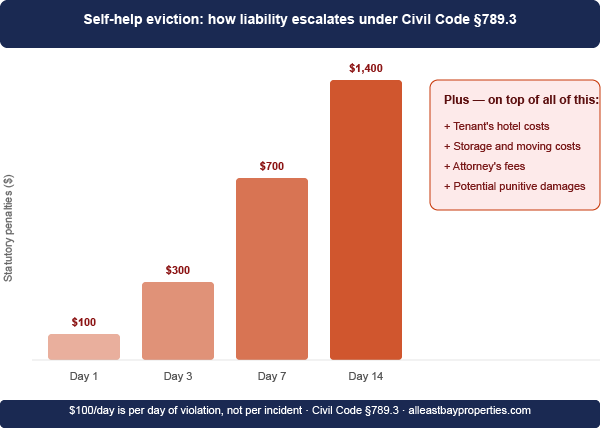
The penalty under section 789.3 is one hundred dollars per day from the first day of the violation. Two weeks is fourteen hundred dollars — before hotel costs, storage, and attorney’s fees. The locksmith cost a hundred and fifty. The legal exposure can be five figures.
A voluntary cash-for-keys agreement is legal. Voluntary. In writing. Genuine choice by the tenant. Not a pressure tactic. Not a substitute for the legal process if they say no.
At All East Bay Properties, we review AB 1482 status on every new property we take on. When tenants stop paying, we follow the legal process exactly. We have never advised a client to change locks or shut off utilities. And we never will.
This wraps our May series on California eviction law. Four weeks. Four topics. Full written guides linked in the description.
Questions about your property’s exemption status or a difficult tenancy? Link in the description. All East Bay Properties — protecting East Bay owners.
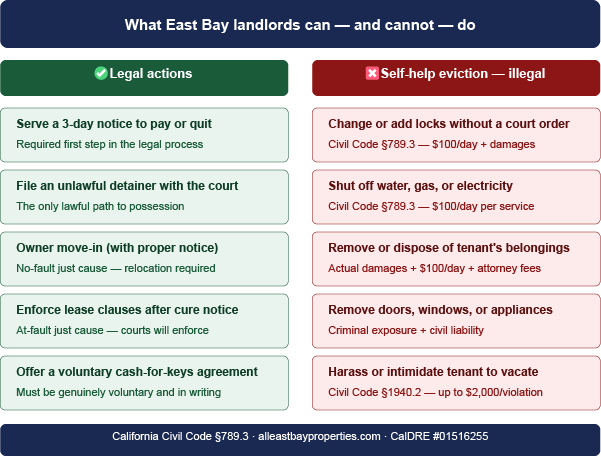
At a Glance: What East Bay Landlords Can and Cannot Do
| Action | Legal? |
|---|---|
| Serve a 3-Day Notice to Pay or Quit | ✅ Yes |
| File an unlawful detainer with the court | ✅ Yes |
| Owner or family member move-in (with proper notice) | ✅ Yes — with rules |
| Use properly drafted lease clauses to pursue at-fault termination | ✅ Yes |
| Offer a voluntary cash-for-keys agreement | ✅ Yes — if genuinely voluntary |
| Change locks without a court order | ❌ Illegal |
| Shut off utilities | ❌ Illegal |
| Remove the tenant’s belongings | ❌ Illegal |
| Repeatedly enter the unit to pressure tenant to leave | ❌ Illegal harassment |
| Remove appliances or doors to make unit uninhabitable | ❌ Illegal |
Who This Guide Is For
→ East Bay landlords who own properties that may be exempt from AB 1482 and want to understand their actual options
→ Self-managing owners who’ve considered changing locks or shutting off utilities and need to understand the legal consequences before acting
→ Rental property owners who want to reclaim a unit for personal use and need to understand Oakland’s owner move-in requirements
→ Anyone who wants to understand what legal protections California actually gives landlords — and where the law draws hard, uncrossable lines
Introduction
California gets a reputation as a landlord’s worst nightmare — and for some owners, it can feel that way when a tenant stops paying, stops cooperating, and the formal eviction process feels impossibly slow.
But the picture is more nuanced than most people think. California law gives landlords real protections: the right to evict for specific, well-defined reasons, exemptions from rent control for a broad class of properties, the ability to recover possession for owner occupancy, and lease clause tools that courts will enforce. What it does not give landlords is the right to take matters into their own hands.
This post covers both sides of that equation — what East Bay landlords can legally do to protect their interests, and the specific actions that California law prohibits so absolutely that courts treat them as independent grounds for liability, separate from whatever the tenant may have done wrong.
Part 1: The Legal Protections California Gives Landlords
AB 1482 Exemptions: The Most Misunderstood Protection in East Bay Property Management
The Tenant Protection Act of 2019 (AB 1482) established statewide rent caps (5% + CPI, max 10%) and a just cause eviction framework that applies to most California rental housing built before 2005. But it also contains significant exemptions — and many East Bay landlords who qualify for those exemptions don’t know it, haven’t served the required notice, or have inadvertently waived the protection.
Commonly Exempt Property Types
- Single-family homes where the tenant received the proper written exemption notice (Civil Code §1946.2(e)(8))
- Condominiums sold separately from other dwelling units where proper notice was served
- Owner-occupied duplexes — where the owner occupies one unit and rents the other
- Housing built within the last 15 years (after January 1, 2010 as of 2026)
- Detached accessory dwelling units (ADUs) that have never been rented under AB 1482
Why the Notice Requirement Matters
The exemption for single-family homes and condos is not automatic. It requires delivery of a specific written notice to the tenant that the property is not subject to AB 1482. If that notice was never served — or was served in a lease addendum that doesn’t contain the statutory language — a court may find the exemption waived. This matters enormously when you’re trying to terminate a tenancy, because without the exemption, you must demonstrate just cause.
The Most Common Exemption Mistake
AEBP note: This is one of the most common documentation gaps we find when new clients bring us properties they’ve been self-managing. The property qualifies for the single-family exemption — but the owner never served the exemption notice. You can correct the issue going forward, but you generally can’t rely on an exemption notice that was never properly served in the first place.
AB 1482 and the 2026 expiration question: The law was written with a January 1, 2030 sunset date. Nothing has changed that date as of May 2026 — AB 1482 remains fully in effect. If you’ve seen online content suggesting otherwise, treat it with skepticism and verify with a current source before making any tenancy decisions based on it.
Just Cause Eviction: What “Good Reason” Actually Looks Like
For properties covered by AB 1482 (not exempt), landlords cannot terminate a tenancy — even at the end of a lease term — without documented just cause. AB 1482 divides just cause into two categories:
At-fault just cause (tenant did something wrong):
- Nonpayment of rent after a proper 3-Day Notice to Pay or Quit
- Lease violation after a proper 3-Day Notice to Cure or Quit — and the tenant failed to cure
- Criminal activity that affects the safety of other residents or the landlord’s agent
- Subletting without permission in violation of the lease
- Refusal of access after proper legal entry notice
No-fault just cause (owner’s decision, not tenant’s fault):
- Owner or qualified family member move-in
- Withdrawal of the unit from the rental market under the Ellis Act
- Substantial remodel requiring the unit to be vacated for 30+ days
- Government order requiring vacancy
In each no-fault category, relocation assistance is required — typically one month’s rent. In Oakland and Berkeley, local ordinances layer additional requirements on top of state law.
Owner Move-In Evictions: What East Bay Owners Can and Cannot Do
If you need to recover your rental property for personal use, California law gives you that right — but with significant procedural conditions, especially in Oakland.
Statewide requirements under AB 1482:
- The owner (or a specified family member — parent, child, sibling, grandparent, grandchild, or spouse/domestic partner) must intend to occupy the unit as a primary residence
- At least one month’s rent in relocation assistance is required
- The stated intent must be genuine — using owner move-in as a pretext for a tenant you simply want out is grounds for a wrongful eviction claim
Oakland-specific requirements under the Oakland Just Cause for Eviction Ordinance:
- 60-day written notice is required — the same as state law for tenants who have resided in the unit more than one year, though Oakland’s procedural requirements around that notice are more demanding
- Relocation assistance is required — the amount varies by tenant circumstances and is subject to change by Oakland RAP regulation; consult the Oakland Rent Adjustment Program or an attorney for current figures before serving any notice
- The owner must actually move in within 60 days of the tenant vacating and must occupy the unit as a full-time primary residence for a minimum of 3 years
- Landlords must file documentation with the Oakland Rent Adjustment Program within 10 days of service
Berkeley: The Berkeley Rent Stabilization Board imposes similar requirements. Owner move-in evictions in Berkeley require a petition and approval from the Board before service of the notice — making them procedurally more demanding than Oakland cases.
Practical AEBP insight: Owner move-in cases in Oakland are high-scrutiny situations. We’ve seen cases where the owner moved in for a short period and then moved out, immediately renting the unit at a higher rate — which is exactly the fact pattern that triggers a wrongful eviction claim. Oakland requires the owner to occupy the unit as a full-time primary residence for 3 years. Courts and the Rent Adjustment Program take that seriously, and the eviction record follows the property. If you’re considering an owner move-in, talk to an attorney before you serve the notice.
Lease Clause Protections That Courts Enforce
Even within the constraints of AB 1482 and local rent ordinances, East Bay landlords have real tools at the lease level. Courts will enforce:
- No-smoking clauses — with lease termination authority if materially violated after cure notice
- Pet restrictions — including no-unauthorized-pet clauses that survive AB 1482 just cause analysis as lease violations
- Guest and subletting provisions — particularly AirBnB and short-term rental prohibitions, which courts have upheld as valid at-fault just cause grounds
- Property condition obligations — lease clauses that require tenants to maintain the premises in a clean, sanitary condition and promptly report needed repairs
- Lease forfeiture clauses — specifying that material, uncured violations are grounds for forfeiture and unlawful detainer
The key requirement: the clause must be reasonable, clearly stated, and you must follow the notice-and-cure process before filing an unlawful detainer based on a lease violation. A court will not enforce a termination based on a violation the tenant was never given the opportunity to cure.
Cash-for-Keys Agreements: A Legal Alternative Worth Understanding
When a tenancy needs to end and time matters, some East Bay owners ask about cash-for-keys — a voluntary agreement where the landlord offers the tenant a payment in exchange for vacating by a specified date and returning possession of the unit.
Done correctly, cash-for-keys is legal and can be faster than the formal unlawful detainer process. The key elements that make it work:
- It must be genuinely voluntary. An agreement signed under threat of harassment, illegal lockout, or utility shutoff is not enforceable and may itself constitute harassment under Civil Code §1940.2.
- Put everything in writing. The agreement should specify the payment amount, the vacate date, the condition the tenant must leave the unit in, and that the tenant is surrendering possession voluntarily.
- The key exchange and payment happen simultaneously — or payment is tied to confirmed possession, not promised afterward.
- It is not a substitute for legal process if the tenant refuses. A tenant who accepts a cash-for-keys offer and then doesn’t vacate still has to be evicted through the courts. The written agreement becomes evidence in that case.
Part 2: What You Absolutely Cannot Do — Even If the Tenant Hasn’t Paid in Months
California’s Self-Help Eviction Prohibition: Why It’s Absolute
California Civil Code §789.3 makes self-help eviction illegal — without exception. The statute applies regardless of the tenant’s conduct, the amount of unpaid rent, the length of the tenancy, or the owner’s frustration level. There is no situation in which a landlord may legally:
| Prohibited Action | Legal Consequence |
|---|---|
| Changing or adding locks to the rental unit | Civil liability; immediate right of tenant re-entry |
| Removing the tenant’s belongings from the unit | Actual damages + statutory damages of $100/day |
| Shutting off utilities (water, gas, electric) | Damages for each day without service; attorney’s fees |
| Removing doors, windows, or appliances to make the unit uninhabitable | Criminal exposure; civil liability |
| Threatening or intimidating a tenant to induce them to leave | Harassment and retaliation liability under §1940.2 |
| Withholding mail or blocking access to the unit | Additional liability under §789.3 |
The $100/day penalty is per day, not per incident. If a landlord changes locks on a Monday and a court doesn’t order restoration until the following Friday, that’s five days of statutory damages — on top of actual damages (the tenant’s hotel, storage costs, meals), attorney’s fees, and potential punitive damages if the conduct was egregious.
The Lockout Scenario: What Typically Happens in the East Bay
The pattern is well-documented across East Bay property management: an owner changes the locks on a tenant who hasn’t paid rent in several months, believing the tenant has “abandoned” the property. The sequence that follows is almost always the same:
- The owner changed the locks, assuming the tenant was gone or would simply leave
- The tenant called the police within hours
- Local police or sheriff’s deputies informed the owner that the lockout was illegal and required them to provide access — or potentially face arrest for unlawful exclusion
- The tenant contacted a tenant legal aid organization (both Oakland and Berkeley have well-resourced ones) and filed a civil claim within 72 hours
- The owner now faced both the original eviction case and a cross-complaint for self-help eviction damages
What made this worse: In many of these situations, the underlying nonpayment case is solid — the landlord has strong documentation and would likely prevail in an unlawful detainer. The self-help attempt didn’t just create a new legal problem. It created leverage for the tenant in the eviction case itself, because courts are not sympathetic to plaintiffs who tried to bypass the legal process entirely.
The formal eviction process exists to protect both sides. The correct path — serving a 3-Day Notice to Pay or Quit, waiting for the notice period, filing the unlawful detainer, attending the hearing — is slower. But it is the only legal path, and it is the only one that ends with a sheriff’s lockout order you can actually enforce.
The Utility Shutoff Trap
Landlords who control utility accounts sometimes consider shutting off water, gas, or electricity as a pressure tactic. Civil Code §789.3(b) prohibits this explicitly. The tenant’s remedy is:
- Immediate restoration ordered by a court
- $100 per day of statutory damages for each day service is withheld
- Actual damages — documented costs the tenant incurred as a result
- Attorney’s fees under the statute
In a unit where the water is shut off for two weeks, the statutory exposure alone is $1,400 — before actual damages or attorney’s fees. In Oakland, tenant legal aid organizations file utility shutoff injunctions routinely and quickly. The fastest way to turn a nonpayment case into a five-figure liability is to shut off the tenant’s utilities.
“Informal Harassment” Is Also Prohibited
Landlords sometimes attempt subtler pressure — repeated unnecessary entry, non-urgent “repairs” that require extended access, removing appliances or allowing conditions to deteriorate. Civil Code §1940.2 prohibits harassment designed to induce a tenant to vacate. Violations carry a civil penalty of up to $2,000 per violation, plus attorney’s fees.
The test courts apply: was the conduct designed, in whole or in part, to force the tenant out of the unit? If yes, it’s harassment — regardless of whether the conduct had a facially legitimate justification.
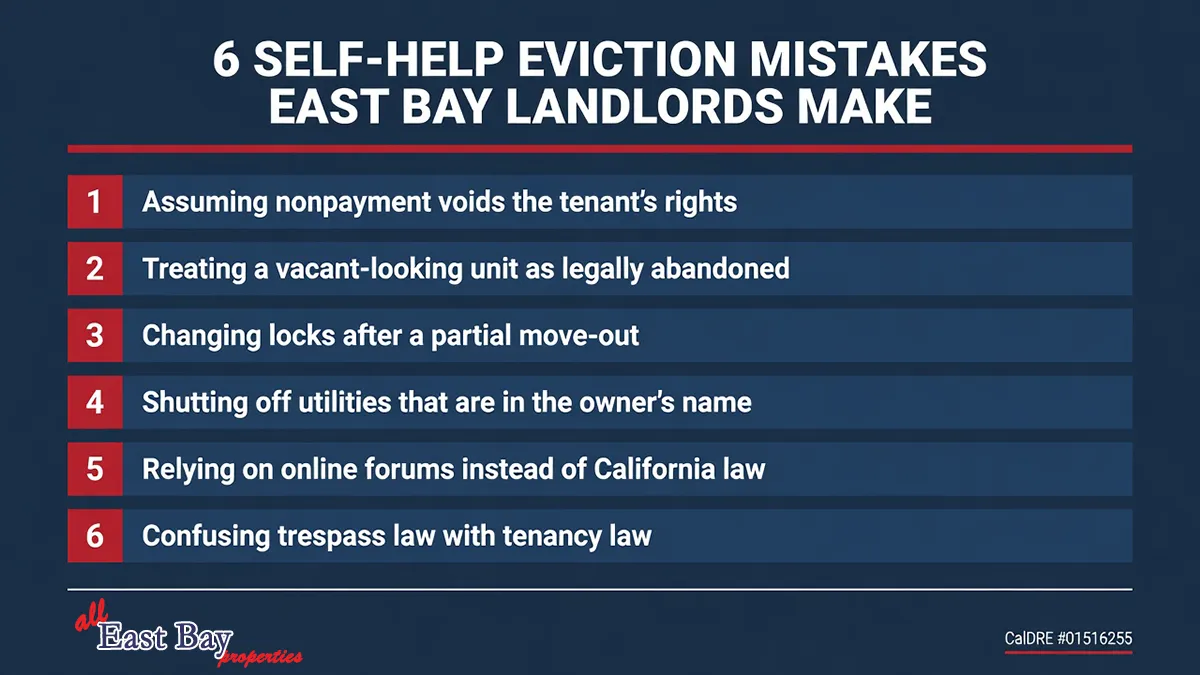
The Most Common Self-Help Mistakes We See
These are the situations that generate calls to our office — after the fact, when the legal exposure is already real:
- Assuming nonpayment voids the tenant’s rights. It doesn’t. A tenant who owes six months of rent still has full statutory protections under Civil Code §789.3 until a court orders otherwise.
- Believing “abandonment” without documented evidence. An empty-looking unit is not legally abandoned. Acting on that assumption — by changing locks or removing belongings — creates liability even if the tenant genuinely did leave.
- Changing locks after a partial move-out. If some of the tenant’s belongings remain, the tenancy has not ended. Locking a tenant out of a unit that still contains their property is a textbook self-help eviction.
- Shutting off utilities that are in the owner’s name. The fact that the landlord is the account holder doesn’t create any exception to §789.3. The prohibition applies to service the landlord controls.
- Relying on online forums or non-attorney advice. California landlord-tenant law is hyper-local — what applies in one city may be preempted in Oakland or Berkeley. Forum advice that worked for someone in a different jurisdiction can create real liability in the East Bay.
- Confusing trespass law with tenancy law. A tenant who hasn’t paid rent is not a trespasser — they are a tenant with full legal occupancy rights until a court terminates the tenancy. The legal frameworks are entirely different.
The Takeaway: Real Protections, Real Limits
California law is not neutral between landlords and tenants — it was deliberately designed with tenant-protective provisions. But that doesn’t mean landlords are powerless. The AB 1482 exemption framework, just cause eviction tools, owner move-in rights, and properly drafted lease clauses give East Bay landlords a meaningful legal toolkit when used correctly and proactively.
What it does not give landlords is a shortcut. The self-help eviction prohibition is absolute, the penalties are substantial, and the East Bay legal aid ecosystem is well-resourced enough to ensure that tenants who are illegally locked out, have utilities shut off, or face harassment will receive prompt legal assistance.
The practical answer — the one that has protected every owner we’ve worked with — is the same: use the legal process, document everything, and make decisions about lease enforcement before a dispute starts, not during one.
How We Handle This at All East Bay Properties
Most eviction problems become expensive because owners wait until the situation has escalated before reviewing the lease, the notice, or the exemption status. By that point, a correctable procedural error has turned into a dismissed case — or a self-help attempt has created a cross-complaint that overshadows the original landlord claim entirely.
At AEBP, when we take on a new property, the first thing we review is AB 1482 coverage and exemption status — because that determination shapes every subsequent lease enforcement decision. If a single-family home or condo owner hasn’t served the exemption notice, we address it before the next lease cycle. If an owner is considering an owner move-in, we walk them through Oakland’s specific procedural requirements before they do anything else.
When tenants stop paying, we follow the legal process exactly: serve the correct notice, wait the correct period, file the unlawful detainer if needed. We have never advised a client to change locks, shut off utilities, or take any self-help action — and we never will.
Frequently Asked Questions
Can a California landlord change the locks if the tenant hasn’t paid rent?
No — under any circumstances. Civil Code §789.3 prohibits a landlord from changing or adding locks to a rental unit regardless of the tenant’s rent payment status. The only lawful way to recover possession is through the unlawful detainer process. Changing locks exposes the landlord to actual damages, $100/day in statutory penalties, and attorney’s fees — and provides the tenant with legal leverage even in an otherwise meritorious eviction case.
What is the AB 1482 exemption and how do I know if my property qualifies?
AB 1482 established statewide rent caps and just cause eviction requirements for most California rentals built before 2005. However, certain property types are exempt — including single-family homes, condos sold separately, owner-occupied duplexes, housing built after January 1, 2010, and certain ADUs. For single-family homes and condos, the exemption is not automatic: it requires delivery of a specific written notice to the tenant. Properties where that notice was never served may not be able to claim the exemption in a subsequent legal proceeding.
How does an owner move-in eviction work in Oakland?
In Oakland, owner move-in evictions require 60 days’ written notice (consistent with state law for tenants who have been in the unit more than one year), relocation assistance in an amount set by Oakland RAP regulation (which can change — verify current figures before serving any notice), and documentation filed with the Oakland Rent Adjustment Program within 10 days of service. Certain tenants with long tenancies — including elderly, disabled, or catastrophically ill tenants — may have additional protections or be exempt from owner move-in evictions entirely. The owner must move in within 60 days of the tenant vacating and must occupy the unit as a full-time primary residence for at least 3 years. The occupancy must be genuine — courts and the Rent Adjustment Program scrutinize owner move-in cases carefully, and a short occupancy followed by a market-rate re-rental is the fact pattern most commonly associated with wrongful eviction claims.
Can I shut off utilities to force a tenant to leave?
No. Civil Code §789.3(b) explicitly prohibits landlords from interrupting utility service as a tactic to remove a tenant. Violations are subject to $100/day in statutory damages for each day service is withheld, actual damages, and attorney’s fees. Courts issue restoration orders quickly in these cases, and tenant legal aid organizations in Oakland and Berkeley file utility shutoff injunctions routinely.
What is “just cause” under AB 1482 and does it apply to my property?
AB 1482 requires just cause to terminate a tenancy for properties that are not exempt. Just cause falls into two categories: at-fault (nonpayment, lease violation, criminal activity) and no-fault (owner move-in, Ellis Act withdrawal, substantial remodel). No-fault terminations require relocation assistance. Just cause does not apply to exempt properties — but only if the landlord served the proper exemption notice. Without that notice, even qualifying properties may be treated as subject to just cause requirements.
Can a tenant’s bad behavior justify a self-help eviction?
No. California courts have been consistent: tenant misconduct — including nonpayment, property damage, lease violations, or even criminal activity — does not authorize a landlord to use self-help. The landlord’s remedy is always the unlawful detainer process. In cases involving criminal activity that poses an immediate safety threat, landlords should contact law enforcement rather than taking matters into their own hands.
What happens if I remove a tenant’s belongings from the rental unit?
Removing a tenant’s belongings from a rental unit is a form of self-help eviction prohibited by Civil Code §789.3. The tenant may recover actual damages (replacement cost of items, storage, etc.) plus statutory damages of $100 per day from the date of removal, attorney’s fees, and potentially punitive damages. There are separate legal requirements for handling property that remains after a tenancy has lawfully ended through the courts — but those procedures only apply after a legal eviction or properly documented abandonment, not as a substitute for either.
Can a landlord remove a tenant after abandonment in California?
Only after following the statutory abandonment process — not by assumption. A unit that looks vacant is not legally abandoned just because the tenant appears to have left. Under Civil Code §1951.3, a landlord who reasonably believes a rental unit has been abandoned must serve a Notice of Belief of Abandonment — a written notice that gives the tenant 15 days to respond if served personally (18 days if mailed). Only if the tenant fails to respond within that window may the landlord treat the tenancy as abandoned and reclaim possession.
Changing locks or removing belongings before completing this process — even in a unit where the tenant has been gone for weeks — is still a self-help eviction under §789.3. The distinction between a tenant who is temporarily absent and one who has genuinely abandoned the unit is a legal determination, not a visual one.
Related Reading
- California Eviction Law 101: The East Bay Landlord’s Complete Guide (2026)
- California Eviction Notice Types & Service Rules: Getting It Right the First Time (2026)
- How Long Does an Eviction Take in California? The Alameda County UD Timeline (2026)
- AB 1482 Rent Cap & Exemptions: What East Bay Landlords Need to Know (2026)
- Oakland Property Management
- Berkeley Property Management
- East Bay Property Management Services
The May 2026 Eviction Series — Complete
This post closes out our May series on California eviction law and owner protections. Over the last four weeks, we covered the full lifecycle:




The May series was designed to give you the legal framework before you ever need it. If you’re managing East Bay rentals and find yourself facing a difficult tenancy situation this summer, this is the foundation you need.