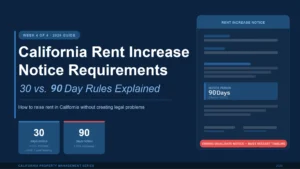

If you own rental property in the East Bay, raising rent in 2026 involves a lot more than picking a number. Oakland, Berkeley, Richmond, and Emeryville each layer their own rules — often far stricter — on top of California’s statewide AB 1482 law. This video is your starting point.

What This Video Covers
This is the overview video in our March series on East Bay rent control and rent increases. It covers the statewide AB 1482 framework, current allowable increase rates for each city, registration requirements, and why notice timing matters. Each city gets a dedicated deep-dive in the posts linked below.
- California’s AB 1482 statewide rent cap — what it is and who it covers
- 2026 allowable increases by city: Oakland (0.8%), Berkeley (1.0%), Richmond (1.62%), Emeryville (6.3% AB 1482 rate)
- Annual registration requirements in Oakland, Berkeley, and Richmond
- Why notice timing can make or break a compliant rent increase
What East Bay Landlords Need to Know
Raising rent in the East Bay in 2026 means navigating two layers of law: California’s statewide AB 1482 cap, and the local ordinances in Oakland, Berkeley, and Richmond that are often far stricter. Knowing which rule governs your specific unit — and applying it correctly — is the difference between a valid increase and a tenant petition.
Under AB 1482, most California landlords are capped at 5% plus the local Consumer Price Index, with a hard ceiling of 10%. For the SF-Oakland-Hayward metro area in 2026, that works out to 6.3%. But in Oakland, the Rent Adjustment Program caps increases at just 0.8%. Berkeley’s Annual General Adjustment for 2026 is 1.0%. Richmond’s is 1.62%. Where a local ordinance applies and is stricter than AB 1482, the local rule governs — not the statewide one.
Emeryville is a different case: the city has no local rent cap, so AB 1482’s 6.3% applies. But Emeryville has one of the stronger just cause eviction ordinances in the East Bay, and landlords who terminate a tenancy must deliver a copy of the notice to the City Clerk within 10 days — a procedural step that frequently gets missed.
Oakland, Berkeley, and Richmond all require annual registration of covered units. In Oakland, an unregistered landlord cannot lawfully implement a rent increase and may face the failure to register raised as an affirmative defense in eviction proceedings. Registration isn’t optional and missing the deadline has real consequences.
Notice timing is where many technically correct increases fall apart. The notice period starts on the date of delivery — not when you wrote it, not when you dropped it in the mail. Mailing adds five days. Serve the wrong period or use the wrong delivery method and the notice is void. You start over.
2026 Allowable Increases at a Glance
| City | 2026 Rent Cap | Rate Period | Registration Required? |
|---|---|---|---|
| Emeryville | 6.3% (AB 1482) | Aug 1 – Jul 31 | No |
| Oakland | 0.8% (RAP) | Aug 1 – Jul 31 | Yes — by March 1 |
| Berkeley | 1.0% (AGA) | Jul 1 – Jun 30 | Yes — annually |
| Richmond | 1.62% (AGA) | Sep 1 – Aug 31 | Yes — annually |
| Statewide (AB 1482) | 6.3% (CPI + 5%) | Aug 1 – Jul 31 | No |
Key Takeaways
- AB 1482 is the floor, not the ceiling — Oakland, Berkeley, and Richmond all impose stricter local caps that override the statewide law.
- 2026 caps by city: Oakland 0.8% · Berkeley 1.0% · Richmond 1.62% · Emeryville 6.3% (AB 1482 rate applies).
- Oakland, Berkeley, and Richmond require annual unit registration. Non-registration can block rent increases and affect eviction proceedings.
- Emeryville has no rent cap but has strong just cause eviction protections and a City Clerk notice requirement for terminations.
- One increase per 12-month period under AB 1482 — and most local ordinances match this restriction.
- Notice timing starts on the date of delivery — mailing adds 5 days. A defective notice is void; you restart the timeline.
Laws & Resources Mentioned
- Related: AB 1482 Rent Cap Explained — Coverage, Formula & Step-by-Step Calculation
- Related: Oakland Rent Control in 2026 — RAP Rules, Registration & Allowable Increases
- Related: California Rent Increase Notice Requirements — 30 vs. 90 Day Rules
- Full guide: Rent Increases in the East Bay — What Landlords Can and Cannot Do in 2026
- Oakland Rent Adjustment Program
- Berkeley Rent Stabilization Board
Have Questions About Your Property?
We manage 600+ rental units across Oakland, Berkeley, Emeryville, and Richmond. We handle rent increase calculations, compliance notices, and registration so our clients capture every dollar they’re entitled to — without the risk.
Video Transcript
If you own rental property in the East Bay, raising rent in 2026 isn’t as simple as picking a number. Between California’s statewide AB 1482 law and the local ordinances in Oakland, Berkeley, Richmond, and other East Bay cities — the rules vary significantly depending on exactly which units you own, and the penalties for getting it wrong are real.
Here’s what you need to know at a glance. Under AB 1482, most California landlords are capped at 5% plus local CPI — with a hard ceiling of 10%. But in the East Bay, local rules are often much stricter. Oakland’s current cap is just 0.8%. Berkeley sits at 1.0%. Richmond is at 1.62%. And Emeryville has no local rent cap — but carries some of the strongest eviction protections in the region.
On top of the percentages, Oakland, Berkeley, and Richmond all require annual unit registration. Notice timing matters too — get that wrong, and your increase may not hold up.
This month, we’re diving deep into all of it — city by city, rule by rule. Start with the full breakdown in the first of our March series on rent control and increases — the link is right below this video.