
💡 Thursday Landlord Tip
Most East Bay landlords know that AB 1482 limits how much they can raise rent each year — but fewer know how to calculate the allowable increase correctly.
The statewide cap isn’t a fixed number. It’s a formula based on regional inflation data, combined with a fixed 5% allowance, subject to a 10% maximum. Using the wrong CPI figure — or misunderstanding the 12-month lookback rule — can result in an invalid notice and required refunds.
Getting the math right before you send a notice protects both your income and your compliance.
Why This Matters
AB 1482, the Tenant Protection Act of 2019, set a statewide ceiling on annual rent increases for most California residential rentals. The cap applies to multi-family properties in buildings more than 15 years old, and to single-family homes owned by corporations or LLCs.
But the cap isn’t the same number every year — it changes annually based on the Consumer Price Index for the region where the property is located.
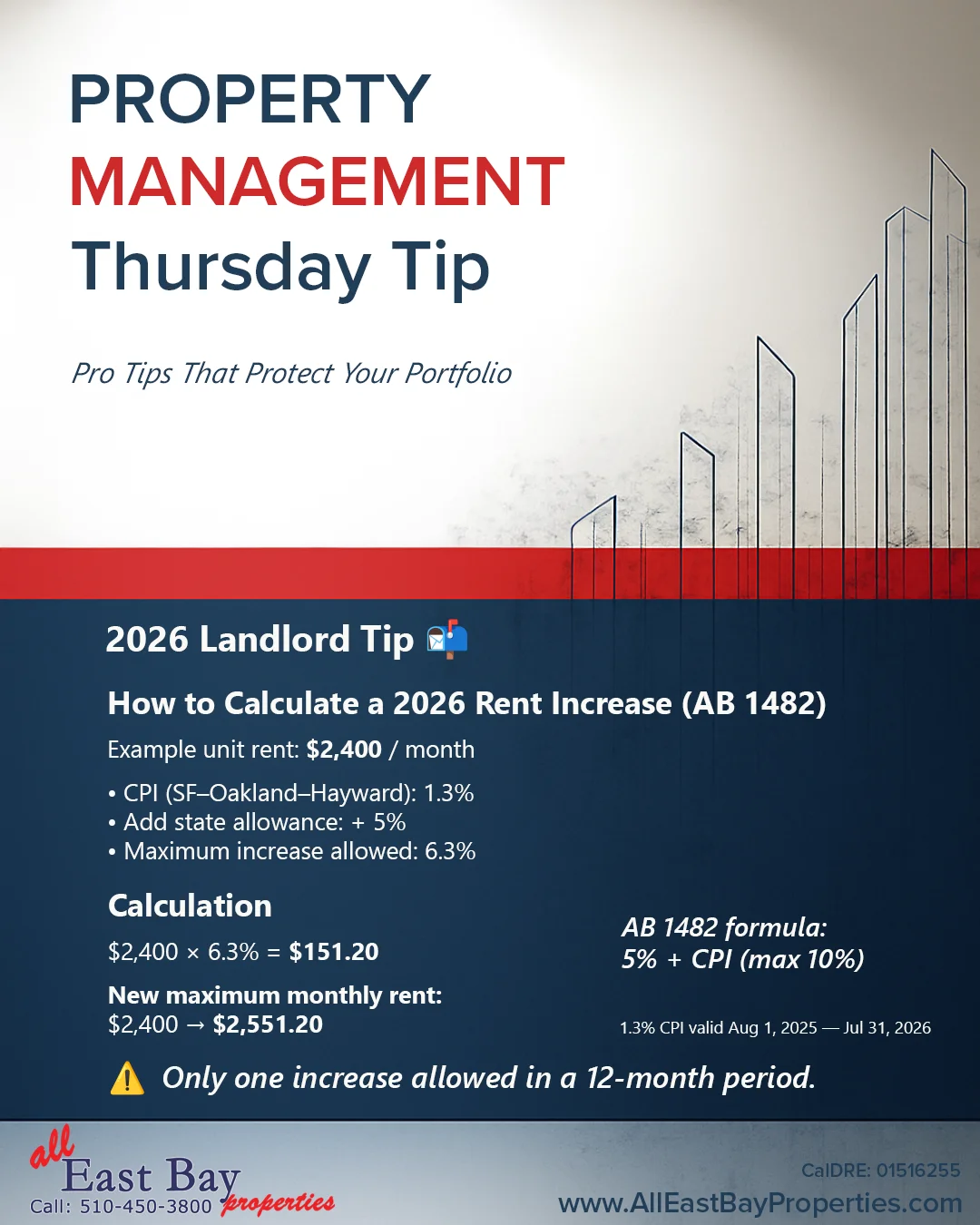
For the current period — August 1, 2025 through July 31, 2026 — the confirmed CPI for the San Francisco–Oakland–Hayward metro area is 1.3%, based on April 2025 data published by the Bureau of Labor Statistics. That produces a maximum allowable increase of 6.3%.
Using the national CPI figure, or last year’s regional figure, gives you the wrong number. And in Oakland and Berkeley, AB 1482 doesn’t govern at all — local ordinances cap increases far lower.
Where Risk Often Appears
Calculation errors under AB 1482 frequently occur when landlords:
- Apply the statewide 6.3% cap to a property in Oakland or Berkeley, where local rules are stricter
- Use the wrong CPI region — AB 1482 requires the regional figure for where the property sits, not the national average
- Fail to check the 12-month lookback before issuing a notice
- Treat a partial increase earlier in the year as separate from the annual cap
- Assume the cap resets on January 1 rather than running from the date of the last increase
These mistakes are most common for:
- Self-managing landlords calculating increases without a formal process
- Owners with units in multiple jurisdictions governed by different rules
- Landlords relying on prior-year numbers without confirming the current CPI
- Anyone issuing a notice without first confirming the last increase date
What Landlords Often Miss
The 12-month lookback rule is one of the most frequently misunderstood parts of AB 1482.
The law allows only one rent increase within any rolling 12-month period — and that window runs from the date of the most recent increase, not the calendar year. A landlord who raised rent in June 2025 cannot raise it again until June 2026, even if the new year has started.
Partial increases count too. If a smaller increase was applied earlier in the year, that amount counts toward the annual cap. A landlord cannot issue a second increase to “top up” to the maximum.
The safest approach is to confirm three things before issuing any notice:
- The correct regional CPI figure for the current period
- The date of the last rent increase for each unit
- Whether local rent control — not AB 1482 — governs that specific property
When each step is documented before the notice goes out, the increase is defensible.
💡 This Week’s Calculation Example
Here is a step-by-step example using the confirmed 2025–2026 figures for the SF–Oakland–Hayward metro:
Example unit rent: $2,400 per month
| Step | Detail | Result |
|---|---|---|
| Current rent | — | $2,400.00 |
| Regional CPI (April 2025) | SF–Oakland–Hayward | 1.3% |
| AB 1482 formula | CPI + 5% | 6.3% |
| 10% cap check | 6.3% is under 10% | Maximum confirmed |
| 12-month lookback | No prior increase | Eligible |
| Dollar increase | $2,400 × 6.3% | $151.20 |
| New maximum rent | $2,400 + $151.20 | $2,551.20 |
The maximum allowable rent increase for this unit is $151.20 per month. The landlord is not required to take the full increase — but cannot exceed it without violating AB 1482.
The Takeaway
AB 1482 compliance isn’t just about knowing the cap exists — it’s about applying the right number to the right property in the right window.
A calculation error doesn’t produce a reduced increase. It produces an invalid notice, a required refund, and potential exposure to tenant petitions and attorney’s fees.
Confirming the current CPI, verifying the lookback date, and checking whether local ordinances apply before every increase is what keeps East Bay landlords on the right side of the law.
📘 Learn More
This tip is part of our March Rent Increases & Rent Control series, covering the statewide AB 1482 cap and the local ordinances that govern Oakland, Berkeley, Richmond, and Emeryville.
For the complete breakdown — including which properties are covered, how the CPI formula works, just cause eviction rules, and how local rent control interacts with the statewide cap — read:
👉 AB 1482 Rent Cap Explained: California’s Statewide Rent Increase Limits for 2026
Next week we’ll cover Oakland’s Rent Adjustment Program and what the 0.8% local cap means in practice for Oakland landlords.
This tip is part of our ongoing education series for Bay Area landlords focused on compliance, risk reduction, and smarter property management. 📋 Browse all Thursday Landlord Tips →
 Submit your email below to get your free eBook, 5 Mistakes Landlords Make, and start managing your properties like a pro. Get your copy