

Share this post
Quick Summary (Read This First)
California landlords must comply with federal, state, and local fair housing laws — not just the federal Fair Housing Act.
California recognizes 20+ protected classes, far more than the federal baseline.
Many fair housing complaints begin with innocent questions or inconsistent screening decisions, not intentional discrimination.
Asking about source of income, family status, disability, national origin, or immigration status — even casually — can create legal exposure.
The safest approach: Clear, written screening criteria applied consistently, with the first qualified applicant approved.
This article explains:
- Which protected classes trip landlords up most often
- What questions you should never ask
- Why “reasonable judgment” isn’t a legal defense
- How Bay Area enforcement actually works
- What practical steps reduce risk immediately
This article is week 3 of our February 2026 education series focused on helping Bay Area landlords stay informed, compliant, and protected.
🔹 February overview: Screening Mistakes And Fair Housing in California (How To Avoid Them)
🔹 Week 2: “Flexible Screening” = Fair Housing Risk (What to Do Instead)

A $15,000 Question Most Landlords Don’t Realize They’re Asking
A landlord in Oakland asked a prospective tenant during a showing:
“What country are you from?”
It felt like small talk.
It wasn’t tied to rent, credit, or income.
It seemed harmless.
It still resulted in a five-figure fair housing settlement.
Why? Because national origin and citizenship status are protected classes under California law, and intent doesn’t matter. Once the applicant was denied (for legitimate credit reasons), the earlier question created the appearance of bias — and that was enough to trigger a discrimination claim.
Most landlords can name a few protected classes: race, religion, disability.
Very few understand how many exist in California — or how easy it is to violate the law without realizing it.
Federal vs. California vs. Local Law: Why the List Keeps Growing
Many landlords assume that complying with the federal Fair Housing Act means they’re covered.
In California — especially in the Bay Area — that assumption is dangerous.
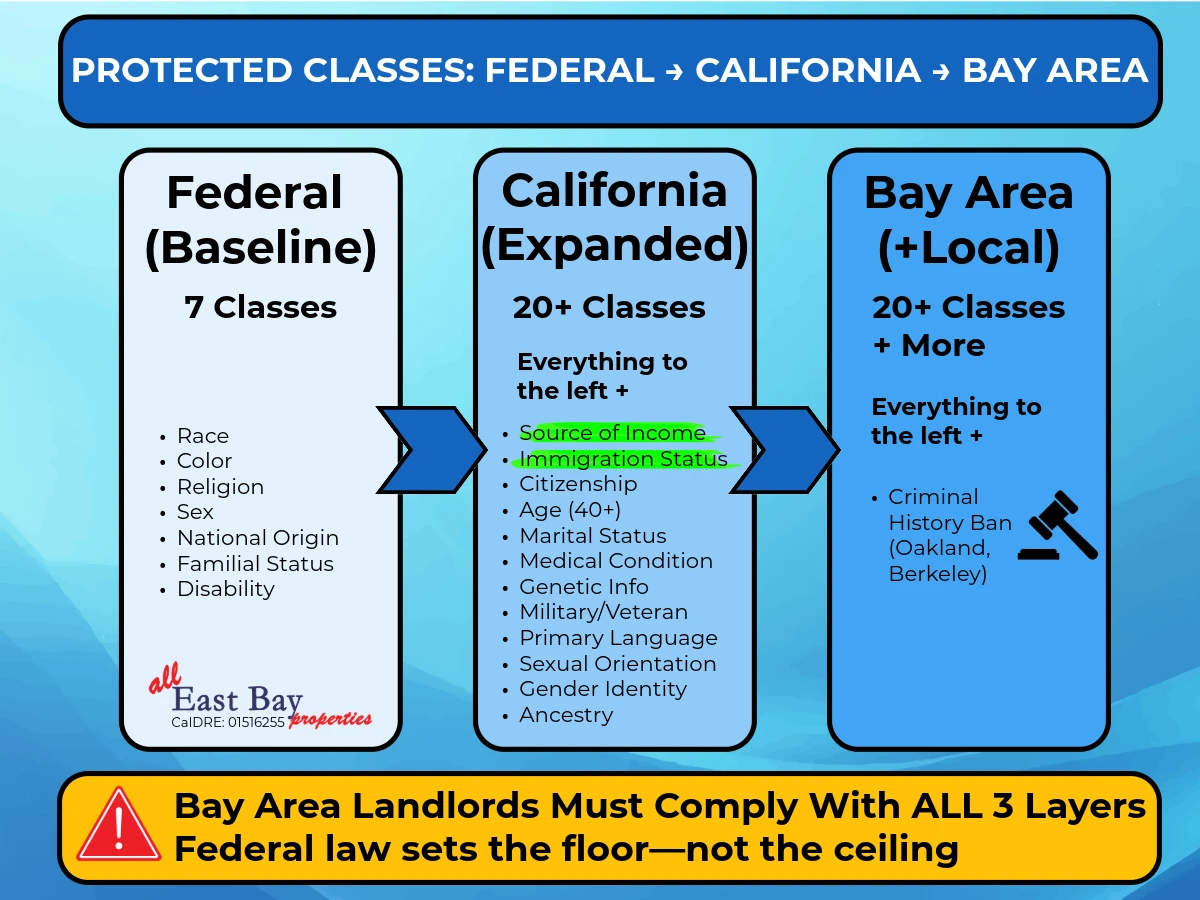
Federal Fair Housing Act (The Baseline)
The federal Fair Housing Act protects seven classes:
- Race
- Color
- Religion
- Sex (including gender identity and sexual orientation as of 2021)
- National origin
- Familial status (families with children)
- Disability
Source: U.S. Department of Housing and Urban Development – Fair Housing Act Overview
California Fair Employment and Housing Act (FEHA)
California law expands protections significantly, adding:
- Source of income (including housing vouchers and government assistance)
- Immigration status
- Citizenship
- Marital status
- Sexual orientation
- Gender identity and expression
- Ancestry
- Medical condition
- Genetic information
- Military or veteran status
- Age (40 and over)
- Primary language
Sources:
Local Bay Area Expansions
Cities like Oakland, Berkeley, San Francisco, and Emeryville layer on additional tenant protections and maintain aggressive enforcement mechanisms.
Notable local restrictions:
Criminal Background Check Bans
Both Oakland and Berkeley prohibit the use of criminal background checks in tenant screening under their respective Fair Chance Housing Ordinances. While criminal history isn’t a “protected class” in the traditional sense, these local laws effectively remove it as a screening tool.
Sources:
Other Local Protections:
- Oakland enforces strict source of income protections and maintains active tenant rights programs
- Berkeley has its own Rent Stabilization Board with enforcement authority
- San Francisco adds protections around caregiver status and gender expression
Sources:
Key takeaway: You can comply with federal law and still violate California or local law.
The Protected Classes That Get Landlords in Trouble Most Often
Not all protected classes generate equal risk in practice. The following categories account for the majority of real-world complaints.
1. Source of Income (The Most Common Mistake)
What landlords think is okay:
- “I don’t accept Section 8”
- “I only rent to tenants with traditional employment”
- “Vouchers add too much paperwork”
Why it’s not:
In California, source of income has been a protected class since 2020. This includes:
- Section 8 Housing Choice Vouchers
- Veterans Affairs Supportive Housing (VASH) vouchers
- Social Security Disability Insurance (SSDI)
- Supplemental Security Income (SSI)
- CalWORKs housing support
- Any other lawful source of income or rental assistance
Refusing to accept vouchers — or discouraging applicants who use them — violates state law.
You can still screen for income sufficiency (e.g., “total household income must equal 3x monthly rent”), but you cannot treat voucher income differently than employment income.
Sources:
What to do instead:
Screen for income sufficiency, not income source. If total verified income (including vouchers) meets your requirement, the applicant must be evaluated equally.
2. Familial Status (The “Quiet Building” Trap)
What landlords think is okay:
- “This building is better for professionals”
- “It’s a quiet property — probably not ideal for kids”
- “Most of our tenants don’t have children”
Why it’s not:
Familial status is a federally protected class. Discouraging families — even indirectly — is discrimination.
Statements about the “type” of tenant who would be a “good fit” are a common trigger for complaints, especially when followed by a denial.
Even asking “Do you have kids?” creates exposure, because it signals that family composition is part of your decision-making process.
A simple rule of thumb: Describe the property, not the person.
Say: “This is a second-floor unit with no elevator” or “The building has hardwood floors throughout.”
Don’t say: “This is perfect for a single professional” or “Most residents here are child-free.”
Source:
What to do instead:
Apply neutral occupancy standards consistently (e.g., HUD’s guideline of 2 persons per bedroom is a common reference) and avoid any commentary about children, noise, or household composition. Stick to describing the physical features of the property.
3. Disability & Reasonable Accommodations
What landlords think is okay:
- “We don’t allow pets, so that emotional support animal can’t stay”
- “That accommodation request seems unreasonable”
- “Can you show me proof that you’re really disabled?”
Why it’s not:
Under federal and state fair housing law:
- Emotional support animals (ESAs) are not pets — they are reasonable accommodations for disabilities
- You must evaluate accommodation requests individually, not apply blanket rules
- You cannot ask about the nature or severity of a disability
- You cannot delay — delays are treated as denials
For ESAs, you may request documentation from a licensed healthcare provider verifying that the animal provides therapeutic benefit. You cannot demand:
- “Certification papers” (no official ESA registry exists)
- Details about the person’s diagnosis
- Demonstrations of the animal’s training
Sources:
- CRD – Emotional Support Animals and Fair Housing Law
- CA Dept. of Rehabilitation – What you need to know about Service Animals
What to do instead:
Use a standard reasonable accommodation request form that asks for verification that the accommodation is necessary, without probing medical details. Process requests promptly.
4. Immigration & Citizenship Status (The “I Didn’t Know” Category)
What landlords think is okay:
- Casual questions during showings
- “Where are you from originally?”
- “Do you have a work permit?”
Why it’s not:
Immigration status and citizenship are explicitly protected under California law. Even asking about them — even as small talk — creates exposure if the applicant is later denied.
You cannot require specific forms of ID (e.g., U.S. passport only) or ask about work authorization.
Source:
Citizenship and Immigration Status Protections under the Unruh Civil Rights Act
What to do instead:
Verify income and identity using standard documentation. Accept any government-issued ID (driver’s license, passport, state ID, consular ID). Focus exclusively on rental qualifications: income, credit, rental history.
“I Was Just Asking…” — Innocent Questions That Are Actually Illegal
Most landlords don’t set out to discriminate. They’re making conversation. They’re trying to assess “fit.”
But fair housing law doesn’t evaluate intent. It evaluates impact and consistency.
Here are questions that feel harmless — and can cost you thousands:

The pattern: These questions aren’t about rental qualifications. They’re about who the person is — and that’s where protected classes live.
The “Reasonable” Justification That Doesn’t Hold Up in Court
Landlords often defend decisions with explanations that feel logical — but fail legally.
Examples of defenses that don’t work:
“I denied them for income, not the voucher.”
→ Still illegal if your income requirement effectively excludes voucher holders, or if applied inconsistently.
“I don’t allow pets, so no ESA.”
→ Assistance animals are not pets under fair housing law. This is not discretionary.
“I was just trying to be helpful by suggesting they look elsewhere.”
→ Steering applicants away from a property is still discrimination, even with “good” intentions.
“I went with my gut — the other applicant just seemed more reliable.”
→ “Gut feeling” is not a legal defense. It’s often interpreted as evidence of bias.
Fair housing law looks at process and consistency, not motivation.
Bay Area Reality: Who Actually Files Complaints (And Why)
Many landlords assume complaints come from “problem tenants.”
In reality, complaints often originate from:
Rejected Applicants
Applicants who sensed inconsistency, inappropriate questions, or discriminatory treatment during the screening process.
Tenant Advocacy Organizations (“Shoppers”)
The Bay Area has particularly active fair housing enforcement. Advocacy groups routinely:
- Monitor rental listings for problematic language
- Call landlords posing as prospective tenants to ask loaded questions
- Test whether landlords apply screening criteria consistently
In the industry, these are known as “shoppers” or “testers.”
Real examples we’ve encountered:
- Callers asking “Do you accept Section 8?” to test source of income compliance
- Applicants for clearly-advertised second-floor walk-ups asking “Would this work for someone in a wheelchair?” to test disability responses
- Questions designed to elicit statements about family status, age, or national origin
While these organizations serve as tenant advocates, there is also significant financial incentive in identifying violations — settlements and legal fees can be substantial.
Active Bay Area organizations include:
- East Bay Community Law Center – Housing Rights
- Centro Legal de la Raza – Housing Program
- Tenants Together (statewide)
Current Tenants
Tenants who notice unequal treatment in repairs, renewals, or lease enforcement compared to other tenants.
Neighbors and Third Parties
People who overhear conversations during property showings or application discussions.
The key point: Complaints are driven by individual interactions and specific statements — not random audits. But those interactions are being monitored more actively in the Bay Area than in most other markets. One problematic question to the wrong caller can trigger a formal investigation.
Why Inconsistent Screening Is the Real Liability
Consider this scenario:
Two applicants.
Same credit score.
Same income level.
One mentions receiving SSDI.
You approve the other because they “seemed more stable.”
You didn’t document the decision.
You didn’t apply a written standard.
You just… decided.
That’s not judgment — that’s exposure.
If the SSDI recipient files a complaint, you’ll be asked:
- What criteria did you use?
- How did you apply them consistently?
- Why was one applicant approved and not the other?
Without documentation, your explanation will sound like rationalization — even if you truly weren’t discriminating.
The legal standard: Approving the first applicant who fully meets your written criteria removes subjectivity and is the most defensible approach.
Source: HUD – Guidance on Application of Fair Housing Standards
Best Practices That Actually Reduce Risk
Screenshot this section.
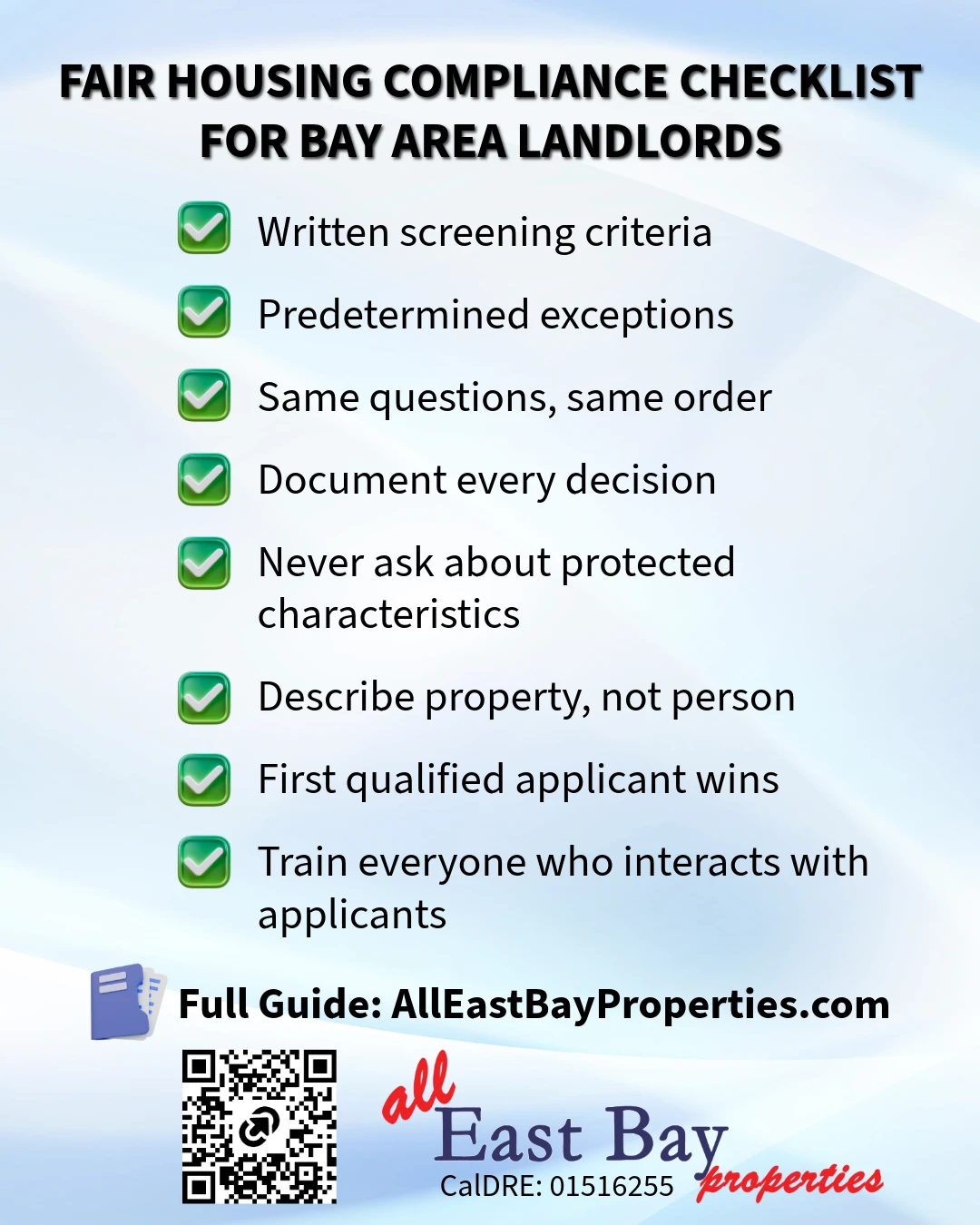
✅ Use written, specific screening criteria
Define minimum income, credit score, and rental history requirements in writing. Apply them to every applicant.
✅ Establish predetermined exceptions in advance
Don’t make up exceptions on the fly — that’s where inconsistency creates liability.
If an applicant doesn’t meet your standard criteria, will you consider:
- A qualified co-signer?
- X months rent paid in advance?
- Proof of liquid reserves?
Note: asking for additional security deposit is no longer a legal option as of July 1st, 2024 under California’s New Security Deposit Law (AB 12)
Write down your exception policy before you receive any applications. Apply these exceptions equally to all applicants who don’t meet base criteria. Document which exception was used and why the applicant qualified.
Example:
“Applicants who don’t meet the 3x income requirement may qualify with:
• A co-signer who meets 5x income requirement, OR
• Payment of 3 months rent in advance”
✅ Ask the same questions in the same order
Use a standardized application and showing script. Train anyone who interacts with applicants.
✅ Document every approval and denial
Note which criteria the applicant met or didn’t meet. Keep records for at least 3 years.
✅ Never ask about protected characteristics
Focus exclusively on: income, credit, rental history, references.
✅ Describe the property, not the person
Say “second-floor walk-up” not “perfect for young professionals.” Stick to physical features.
✅ If two applicants both qualify, use date/time of completed application
First complete application wins. Document the timestamp.
✅ Train anyone who interacts with applicants
Property managers, assistants, maintenance staff — everyone needs to know what not to ask.
✅ Process accommodation requests promptly
Delays are treated as denials. Respond within a reasonable timeframe (typically 10-14 days maximum).
For a detailed breakdown of how standardized screening protects you from liability, read:
👉 Why Flexible Tenant Screening Creates Fair Housing Risk
Frequently Asked Questions (FAQ)
How many protected classes are there in California?
California recognizes 20+ protected classes under the Fair Employment and Housing Act (FEHA), compared to 7 under federal law. Local jurisdictions may add additional protections.
Can landlords choose between two qualified applicants?
Only if the decision is based on documented, neutral criteria applied consistently. Otherwise, approving the first qualified applicant (based on application timestamp) is the safest and most defensible approach.
Is “gut feeling” ever a valid reason to deny an applicant?
No. “Gut feeling” is not a legal defense in fair housing cases. Courts view unexplained decisions as evidence of potential bias.
Source: U.S. Department of Justice – Housing Discrimination Cases
Can I ask about vouchers or government assistance programs?
No. Source of income is a protected class in California. You cannot ask whether an applicant uses vouchers, and you cannot refuse to accept them.
You can set minimum income requirements, but voucher income must be counted equally with employment income.
Source: California AB 1482
Do fair housing violations require intent to discriminate?
No. Violations are based on impact and inconsistency, not intent. Even unintentional discrimination — or the appearance of it — can result in penalties.
Source: U.S. Department of Justice – Housing Discrimination Cases
What happens if someone files a fair housing complaint against me?
Complaints can be filed with:
- U.S. Department of Housing and Urban Development (HUD)
- California Civil Rights Department (CRD)
- Local fair housing agencies
Investigations typically involve:
- Document requests (applications, communications, screening criteria)
- Interviews with both parties
- Review of your screening process for consistency
Settlements often start at $10,000–$15,000, and cases can take 6–18 months to resolve.
We’ll cover enforcement in detail in next week’s article.
Why This Matters
You don’t need to intend to discriminate to face a fair housing claim.
All it takes is any one of these:
- One question you shouldn’t have asked
- One inconsistent decision you can’t explain
- One applicant filing a complaint
The only reliable defense is a clear, documented, consistent screening process that removes subjectivity from tenant selection.
Learn More
This article is part of our ongoing Fair Housing & Tenant Screening series for Bay Area landlords.
👉 Tenant Screening Mistakes That Trigger Fair Housing Claims in California (And How Bay Area Landlords Can Avoid Them)
For a deeper breakdown of why flexible screening creates risk, read:
👉 Why Flexible Tenant Screening Creates Fair Housing Risk in California
Next up: Fair Housing Starts Before the Application: Rental Ads & Language That Create Liability
Related video: Fair Housing Protected Classes in California: The 20+ Classes East Bay Landlords Often Miss
Last month: We covered 2026 changes to property management law in California including guides to checking that your lease agreements still comply, the real cost of non-compliance, and self managing your property in 2026. We hope you find them useful and informative.