
Share this post
Quick Summary (Read This First)
Most landlords assume fair housing risk begins when applications arrive. It doesn’t.
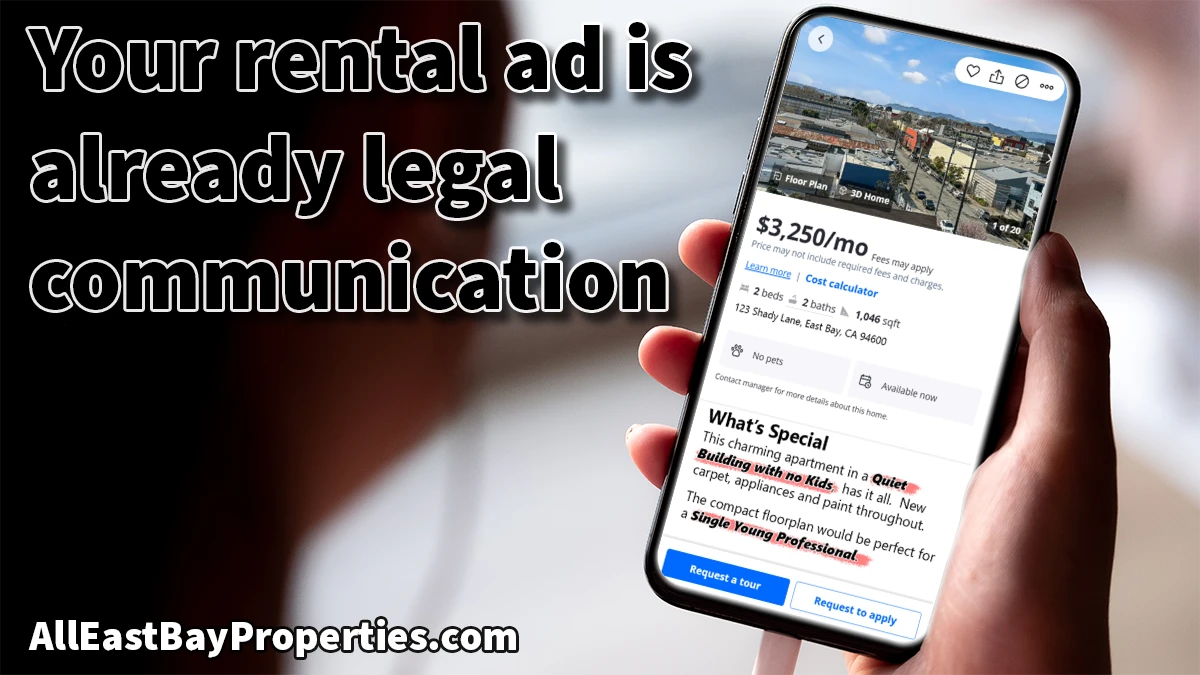
Your rental ad — and every message, text, and comment during a showing — is already legal communication and should take into account fair housing rental advertising rules. Under the Fair Housing Act, advertising that signals a preference based on a protected class is a violation, even if you ultimately rent to a fully qualified tenant afterward.
This article covers:
- Why rental listings are a fair housing trigger point
- Specific phrases that create liability (and safer alternatives)
- How pet language and ESA requirements are routinely confused
- Why casual comments during showings are the most common source of violations
- What a compliant listing and communication process actually looks like
This article is Week 4 of our February 2026 education series focused on helping Bay Area landlords stay informed, compliant, and protected.
🔹 February series overview: Screening Mistakes and Fair Housing in California (How to Avoid Them)
🔹 Week 2: Why “Flexible Screening” = Fair Housing Risk
🔹 Week 3: Fair Housing Protected Classes: What California Landlords Need to Know

Why Advertising Is a Fair Housing Trigger
Most property owners think the fair housing clock starts ticking when applications come in.
It doesn’t.
Section 804(c) of the Fair Housing Act makes it illegal to make, print, or publish any notice, statement, or advertisement that indicates a preference, limitation, or discrimination based on a protected characteristic. That means the violation can exist in the ad itself — before a single application is submitted, and before any screening decision is made.
The channels this covers are broader than most landlords realize:
- Website listings
- Zillow and Realtor.com descriptions
- Facebook Marketplace ads
- Craigslist posts
- Email and text message responses to inquiries
- Verbal comments during showings
As the National Fair Housing Alliance notes, this includes advertising on web-based platforms — and even the targeting settings you apply when boosting a rental listing on social media can create exposure.
Intent does not matter. Impact does.
Courts consistently apply what’s known as the “ordinary reader” standard: if a reasonable person could interpret the language as expressing a preference related to a protected class, the violation exists — regardless of what the landlord meant. Once language is published or sent, it’s documented. In today’s environment, screenshots last forever.
The Phrases That Create Risk (And What to Say Instead)
Many problematic phrases sound completely normal. That’s exactly what makes them dangerous — they feel like natural, helpful description. But HUD’s fair housing advertising regulations evaluate the effect of language on protected groups, not the intention behind it.
Here are the most common offenders:
| Problematic Phrase | Why It Creates Risk | Safer Alternative |
|---|---|---|
| “Perfect for a single professional” | Implies preference for one occupant and a specific lifestyle; may suggest age preference | “Studio layout — efficient floor plan for one occupant” |
| “Quiet building, no kids” | Direct familial status discrimination — federally protected | “Quiet hours enforced per lease terms” |
| “Adult building” | Same as above — signals preference against families with children | “Respectful community environment” |
| “Mature tenants preferred” | Signals age and familial status preference | Describe the property rules, not the resident type |
| “Great for empty nesters” | Implies preference based on family composition | “Two-bedroom unit with dedicated home office space” |
| “Ideal for a couple” | Suggests preference based on relationship status or family size | “Comfortable two-bedroom layout” |
| “No ESAs — no exceptions” | Assistance animals are not pets under federal law; this signals non-compliance before anyone applies | “Contact us to discuss accommodation requests” |
The consistent principle: Describe the property and its rules. Never describe the person you’re looking for.
Share this:

Per HUD’s advertising guidance, the simplest test is this: does the ad describe the dwelling, or does it describe the person you want living there? If it’s the latter, you have a problem.
Pet Language vs. ESA Requirements: Where Owners Create Serious Liability
This is one of the most common areas of unintentional violation — and one of the most expensive.
Statements in your listing like “No pets allowed,” “Small dogs only,” or “Pet deposit required” are generally acceptable. For pets, those rules apply.
But assistance animals — including emotional support animals (ESAs) — are not pets under housing law. According to HUD’s official guidance on assistance animals, an assistance animal is an animal that works, provides assistance, or performs tasks for the benefit of a person with a disability, or that provides emotional support that alleviates one or more identified effects of a person’s disability. An assistance animal is not a pet.

Under HUD’s guidance:
- ESAs cannot be charged pet rent or a pet deposit
- Breed and weight restrictions do not apply to assistance animals
- “No pet” policies do not override a tenant’s right to request a reasonable accommodation
If your listing, your auto-response email, or your verbal follow-up with an inquiring tenant suggests that no exceptions exist to your pet policy, you may already be in violation before a single application arrives.
What you can do: When a tenant requests an accommodation for an assistance animal, you may ask for documentation from a licensed healthcare provider confirming that the animal provides a therapeutic benefit. You cannot demand certification papers (no official ESA registry exists under law — HUD has specifically warned against certificates sold online as insufficient documentation), details about the nature of their disability, or demonstrations of the animal’s training.
The safest approach is to handle all accommodation requests through a standardized written process — and to ensure your listing language doesn’t foreclose that conversation before it begins.
The Real Risk: Casual Communication
Most fair housing violations don’t happen in formal listings that have been reviewed and polished.
They happen in casual moments — the text reply sent in a hurry, the comment made during a showing, the answer given to a question over the phone.
Examples that create exposure:
- “How many kids do you have?” — familial status
- “What part of the world are you from originally?” — national origin, immigration status
- “The neighbors here are mostly older — it’s a very quiet group.” — familial status, steering
- “This probably isn’t a great fit for your situation.” — steering, without documented neutral reason
- “Our current tenants are all working professionals.” — implies preference based on source of income or lifestyle
Even if the tone is friendly and the intent is harmless, these comments can be interpreted as steering or discriminatory preference. And applicants — and fair housing testers — screenshot everything.
The Bay Area has particularly active fair housing enforcement. Organizations like the East Bay Community Law Center and Centro Legal de la Raza routinely monitor listings and conduct testing to identify violations. One unscripted answer to the wrong caller can trigger a formal investigation.
It’s also worth noting that the California Civil Rights Department (CRD) — which enforces the Fair Employment and Housing Act — extends protections well beyond the federal baseline. Under California law, source of income, immigration status, primary language, and citizenship are all protected, meaning casual questions that touch those areas carry legal weight even if they’d be less actionable in other states. We took an in-depth look at California’s protected classes in last week’s post.
Best Practices for Compliant Advertising and Communication
✅ Use standardized listing language reviewed for compliance before any vacancy is posted
✅ Describe property features, not ideal residents — physical attributes, lease rules, and amenities only
✅ Use a consistent inquiry response template so every prospective tenant receives identical information
✅ Train anyone who responds to inquiries — property managers, assistants, maintenance staff
✅ Handle ESA and accommodation requests through a formal written process — never as a casual conversation
✅ Document all communications — email and text are preferable to phone calls for this reason
✅ Review your listing language every time a unit goes vacant — don’t recycle old ads without a compliance check
For a deeper look at how written, consistent screening criteria protects you from liability downstream, see our earlier article: Why Flexible Tenant Screening Creates Fair Housing Risk in California.
Frequently Asked Questions
Can a landlord say “no kids” in a rental ad?
No. Familial status — which includes families with children under 18 — is a federally protected class under the Fair Housing Act. Stating or implying a preference against families with children in a rental ad is a violation, regardless of intent. This includes phrases like “adult building,” “quiet community,” or “great for empty nesters” when used to signal that children are unwelcome. The only exception is housing that qualifies as senior housing under federal law.
Is it illegal to advertise for a “single professional” in a rental listing?
Yes, in most cases. Phrases like “perfect for a single professional” imply a preference for one occupant, a specific lifestyle, and potentially a specific age group — all of which touch protected characteristics. Focus instead on the physical features of the unit: “efficient studio layout” or “ideal for one occupant due to size” describes the property without suggesting who should live there. HUD’s fair housing advertising guidelines are clear that ads should describe dwellings, not desired residents.
Does a “no pets” policy apply to emotional support animals?
No. Emotional support animals are not classified as pets under fair housing law — they are reasonable accommodations for disabilities. Per HUD’s guidance on assistance animals, a “no pets” policy cannot be used to deny an ESA request. Landlords must evaluate accommodation requests individually and cannot impose pet deposits, breed restrictions, or blanket denials for assistance animals.
Can a landlord charge a pet deposit or pet rent for an emotional support animal?
No. Under HUD guidance, charging pet fees for an assistance animal — including an ESA — is a fair housing violation. You may request documentation from a licensed healthcare provider confirming the therapeutic need, but you cannot impose financial penalties for an approved accommodation. Tenants are still responsible for any damage the animal causes, which can be addressed through the standard security deposit.
What rental ad language actually violates fair housing laws?
Any language that indicates a preference, limitation, or discrimination based on a protected class. This includes overt exclusions (“no kids,” “no Section 8”) as well as subtle phrasing that implies who would — or wouldn’t — be a good fit (“quiet professional building,” “mature tenants only,” “great for empty nesters”). Per HUD regulations, the legal standard is whether an ordinary reader could interpret the language as expressing a preference related to a protected class — intent is irrelevant.
Are verbal comments during showings considered fair housing violations?
Yes. Verbal statements made during showings, phone calls, or any other interaction with prospective tenants are subject to fair housing law. The Fair Housing Act covers all notices, statements, and advertisements — which courts have consistently interpreted to include spoken communication. Comments about the building’s current residents, the “type” of neighborhood, or suggestions that a unit may not be right for a particular applicant can constitute illegal steering. These interactions are increasingly documented by fair housing testers operating throughout the Bay Area.
Can a landlord ask how many people will live in the unit?
You may apply neutral occupancy standards — HUD’s commonly referenced general guideline treats two persons per bedroom as a reasonable baseline — but you cannot ask about the presence or number of children specifically. Focus on total occupancy relative to your documented standard, not on family composition. Under California’s FEHA, landlords also cannot make overly restrictive rules or statements that discourage families from enjoying all parts of the premises.
What’s the difference between describing a property and steering?
Describing a property means communicating physical features, lease rules, and amenities: square footage, floor level, parking availability, quiet hour policies. Steering means communicating — directly or indirectly — that a property is or isn’t suitable for a person based on a protected characteristic. The line is crossed when language shifts from the unit to the person. This applies in written ads, email responses, and verbal comments during showings — all of which are covered under the Fair Housing Act’s advertising provisions.
How We Remove This Risk for Our Clients
At All East Bay Properties, every listing goes through a compliance review before it’s published. Our inquiry process uses standardized language applied equally to every prospective tenant, and all ESA and accommodation requests are handled through a formal written protocol — not ad hoc.
When you self-manage, every ad and every casual text reply becomes legal communication. Without a standardized process, risk enters quickly and is often invisible until it isn’t.
If you’re unsure whether your current listings or communication practices are compliant, we offer a free review. One conversation before your next vacancy goes live is a significantly better outcome than a complaint after it.
What’s Coming in March
This wraps up our February series on fair housing and tenant screening. Starting in March, we’ll turn to Rent Increases & Rent Control — covering what Bay Area landlords can and cannot do under California’s AB 1482, local rent ordinances in Oakland, Berkeley, and beyond, and how to raise rents without triggering tenant protections.
Learn More
This article is part of our February 2026 Fair Housing & Tenant Screening series for Bay Area landlords.
👉 Tenant Screening Mistakes That Trigger Fair Housing Claims in California
👉 Why Flexible Tenant Screening Creates Fair Housing Risk in California
👉 Fair Housing Protected Classes: What California Landlords Need to Know
Related video: Fair Housing Starts Before the Application: Rental Ad Language That Creates Liability
Additional resources:
HUD – Fair Housing Act Overview
HUD – Assistance Animals Guidance
California Civil Rights Department – Fair Housing
National Fair Housing Alliance – Responsible Advertising