

Share this post
Fair Housing violations rarely start with bad intentions. They usually start with inconsistent screening decisions.
In California—especially in the Bay Area—tenant screening is one of the fastest ways for well-meaning landlords to stumble into serious legal trouble. Federal Fair Housing rules are only the starting point. State and local laws add layers of protection, and enforcement is largely complaint-driven, meaning a single denied applicant can trigger months (or years) of stress.
This guide explains where landlords most often go wrong, how Fair Housing complaints actually happen, and what a compliant screening process looks like in 2026.
Key Takeaways (Quick Summary)
- Most Fair Housing violations are unintentional and stem from inconsistent tenant screening.
- California and Bay Area laws expand protected classes far beyond federal Fair Housing rules.
- Fair Housing enforcement is complaint-driven, not audit-based—denied applicants are the biggest risk.
- Verbal decisions and undocumented exceptions create major legal exposure.
- A compliant screening process relies on written criteria, consistency, and documentation.

Why Tenant Screening Is Where Most Landlords Get In Trouble
Tenant screening sits at the intersection of judgment, discretion, and denial—three things Fair Housing law treats very carefully.
Most landlords don’t wake up intending to discriminate. Problems arise when decisions are made informally, exceptions are granted inconsistently, or criteria are applied differently from one applicant to another.
In the Bay Area, this risk is amplified by:
- Expanded protected classes under California and local law
- Strong tenant advocacy infrastructure
- Rent boards and agencies that actively process complaints
Reality check: Most Fair Housing complaints begin with a rejected application—not a bad actor.
The Most Common Tenant Screening Mistakes Landlords Make
1. Using Inconsistent Screening Criteria
Many landlords rely on “case-by-case” judgment, believing flexibility is a strength. In practice, flexibility without structure is one of the fastest ways to create Fair Housing exposure.
Common examples include:
- Making exceptions for one applicant but not another
- Adjusting credit or income standards informally
- Letting personal impressions influence decisions
💰 Real-world scenario:
A landlord requires verifiable income of 3x the monthly rent for approval. One applicant with steady employment income at exactly 3x rent is approved after standard checks. Another applicant with identical total financials (3x rent when combining their own income plus a Section 8 voucher subsidy) is denied, with the landlord citing “voucher paperwork is too complicated” or that the subsidy “doesn’t count the same for stability.”The denied applicant files a complaint with the California Civil Rights Department (CRD) alleging source of income discrimination.
Without consistent, written screening criteria applied uniformly to all applicants, the landlord can’t easily explain why voucher-assisted income was treated differently—such as by discounting it or adding extra hurdles not required for non-voucher applicants—which violates state law (and some city ordinances, like Berkeley’s as we’ll see below). .
2. Misunderstanding Protected Classes in California
Federal Fair Housing law protects seven classes: race, color, national origin, religion, sex, familial status, and disability. But California goes much further.
Under the California Fair Employment and Housing Act (FEHA), additional protections include:
- Source of income (including Section 8 vouchers and other housing assistance)
- Sexual orientation and gender identity
- Marital status
- Ancestry
- Genetic information
- Military or veteran status
⚠️ Examples of violations landlords don’t see coming:
- Refusing to accept housing vouchers or making the application process more difficult for voucher holders
- Asking about family composition in ways that discourage families with children
- Failing to provide reasonable accommodations for disabilities (including emotional support animals)
- Making assumptions about immigration or citizenship status
“I didn’t know” is not a defense once a complaint is filed with the U.S. Department of Housing and Urban Development (HUD) or state agencies.
3. Applying Criteria Selectively
Even when screening standards exist on paper, problems arise when they’re applied unevenly.
Risky practices include:
- Verifying income more aggressively for certain applicants
- Accepting alternative documentation inconsistently (e.g., accepting bank statements from one applicant but requiring pay stubs from another)
- Overlooking red flags for some applicants but not others
🖋️ Real-world scenario:
A landlord accepts a co-signer for one applicant who falls slightly below the income threshold, but denies another applicant in the same situation without offering that option. The second applicant happens to be a single mother. Even if family status wasn’t the landlord’s conscious consideration, the pattern creates legal exposure.
Fair Housing law focuses heavily on patterns, not just individual decisions. Enforcement agencies and courts look at whether similarly situated applicants were treated differently.
4. Poor Documentation (or None at All)
Many Fair Housing cases aren’t lost because the decision was wrong—but because it can’t be explained later.
Common documentation gaps:
- Verbal approvals or denials with no written record
- No documented reason for rejection
- Missing application timelines or records of when decisions were made
- No evidence that criteria were applied consistently
🏠 Real-world scenario:
A landlord denies an applicant due to insufficient rental history but never documents this reason. Six months later, when a complaint is filed, the landlord can’t remember the specific basis for denial and has no records to support the decision. The case settles for $18,000 rather than risk a larger judgment.
Compliance tip: Documentation protects decisions, not just denials. Keep records of every application, the criteria applied, and the outcome.
How Fair Housing Complaints Actually Happen
Understanding enforcement is key to understanding risk. Unlike building code violations or business license issues, Fair Housing enforcement is almost entirely reactive.
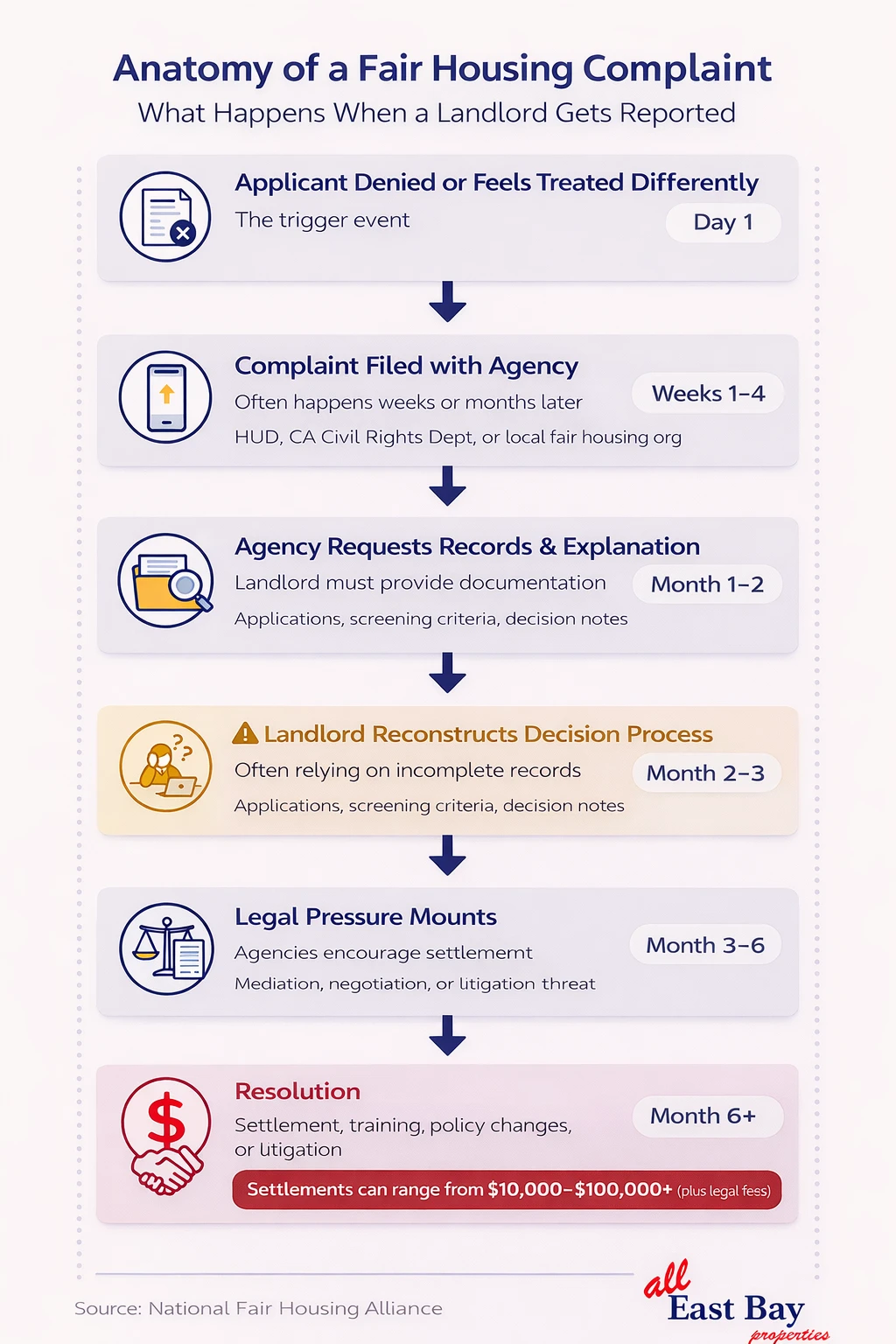
Anatomy of a Fair Housing Complaint
- An applicant is denied or feels treated differently during the application process
- A complaint is filed—often online through HUD, the California Civil Rights Department, or a local fair housing organization—sometimes weeks or months after the denial
- A housing agency requests records and written explanations from the landlord
- The landlord must reconstruct the decision-making process, often relying on memory and incomplete records
- Legal pressure mounts, with agencies encouraging settlement to avoid litigation
- Resolution typically involves a settlement payment, mandated training, policy changes, or in severe cases, litigation
Key insight: Complaints are reactive, not proactive. There are no routine inspections or audits. You usually have no warning until the process has already begun—and by that point, your documentation (or lack thereof) determines the outcome.
Fair housing discrimination settlements: In California settlements often include compensatory damages to victims ranging from $30,000 to $100,000+ (excluding legal fees, civil penalties to the state, or other relief like policy changes and training). For context, that’s often more than a year’s worth of rent from a single unit.
Examples include:
- $40,000 to a complainant in a San Diego disability rights case (2023)
CRD Case Number: 202107-14129009. - $42,500 in a Sacramento Section 8 harassment/eviction settlement (2025)
Sacramento Superior Court Case No. 34-2022-00331695). - $145,000 total (including $110,000 to the tenant) in a San Bernardino source-of-income case (2025)
San Bernardino County Superior Court Case No. CIVRS2400908
Why Bay Area Laws Increase Tenant Screening Risk
Bay Area landlords don’t just navigate state law—they operate under overlapping and often stricter local frameworks:
- Federal Fair Housing Act (HUD)
- California Fair Employment and Housing Act (FEHA)
- Local city ordinances and rent board regulations
Local enforcement agencies in the Bay Area often take a broader view of discrimination, especially around source of income, criminal history, and family status. Screening practices that may seem reasonable elsewhere can trigger scrutiny here.
Specific Bay Area Compliance Traps
Oakland:
The Fair Chance Housing Ordinance in severely restricts the use of criminal background checks. Landlords cannot ask about criminal history until after a conditional offer is made, and even then, only certain convictions can be considered. Asking about arrests (rather than convictions) or inquiring about criminal history too early in the process—even if the applicant volunteers the information—can violate local law.
Berkeley:
Berkeley’s source of income protections (Municipal Code 13.31.020) go beyond state law, although in recent years state law has begun adopting many of these policies. The city actively enforces complaint driven anti-discrimination rules against landlords who discourage voucher holders through differential treatment, such as requiring higher security deposits or additional documentation not required of other applicants, or in advertising. Complaints may also be investigated on the state level through the California Civil Rights Department (CRD). Remedies may include damages, injunctions, civil penalties, and access to denied housing.
Emeryville:
Emeryville has its own inclusionary housing requirements and tenant protections that affect how landlords can screen and select tenants, particularly in buildings subject to affordable housing mandates. For BMR/affordable units in inclusionary developments, landlords/property managers must follow specific qualification rules (e.g., income verification, household size, local preference). Screening must comply with fair housing and cannot arbitrarily exclude based on non-relevant factors.
This is one reason self-managing landlords face elevated compliance risk in the Bay Area. What works in Sacramento or Fresno may not work here—and local tenant advocacy groups are well-resourced and highly active.
What a Compliant Screening Process Actually Requires
A compliant process is not complicated—but it is disciplined. Here’s what it looks like in practice:
Written, Standardized Criteria
Develop specific, objective standards for every decision point: income requirements, credit score minimums, rental history expectations, and allowable negative marks.
Example criteria:
- Gross monthly income must be at least 2.8x the monthly rent
- Minimum credit score of 620 (or explanation of extenuating circumstances)
- No more than one late payment in the past 12 months
- No evictions in the past 5 years
Once these are documented, apply those exact numbers to every applicant—no exceptions without a documented, non-discriminatory reason.
Consistent Review Procedures
Every application must be reviewed using the same steps, in the same order, with the same documentation requirements.
Critical detail: Screen for qualifications first, then conduct background checks—never the reverse. Running a background check before verifying income or rental history can create the appearance that you’re making decisions based on protected characteristics rather than objective qualifications.
Process every application on a first-come, first-qualified basis. Don’t hold applications to compare multiple candidates—this invites subjective decision-making.
Neutral Communication Templates
Standardized approval, denial, and follow-up messaging reduces risk and eliminates ambiguity.
Example denial language:
“Thank you for your interest in our property. Based on our standard screening criteria, we are unable to move forward with your application at this time. You may request a copy of the consumer report we relied upon by contacting [screening company]. If you believe this decision was made in error, please contact us within 10 days.”
This language is factual, doesn’t invite debate, and complies with adverse action notice requirements under the Fair Credit Reporting Act.
Secure Recordkeeping
Retain all applications, screening reports, correspondence, and decision records for at least 3 years—longer if possible. Complaints can be filed months or even years after a denial, and your documentation is your only defense.
Store records securely and consistently. Cloud-based property management systems with audit trails are far superior to paper files or scattered email threads.

Do You Know If Your Screening Process Is Compliant?
Even well-intentioned landlords can have gaps in their processes. The question isn’t whether you mean well—it’s whether your documentation and procedures can withstand scrutiny if a complaint is filed.
Not sure if your tenant screening process is Fair Housing–compliant?
We offer a free 15-minute Fair Housing screening audit for Bay Area landlords—no obligation, no pressure. Sometimes one conversation can prevent years of legal headaches.
Or explore our full property management services to handle compliant screening, rent collection, maintenance, and more.
Frequently Asked Questions (FAQ)
What is the biggest Fair Housing risk for landlords?
Inconsistent tenant screening decisions—especially undocumented exceptions—are one of the most common triggers for Fair Housing complaints. When criteria are applied differently from one applicant to another, it becomes nearly impossible to defend those decisions later.
Does Fair Housing law apply to small landlords?
Yes. While some federal exemptions exist (such as owner-occupied buildings with four or fewer units), California law eliminates most of these exemptions. The California Fair Employment and Housing Act applies to nearly all rental housing, regardless of size.
Can I deny a tenant for poor credit without violating Fair Housing laws?
Yes—if credit standards are written, reasonable, and applied consistently to all applicants. The key is that the same credit threshold must apply to everyone, and you must be able to document that the decision was based solely on credit, not on a protected characteristic.
What is source of income discrimination in California?
Source of income discrimination refers to denying or discouraging applicants based on lawful income sources, such as Section 8 housing vouchers, Social Security, disability benefits, or other government assistance programs. California law prohibits this discrimination statewide, and many Bay Area cities have additional protections.
How long should landlords keep tenant screening records?
Best practice is to retain all application materials, screening reports, and decision documentation for at least 3 years. Fair Housing complaints can be filed well after a decision is made, and your records may be your only defense.
Does professional property management reduce Fair Housing risk?
Professional property managers typically use standardized screening criteria, documented procedures, and compliance processes that significantly reduce exposure. They also stay current on changing local laws and have systems in place to handle complaints if they arise.
Can I ask if an applicant has an emotional support animal before approving them?
No. Under Fair Housing law, disability-related questions (including ESA inquiries) can only be asked after approval, and only if verification is needed for a reasonable accommodation request. Asking upfront—or requiring disclosure on the application—can be considered disability discrimination under both HUD guidelines and California law.
Related Reading
Coming in February
- February 10th: Why “Flexible Screening” Is a Fair Housing Risk
- February 17th: Fair Housing Protected Classes in California: What Landlords Often Miss
- February 24th: Fair Housing Starts Before the Application: Rental Ads & Language That Create Liability
Related video: Fair Housing & Tenant Screening in California: What East Bay Landlords Need to Know