
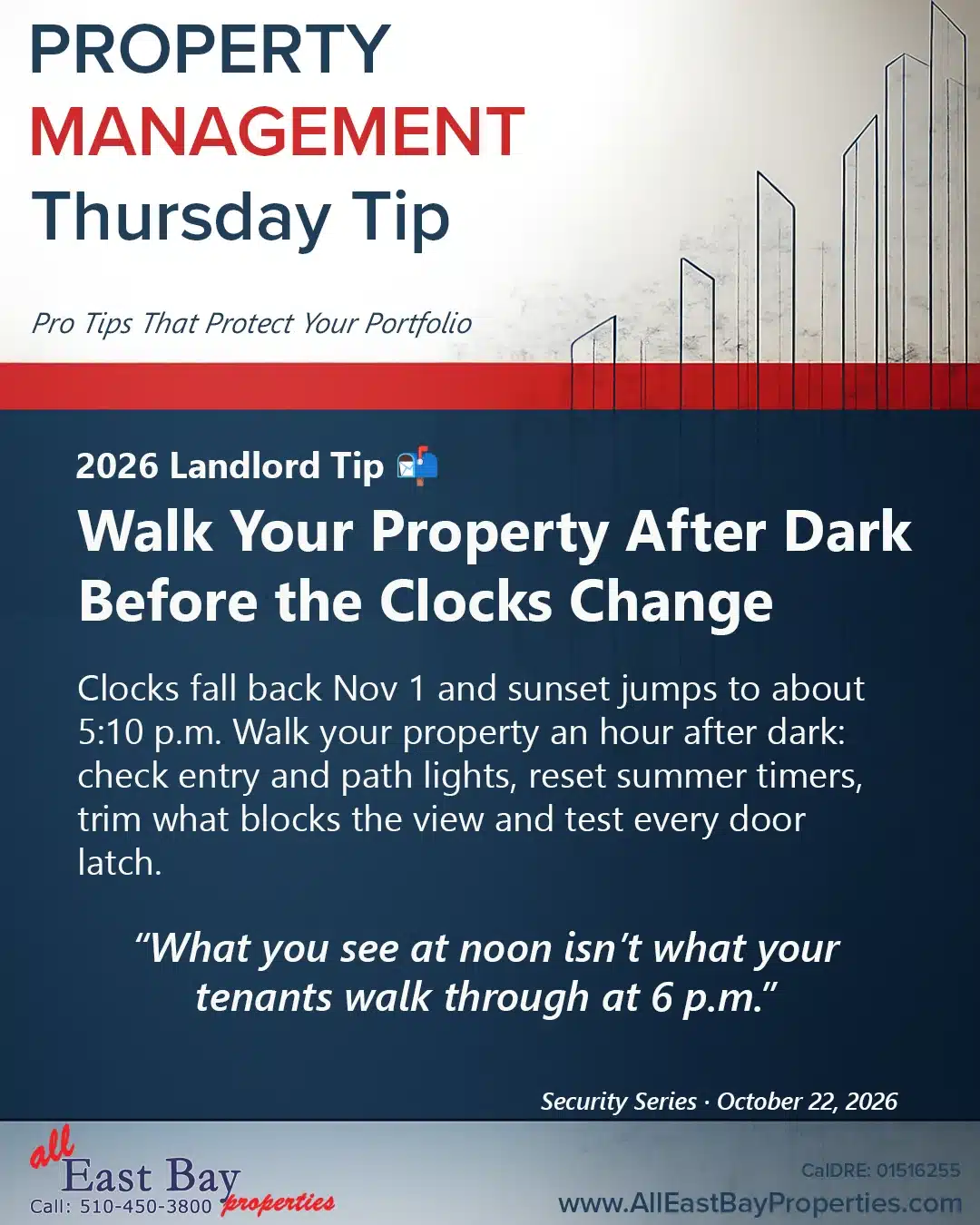
💡 Noon Inspections Miss What Tenants See at 6 P.M.
Most owners see their buildings in daylight: a repair visit, a showing, a quick drive-by. Your tenants see the same building after dark, every night. A burned-out walkway light, a shrub covering the entry or a gate that no longer latches can look like nothing at noon and feel very different at 6 p.m.
This is the month it matters most. Clocks fall back on Sunday, November 1, and Oakland’s sunset moves from about 6:11 p.m. on October 31 to about 5:10 p.m. the next day (sunrise-sunset.org). Exterior lights on a basic timer set for summer evenings can leave entries and paths dark right when tenants are coming home.
What We See at AEBP
Our tenants see the property after dark every night; we mostly see it in daylight. So we rely on them to tell us what’s wrong. Our October tenant newsletter asked residents to submit a maintenance request whenever an exterior light is out, flickering or on a timer that’s no longer set right, and to report any door or gate that isn’t latching on its own. We can only fix what we know about.
Once a tenant reports it, though, we do know about it, and the clock is running. That’s why we treat a broken entry or lobby lock as an emergency, with a vendor sent the same day (company policy). If you self-manage, you’re in the same position: unless someone tells you or you go look, a dark walkway stays invisible. Here’s what to look for when you go (best practice and professional opinion, not a code inspection):
| Spot | What it can look like at noon | What to check after dark |
|---|---|---|
| Main entry | A working door and a fixture on the wall | Is the door, lock and keypad lit? Can you see the entry from the sidewalk? |
| Walkways and stairs | A clear path | Dark gaps between lights, or branches covering a fixture |
| Mail and package area | An ordinary alcove | Is it lit when tenants pick up mail after work? |
| Parking and side gates | Gates that are closed | Dark corners; gates and doors that don’t close and latch on their own |
What you see at noon isn’t what your tenants walk through at 6 p.m.
Your After-Dark Walk Before November 1
- Pick an evening this week: go about an hour after sunset and start from the sidewalk, the way a tenant comes home. Can you see the entry and read the address numbers?
- Check every light: entries, walkways, exterior stairs, the mail area and parking. Note burned-out bulbs, failed fixtures and dark gaps between lights.
- Check the controls: reset any basic timer still on summer settings, and again after the clock change. Best practice: for entries and main paths, consider a photocell or astronomic timer, which adjusts for the season on its own.
- Look for what blocks the view: Oakland’s residential CPTED checklist uses about 2 feet for landscaping and about 6 feet of clear space beneath tree canopies. We use it as a voluntary self-audit.
- Try every door and gate: California’s lock law (Civil Code §1941.3) addresses locks on exterior doors into common areas of multifamily buildings. Best practice: also confirm doors and gates close and latch on their own.
- Make reporting easy, and log it: remind tenants how to report a light that’s out or a door that won’t latch, then record each report with the date reported and the date fixed.
💡 This week’s takeaway
Walk your property once after dark before the clocks change on November 1. It takes about half an hour, most of what you’ll find is a bulb, a timer or a pair of pruning shears, and every fix is one your tenants would otherwise have had to report.
📘 Learn more
This tip comes from Monday’s full guide to lighting, sightlines and access:
→ Lighting, Sightlines and Access: Crime Prevention Through Environmental Design for East Bay Rentals — the full after-dark checklist, photocells vs. timers, and what the research says about lighting
→ Landlord Security Duties in California — the §1941.3 lock list and how a known problem affects liability
→ How to Stop Package Theft in an Apartment Building — mail and package areas in older East Bay buildings
This tip is part of our ongoing education series for Bay Area landlords focused on compliance, risk reduction, and smarter property management. 📋 Browse all Thursday Landlord Tips →