
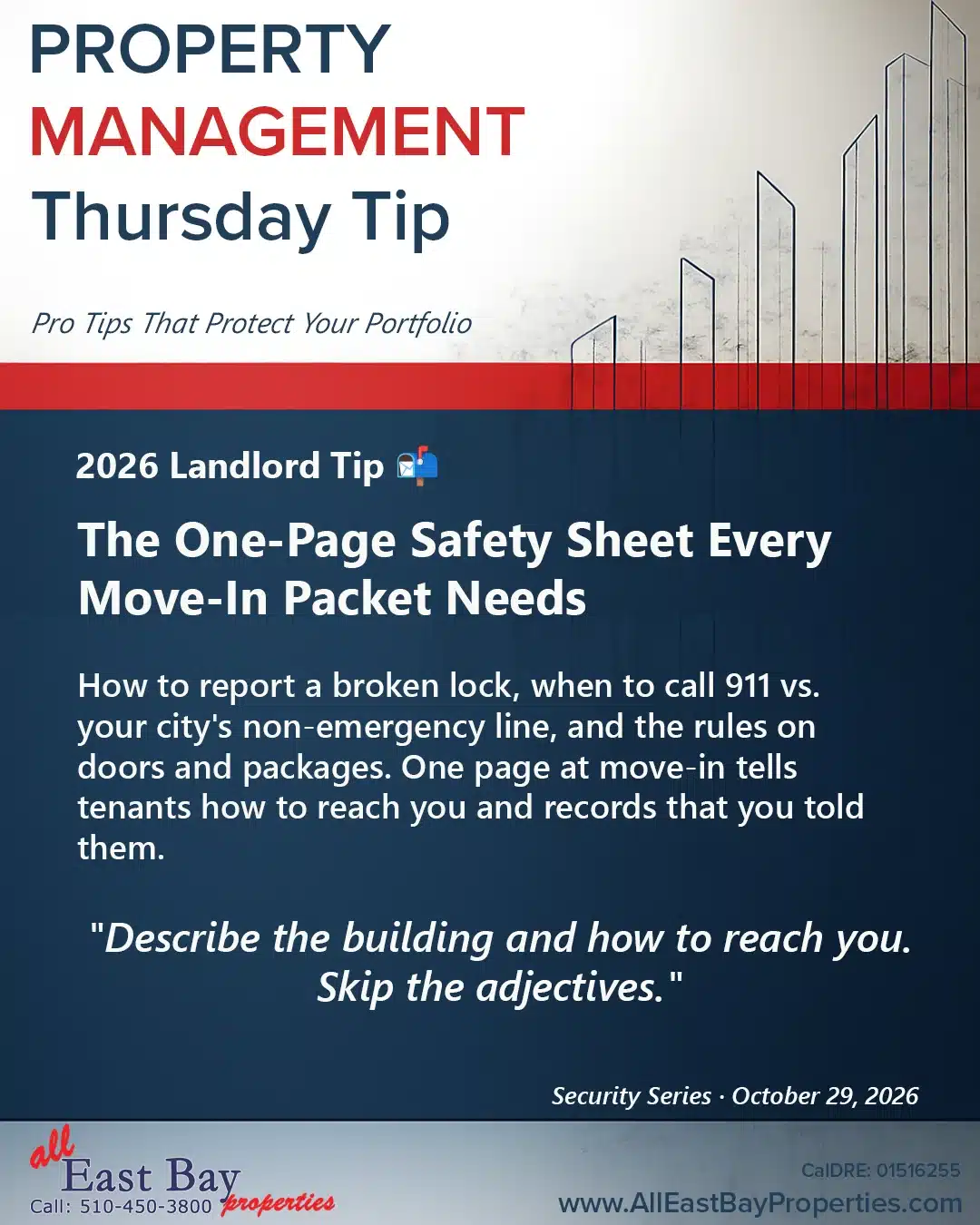
💡 One Page, Two Jobs
A tenant who doesn’t know how to report a broken lobby lock can’t tell you about it. Under California’s lock law, the time to fix a broken required lock starts when you have notice of it (Civil Code §1941.3(b)). The easier you make reporting, the sooner you hear about the problem and can get it fixed.
A one-page safety sheet in the move-in packet does two jobs. It tells tenants exactly how to reach you when something breaks, and it gives you a written record that you told them. It takes about 30 minutes to write. With Halloween this weekend and holiday deliveries picking up, it’s also worth re-sending to the tenants you already have.
What We See at AEBP
Two documents do most of this work for us. The first is the short welcome sheet every new tenant gets on top of the lease documents. It explains that routine repairs go through the tenant portal as a work order and urgent problems go to our 24/7 maintenance line at (510) 450-3815, with a note to save the number. A broken entry or lobby lock counts as urgent, and we send a vendor the same day (company policy).
The second is the tenant newsletter. Our October issue went to every resident. It asked them to report exterior lights that are out and doors or gates that won’t latch, because “we can only fix what we know about.” It reminded them not to prop secured doors or buzz in strangers, listed the Oakland, Berkeley and Emeryville non-emergency police numbers, and asked them to “let us know too so we can follow up on the property side.” If you self-manage, you can put all of that on one page. Here’s a layout (best practice, not a legal form):
| Section | What to write |
|---|---|
| How to report a problem | Your maintenance phone line and portal. Say that a broken lock, an entry door that won’t latch or an exterior light that’s out should be reported right away. |
| 911 or non-emergency | “For an emergency or a crime in progress, call 911. For anything else, call your city’s non-emergency police line, and please let us know too.” |
| Local non-emergency lines | Oakland 510-777-3333 · Berkeley 510-981-5900 · Emeryville 510-596-3700 (Alameda County DA, June 2026) |
| Entry doors | Don’t prop secured doors or gates open. Don’t buzz in anyone you don’t know. |
| Packages | Pick up promptly. Use delivery instructions or a pickup locker for anything valuable. Be careful with “I have a delivery” at the buzzer. |
| Lock changes | Tenants who qualify under Civil Code §1941.5 or §1941.6 can ask for a lock change. Say who to contact. |
| Leave off | “Secure building,” “safe neighborhood,” safety ratings, crime statistics you’ve pulled together yourself, and any promise about outcomes |
Describe the building and how to reach you. Skip the adjectives.
Build Your Sheet This Week
- Start with how to reach you: one phone number and one portal or email address, with a plain line saying lock, door and lighting problems are urgent.
- Add 911 and your city’s non-emergency line: use the numbers in the table above, and ask tenants to let you know too. Don’t discourage calls for help: Civil Code §1946.8 protects calls about abuse, a crime or an emergency.
- Add the house rules: propped doors, buzzing in strangers and package pickup, in one or two lines each.
- Mention lock-change requests: who to contact if a tenant qualifies under §1941.5 or §1941.6.
- Read it once for outcome words: replace “safe,” “secure” and “patrolled” with the features that actually exist, such as “locked lobby entry with a self-closing door.”
- Hand it out and keep proof: include it in every move-in packet, email a copy to current tenants this week, and save the email. Check the phone numbers once a year.
💡 This week’s takeaway
Put how to report a problem, when to call 911 and the house rules on one page, and give it to every tenant. It takes about half an hour, it helps you hear about broken locks and dark entries sooner, and it leaves a record that you told tenants how to reach you.
📘 Learn more
This tip comes from Monday’s full guide to talking with tenants about safety:
→ How East Bay Landlords Can Talk With Tenants About Safety Without Promising More Than the Law Requires — the words-to-avoid table, the full move-in packet list and a five-step process for security complaints
→ A Broken Lock Report Isn’t Just a Complaint. It’s Notice. — what happens once a tenant tells you
→ Before You Add Another Camera, Check Where Packages Land — package areas before the holiday rush
→ Landlord Security Duties in California — what you’re liable for, and what you’re not
This tip is part of our ongoing education series for Bay Area landlords focused on compliance, risk reduction, and smarter property management. 📋 Browse all Thursday Landlord Tips →