

Share this post
Quick Answer
Berkeley’s 2026 allowable rent increase (AGA) is 1.0%, effective January 1 – December 31, 2026 — a calendar-year cycle, not the August–July window Oakland and AB 1482 use. The rate is the easy part. Berkeley layers three separate registration deadlines on top of it, delays a brand-new tenancy’s first increase longer than any other city AEBP manages in, and requires annual security deposit interest that most out-of-area owners don’t discover until they’re already behind on it. Just-cause eviction protection, by contrast, applies from day one of a covered tenancy — no waiting period, despite a persistent myth that one exists.
Key Facts: Berkeley Rent Control 2026
| Requirement | What It Is | Deadline / Detail |
|---|---|---|
| 2026 Annual General Adjustment (AGA) | 1.0% | Jan 1 – Dec 31, 2026 (calendar year) |
| New-tenancy AGA delay | No increase for the rest of the year a tenancy starts, plus one full additional calendar year | Longest new-tenancy delay of any city AEBP manages in |
| Annual registration fee | Rent Board registration & fee payment | FY 2026–27 fees were due July 2, 2026 — 100% penalty for late payment |
| New-tenancy registration | Register the new tenancy with the Rent Board | Within 15 days of move-in; tenancies starting on/after Dec 20, 2024 also require written notice to the tenant of the Ordinance’s applicability, the unit’s exemption status, and any right to petition rent increases |
| Exemption status-change registration | Unit changes from exempt to non-exempt | Within 60 days of the change |
| Just cause for eviction | Applies from day one of a covered tenancy | No blanket occupancy minimum under BMC 13.76.130 |
| Security deposit interest | Annual interest for the Nov 1–Oct 31 interest year, paid each December as a cash payment or rent credit | Legal deadline January 31; if missed, the tenant may recover that year’s interest at a 10% rate |
| No-fault relocation payment | Owner Move-In & Ellis Act evictions | $19,413 standard, plus $6,471 for qualifying households — effective Jan 1, 2026 |
This guide goes deep on Berkeley specifically. For how Berkeley’s rate compares to Oakland, Richmond, and Emeryville, see our East Bay Rent Control Comparison.
Video Transcript
Berkeley’s rent increase this year is 1 percent — the smallest cap in the East Bay. If that’s the only number you know about Berkeley rent control, you’re already behind, because the calendar around that number is where owners actually get tripped up.
Start with timing. Berkeley runs its rent-ceiling year on the calendar — January through December — not the August-to-July window Oakland and the state’s AB 1482 use. Try to schedule a Berkeley increase the way you’d schedule an Oakland one, and you’ll get the date wrong.
Registration isn’t one deadline, it’s three. The annual Rent Board fee — this year due July 2nd, with a full 100 percent penalty if you’re late. A 15-day window to register any new tenancy, which as of December 2024 also requires giving the tenant written notice of their rights under the ordinance. And a 60-day window if a unit’s exemption status changes. Treat those as one open-ended task, and the annual fee is the one that actually costs money.
Then there’s the new-tenancy delay. A Berkeley tenancy can’t see its first rent increase until the rest of the year it started, plus one full additional year. Move a tenant in this March, and the earliest increase is 2028 — the longest new-tenancy delay of any city we manage in.
Now the part that actually surprises people: just cause. There’s a persistent myth that Berkeley eviction protection doesn’t start until 12 months in — sometimes blamed on “Measure MM.” We checked the actual ordinance directly. There’s no waiting period. Just cause applies from day one. That 12-month figure belongs to the state’s AB 1482 backstop, not Berkeley’s own rule — and Measure MM has nothing to do with eviction timing at all; it’s about registration and pandemic-era back rent.
One more figure worth knowing: no-fault terminations. For an owner move-in or an Ellis Act eviction, Berkeley’s relocation payment is $19,413 — well above the state’s flat one-month standard — plus another $6,471 if the household qualifies.
And here’s something we changed on our own end. Berkeley requires annual security deposit interest, and for years the standard was a small paper check. Tenants don’t cash small checks, and an uncashed one eventually has to be escheated to the state — so we stopped mailing checks and now credit the interest straight to the tenant’s rent ledger instead. No check to lose, nothing left outstanding.
The rate is the easy part of Berkeley rent control. The registration calendar, the new-tenancy delay, and the just-cause myth are what actually get owners in trouble — and that’s what the full written guide covers, linked below.
Berkeley’s 1.0% AGA — and Why the Calendar Matters More Than the Rate
Berkeley’s Annual General Adjustment for 2026 is 1.0%, set by the Rent Stabilization Board using 65% of the CPI change for the San Francisco-Oakland-San Jose region over a July 2024–June 2025 lookback window. Berkeley’s rent ceilings adjust by this amount each January 1 — a calendar-year cycle that doesn’t match Oakland’s or AB 1482’s August 1–July 31 cycle, and the mismatch creates an easy scheduling trap for owners managing units in more than one East Bay jurisdiction. Owners shouldn’t treat August 1 as Berkeley’s reset date: the AGA itself resets January 1, though an eligible landlord may still implement an allowable increase later in the year with proper notice.
The 1.0% figure isn’t the whole rule, either. In November 2024, Berkeley voters passed Measure BB, which lowered the AGA’s maximum from 7% to 5%, tightened several just-cause and nonpayment-eviction rules, and expanded registration requirements to more government-subsidized units. Measure BB didn’t set the 1.0% rate itself — the Rent Stabilization Board calculates that separately, every year — but it changed the ceiling the rate operates under.
That 5% ceiling has one exception worth knowing: banking. Banked (deferred) AGAs from prior years can still push an owner’s actual increase above 5% in a given year, up to the unit’s lawful rent ceiling — so a banked-increase calculation isn’t automatically capped at 5% the way a single year’s fresh AGA is.
The New-Tenancy Delay Nobody Warns You About
A brand-new Berkeley tenancy doesn’t just wait out the standard notice period before its first AGA increase — it’s locked out of the AGA entirely for the rest of the calendar year it started, plus one full additional calendar year. A tenancy that begins March 1, 2026 gets no AGA increase for the remainder of 2026 or in 2027; the earliest AGA increase available is in 2028. That’s close to two full years of AGA-ineligibility from a single move-in date, and it’s the longest new-tenancy delay of any city AEBP manages a property in — longer than Oakland’s 12-month delay or Richmond’s next-September-1 rule.
The delay runs from the tenancy’s actual start date, not the lease type and not any later conversion date. A tenancy that begins on a fixed-term lease and later converts to month-to-month under Civil Code §1945 still has its AGA clock keyed to the original move-in date — the conversion doesn’t reset it. Owners coming from a market with no such rule (or from Oakland’s shorter 12-month version) are the ones most likely to try an increase too early.
Registration Isn’t One Deadline — It’s Three
Berkeley Rent Board registration gets described as “ongoing” often enough that owners assume there’s no real deadline attached to it. There is — several, in fact, depending on what triggered the filing:
- Annual registration fee. This one has a fixed, penalized due date. FY 2026–27 fees were due July 2, 2026, and Berkeley’s ordinance imposes a full 100% penalty on any payment not received or postmarked by that date. Check the current year’s Rent Board notice for whether a penalty-waiver window is open that year — it isn’t standing policy every cycle.
- New-tenancy registration. Owners must update tenancy information with the Rent Board within 15 days of a new tenancy starting. This is a rolling, per-tenancy requirement, separate from the annual fee above. For tenancies beginning on or after December 20, 2024, landlords must also give the tenant written notice within that same 15-day window — not a second copy of the city paperwork, but a disclosure telling the tenant where they stand: that the Rent Ordinance exists and applies, whether the unit is exempt (fully covered, partially covered, or exempt) and any partial exemptions, and the tenant’s right to petition against certain rent increases if applicable. The Rent Board publishes a template (“Notice of Tenant Rights”) landlords can use rather than drafting their own language.
- Exemption status-change registration. If a unit’s coverage status changes — for example, from exempt to non-exempt — it must be registered within 60 days of the change.
Treating “registration” as a single, open-ended task is exactly how the annual fee deadline gets missed — the update-anytime provision that applies to keeping contact and manager information current is real, but it isn’t the same thing as the fee deadline, and confusing the two is the mistake that actually costs money.
Just Cause Applies From Day One — Not After 12 Months
A version of Berkeley’s just-cause rule keeps circulating that’s simply wrong: that eviction protection kicks in only after 12 months of continuous occupancy, “under Measure MM.” We checked the actual ordinance text — BMC 13.76.130 — directly. It has no blanket occupancy minimum before just-cause protection applies.
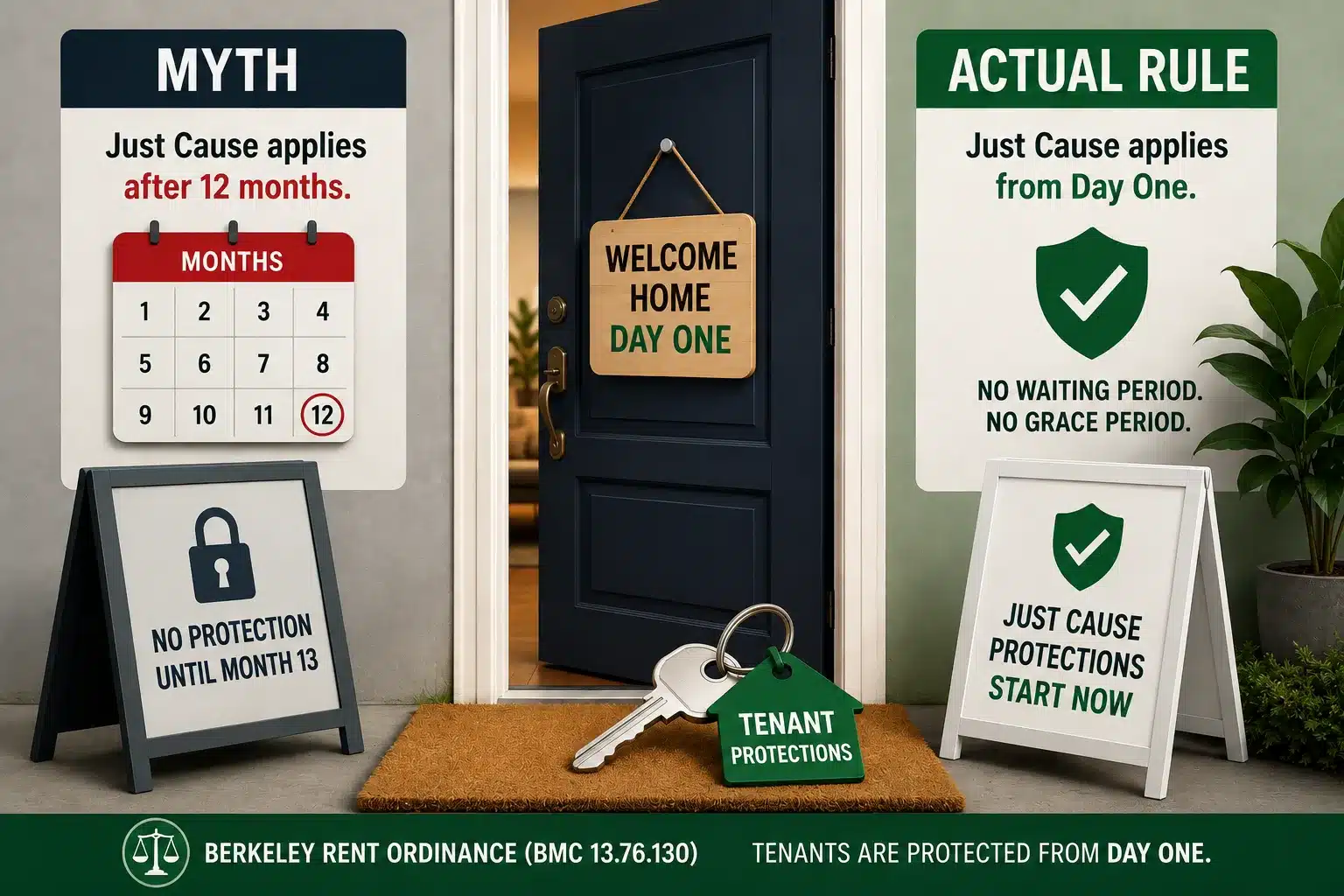
A handful of specific enhanced protections inside that same section do carry their own residency thresholds — additional relocation assistance where a household member has lived there a year or more, and stronger protections for families with minor children (12 months) or seniors, disabled tenants, and tenants in larger portfolios (5 years). Those are add-on safeguards layered on top of baseline just cause, though, not a condition on whether just cause applies at all.
The 12-month figure that keeps getting attached to Berkeley is most likely a mix-up with AB 1482’s own statewide 12-month just-cause backstop, which would only be relevant for a Berkeley unit not covered by the local ordinance at all — a narrow edge case, not the general rule. It’s also a mix-up of two different Berkeley ballot measures with similar names: Measure MM (passed November 2020) is about registration requirements for partially-covered units and reclassifying pandemic-era back rent as consumer debt — it has nothing to do with eviction timing. Measure BB (passed November 2024, discussed above) is the one that actually touched just-cause rules, and even it didn’t add a waiting period.
Bottom line: Berkeley’s local just-cause ordinance applies from day one of a covered tenancy, the same as Oakland’s and Richmond’s local ordinances. If a specific unit’s coverage category is in question — fully covered, partially covered, or exempt — that’s a coverage question, not a timing question, and it’s where Berkeley’s real nuance actually lives.
No-Fault Terminations: Relocation Isn’t AB 1482’s Flat Rate
Where no local ordinance applies, AB 1482 requires relocation assistance equal to one month’s rent (or an equivalent rent waiver) for a no-fault termination. Berkeley doesn’t default to that figure — it sets its own, substantially larger amount under its own eviction-relocation ordinance, which applies to Owner Move-In and Ellis Act evictions. Effective January 1, 2026: a standard payment of $19,413, plus an additional $6,471 for qualifying households — low-income, disabled, or elderly tenants, households with minor children, or a tenancy that began before January 1, 1999 (confirm current criteria against the Rent Board’s own notice before applying it to a specific tenant). This is Berkeley’s eviction-relocation figure specifically; it’s separate from Berkeley’s temporary-displacement relocation program for code-required repairs, which is a different requirement entirely and shouldn’t be cited from the same figure.
What We Do Differently: Paying Berkeley’s Security Deposit Interest
Berkeley calculates security deposit interest on a Nov 1–Oct 31 interest year, and landlords are expected to pay it annually each December, as a cash payment or a credit against rent. The legal backstop is January 31: if it isn’t paid by then, the tenant may recover that year’s interest at a 10% rate instead of the Rent Board’s annual rate. Most owners hold their own tenants’ deposits, so this obligation usually sits with the owner directly — but on the properties where AEBP does hold the deposit, we calculate and apply the credit each November, ahead of the December norm, and we’ve made one specific operational change that came out of a real problem, not a hypothetical one.
We used to issue the interest payment as a physical check, the way most owners assume it works. The problem is that small-value checks — a few dollars, sometimes less — are exactly the kind tenants forget to deposit. Left uncashed long enough, that money doesn’t just disappear; it has to be escheated to the state after several years, which turns a routine annual payment into an open compliance loose end that somebody has to track for years afterward. We now issue Berkeley’s deposit interest as a credit directly on the tenant’s rent ledger instead. It shows up immediately, there’s no check to lose or forget, and there’s nothing left outstanding at year’s end.
It’s a small operational choice, not a legal requirement — the ordinance doesn’t require a physical check; it permits the annual interest to be returned as a cash payment or a rent rebate, so long as it’s paid on time and at the correct rate. But it’s the kind of detail that only shows up after actually managing this requirement across a real portfolio, which is the gap between reading the ordinance and being the one accountable for complying with it every January.
DIY vs. AEBP-Managed: Berkeley Compliance Side by Side
| Requirement | Handling It Yourself | With AEBP |
|---|---|---|
| AGA calculation & notice timing | Track the calendar-year cycle separately from any Oakland/Richmond units you also own, and confirm each unit’s new-tenancy delay before issuing a notice | Calculated and served on the correct calendar, per unit, automatically |
| Rent Board registration (3 deadlines) | Track the annual fee, the 15-day new-tenancy window, and the 60-day status-change window separately, with no single reminder system | All three deadlines tracked and filed as part of standard portfolio management |
| Security deposit interest | Calculate the current rate, pay by January 31, and manage the check-escheatment risk yourself | Calculated, delivered as a rent-ledger credit, and reconciled — no outstanding checks |
| Just-cause documentation | Confirm coverage and grounds yourself before serving any notice, with no local track record to check assumptions against | Paperwork, Rent Board coordination, and legal referral when a case needs it |
| Relocation assistance (no-fault) | Confirm the current year’s dollar figures and qualifying-household criteria before calculating a payment | Current figures applied correctly, verified against the Rent Board’s own current-year notice |
Bottom Line
Berkeley’s 1.0% AGA is the smallest rate in AEBP’s territory, but the system around it is the most layered — a calendar-year cycle that doesn’t match Oakland’s or AB 1482’s, the longest new-tenancy delay of any city here, three separate registration deadlines instead of one, and an annual security deposit interest obligation many owners don’t discover until it’s overdue. Just-cause timing is the one place Berkeley is actually simpler than the myths suggest: it applies from day one, no waiting period. Getting the rate right and getting the system right are two different jobs — this guide is the second one.
Before You Raise the Rent on a Berkeley Unit
Run through this before serving any AGA increase notice:
- Confirm the unit is fully covered by Berkeley’s Rent Ordinance, not partially covered or exempt.
- Confirm the tenancy has cleared Berkeley’s new-tenancy delay (rest of the start year, plus one full additional calendar year).
- Check the unit’s current lawful rent ceiling and whether any banked AGAs from prior years apply.
- Confirm the annual Rent Board registration fee is paid and current for the fiscal year.
- Confirm there’s no open Rent Board order, unresolved habitability violation, or unpaid security deposit interest that could block the increase.
- Check whether a fixed-term lease’s terms permit the increase before its end date.
- Serve the increase with the correct written notice period (30 days for increases of 10% or less, 90 days for larger increases).
Current rule at a glance
Frequently Asked Questions
What is Berkeley’s rent increase cap (AGA) for 2026?
1.0%, effective January 1 through December 31, 2026. Berkeley’s AGA runs on a calendar-year cycle, not the August–July cycle Oakland and AB 1482 use, and it’s set annually by the Berkeley Rent Stabilization Board using 65% of the regional CPI change.
How soon after a new tenancy starts can I raise the rent in Berkeley?
Not until the calendar year after next. Berkeley bars any AGA increase for the rest of the year a tenancy starts, plus one full additional calendar year — so a tenancy that begins in March 2026 isn’t eligible for its first AGA increase until 2028. This is the longest new-tenancy delay of any city AEBP manages a property in.
Do I need to register my Berkeley rental property every year?
Yes, and it’s actually three separate deadlines, not one. The annual registration fee (FY 2026–27 was due July 2, 2026, with a 100% penalty for late payment), a 15-day window to register any new tenancy, and a 60-day window if a unit’s exemption status changes. Treating registration as a single open-ended task is how the fee deadline specifically gets missed.
Does Berkeley require a 12-month wait before just-cause eviction protection applies?
No. That’s a common myth, sometimes attributed to “Measure MM.” We checked BMC 13.76.130 directly — Berkeley’s just-cause ordinance applies from day one of a covered tenancy, with no blanket occupancy minimum. The 12-month figure comes from AB 1482’s separate statewide backstop, which only matters for a Berkeley unit not covered by the local ordinance at all.
How much relocation assistance do I owe a Berkeley tenant for a no-fault termination?
As of January 1, 2026: a standard payment of $19,413 for an Owner Move-In or Ellis Act eviction, plus an additional $6,471 for qualifying households — low-income, disabled, or elderly tenants, households with minor children, or a tenancy that began before January 1, 1999 (confirm current criteria against the Rent Board’s own notice before applying it to a specific tenant). This is well above AB 1482’s statewide flat one-month’s-rent figure, which doesn’t apply where Berkeley’s own ordinance covers the unit.
Sources
- Berkeley 2026 AGA, 1.0% — Required by local ordinance. Berkeley Rent Board — 2026 AGA Published
- Measure BB (Nov 2024) — Required by local ordinance. Measure BB Changes to Berkeley’s Rent Ordinance
- New-tenancy AGA delay — Required by local ordinance. Berkeley Rent Board — Annual General Adjustment
- Registration fee deadline & penalty — Required by local ordinance. Berkeley Rent Board — Registration Fees, FY 2026–2027
- New-tenancy & status-change registration windows — Required by local ordinance. Berkeley Rent Board — Partially Covered Unit Registration
- Just cause, no waiting period — Required by local ordinance. Confirmed directly against BMC 13.76.130, corroborated by Berkeley Rent Board — Just Cause & Other Local Requirements
- No-fault relocation payments, effective Jan 1, 2026 — Required by local ordinance. Berkeley Rent Board — 2026 Adjustments of Relocation Assistance Payments
- Security deposit interest (Nov 1–Oct 31 interest year, December payment, Jan 31 deadline, 10% interest rate if missed) — Required by local ordinance. Berkeley Rent Board — Security Deposit Interest & Calculator; Berkeley Rent Board — 2026 AGA Published and 2025 Security Deposit Interest Payment Due Soon
- AEBP’s security-deposit-interest ledger-credit practice — AEBP documented experience / company policy.
- AB 1482 statewide relocation baseline — Required by law. Civil Code §1946.2
Not Sure Your Berkeley Property Is Fully Covered?
We’ve managed Berkeley rentals since 2005, including Rent Board registration, AGA notices, and Berkeley’s annual security-deposit-interest requirements. If you’re not certain your property is current on all three registration deadlines, we’ll check.