

Share this post
Quick Answer
Richmond’s Fair Rent, Just Cause for Eviction, and Homeowner Protection Ordinance caps most covered units’ annual rent increase at 1.5% for September 1, 2026 through August 31, 2027 — down from 1.62% the prior cycle, and now lower than Oakland’s newly effective 2.3% rate. Richmond also runs its own registration system (a one-time Property Enrollment plus per-tenancy registration, not an annual renewal like Oakland or Berkeley), its own eight-ground just-cause eviction list, and a separate Residential Rental Inspection Program with its own fees. None of it maps cleanly onto Oakland’s or Berkeley’s rules, which is exactly where multi-city owners get tripped up.
Key Facts: Richmond Rent Control at a Glance
| Requirement | What It Is | Deadline / Detail |
|---|---|---|
| 2026–27 Annual General Adjustment (AGA) | 1.5% | Sept 1, 2026 – Aug 31, 2027, down from 1.62% the prior cycle |
| Rent formula | Depends on the Base Rent plus every lawful AGA (and any banked AGA) applied since — no simple formula; use the city’s MAR calculator for a specific unit | Base Rent = rent in effect July 21, 2015, or first rent to a tenant who moved in after that date |
| Full coverage (rent cap + just cause) | Multi-unit properties, one parcel | Permitted before February 1, 1995 |
| Partial coverage (just cause only) | Section 8, single-family homes/condos, new construction | Post-February 1, 1995 permits |
| New-tenancy AGA delay | Tenancy must exist a full calendar year | Before the next September 1 to qualify for that year’s AGA |
| Registration | Two separate filings, not one renewal | Property Enrollment (once per property) + Tenancy Registration (per tenancy, refiled on turnover) |
| Just cause grounds | 8 causes under RMC 11.100.050 | Several require a prior written warning |
| Business License Tax | 1.081% (1–4 units) or 2.880% (5+ units) of prior-year gross receipts | Due March 1 |
| RRIP inspection program | $110/owner registration + $220/unit inspection (confirm registration frequency with the Rent Program) | Re-inspection $94/unit if a unit fails; RMC 6.40 |
| Relocation (permanent, per unit) | $4,356–$21,009 depending on unit size and household | 2025 figures — 2026 update delayed, not yet published |
This guide goes deep on Richmond specifically. For how Richmond’s rate compares to Oakland, Berkeley, and Emeryville, see our East Bay Rent Control Comparison.
Video Transcript
Richmond’s rent cap for the year ahead is 1.5 percent — down from last cycle’s 1.62 percent. That’s the easy number. What actually catches owners is the direction it just flipped, and how differently Richmond runs everything else.
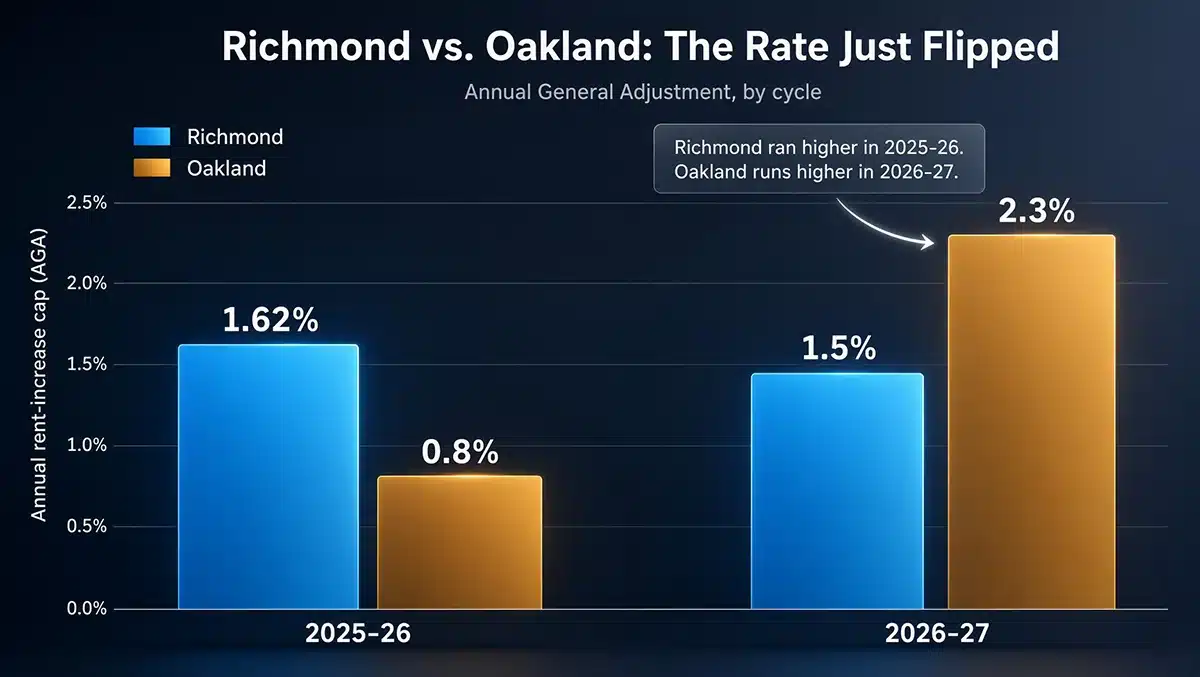
Start with the flip. Last cycle, Richmond’s rate ran higher than Oakland’s — 1.62 percent versus Oakland’s 0.8 percent. Close enough that a multi-city owner could round Richmond up to Oakland’s number and only slightly under-collect. This cycle, that relationship reversed. Oakland’s cap rose to 2.3 percent in August. Richmond’s dropped to 1.5 percent in September. Apply Oakland’s rate to a Richmond unit now, and you’re over the cap — which a tenant can challenge.
Coverage works differently too. Richmond splits every unit into three buckets. Fully covered gets both the rent cap and just-cause protection — that’s multi-unit buildings permitted before 1995. Partially covered — single-family homes, condos, newer construction — gets just cause but not Richmond’s local cap. It might still fall under the state’s AB 1482 cap instead, which is worth checking separately, not assumed away.
Registration is where owners coming from Oakland or Berkeley get tripped up. Richmond doesn’t do one annual renewal. It’s two separate filings: a one-time Property Enrollment per property, and a Tenancy Registration for each individual tenancy in fully-covered units, refiled every time a tenant turns over. An increase issued while either filing is stale is void.
Just cause covers eight grounds — failure to pay rent, lease breach, nuisance, and more — several requiring a written warning first.
Here’s something we’ve seen directly. We manage properties in both Oakland and Richmond, and we watched that rate relationship flip firsthand this cycle. We’ve also seen how closely Richmond tracks ownership changes — a client who’d just bought a Richmond rental got a letter straight from the city reminding him a business license was required. Richmond pays closer attention than a lot of owners expect.
The bottom line: don’t carry forward what was true last cycle, or what’s true in another city. Confirm the current number before you serve the notice. The full written guide breaks down registration, just cause, relocation pay, and the fees Richmond owners don’t see coming — linked below.
Why Richmond Is Easy to Underestimate
Richmond doesn’t come up as often in East Bay landlord conversations as Oakland or Berkeley, and owners managing across multiple cities can end up treating it as an afterthought — the quieter of the three. That’s a mistake. Richmond voters passed the Richmond Fair Rent, Just Cause for Eviction, and Homeowner Protection Ordinance (RMC 11.100) in November 2016, effective that December, and it set up rent control, just-cause eviction protection, a rent-adjustment petition process, and its own registration system — a full local framework, built independently of Oakland’s and Berkeley’s, on its own clock.
The rate itself is the easy part to check. The parts that actually catch owners are what’s covered, how registration works, and — as of this cycle — which direction the rate mistake now runs.
What’s Actually Covered
Richmond’s ordinance sorts every rental unit into one of three buckets:
- Fully covered (rent cap + just cause): multi-unit properties — more than one dwelling unit on a single parcel — permitted before February 1, 1995.
- Partially covered (just cause only, no Richmond rent cap): government-subsidized/Section 8 units, single-family homes and condominiums (one unit per parcel), and “new construction” permitted after February 1, 1995.
- Fully exempt: units where the landlord shares a kitchen or bathroom with the tenant, a permitted ADU added to an owner-occupied single-family home, and non-profit senior housing.
That middle category is where the most common misunderstanding sits. A single-family rental in Richmond isn’t subject to Richmond’s local rent cap — but it does get just-cause eviction protection, and it may still be subject to California’s statewide rent cap under AB 1482 (Civil Code §1947.12), which applies independently of local ordinances. AB 1482 coverage turns on things like whether the property is owned by an individual rather than a corporation or REIT, whether it’s separately alienable from any other unit, and whether the required exemption notice has been given to the tenant — worth checking on its own, not assumed away because Richmond’s local cap doesn’t apply. Owners who’ve only dealt with Oakland or Berkeley, where the coverage lines fall differently, sometimes assume “no local rent cap” means “no rent cap at all” for a single-family unit. It doesn’t — it just means any applicable cap comes from the state instead of the city.
The 2026–27 Rate — and Why the Direction Just Flipped
Richmond’s Annual General Adjustment for September 1, 2026 through August 31, 2027 is 1.5%, calculated as 60% of CPI capped at 3% under Regulation 615 — a slight decrease from the prior cycle’s 1.62%. That 1.5% doesn’t apply to a flat Base Rent figure the way a single-year formula suggests: a unit’s actual Maximum Allowable Rent (MAR) depends on the Base Rent (the rent in effect July 21, 2015, or the first rent charged to a tenant who moved in after that date) plus every lawful AGA applied in the years since, plus any banked AGA an owner is carrying forward. Use the Rent Program’s own MAR calculator for a specific unit rather than multiplying by a single year’s rate.
Here’s the change worth flagging this cycle: last cycle (2025–26), Richmond’s AGA (1.62%) ran higher than Oakland’s (0.8%) — close enough that a multi-city owner could default to Oakland’s lower number on a Richmond unit and only under-collect a little. That relationship reversed for 2026–27: Oakland’s RAP rate rose to 2.3% on August 1, 2026, and Richmond’s dropped to 1.5% on September 1. Which city runs higher has moved before and will likely move again, so the safer habit is checking each city’s current-cycle number rather than assuming either one “usually” runs hotter. Getting it backwards this cycle isn’t a rounding error — applying Oakland’s 2.3% to a Richmond unit without a lawful banking basis or other authorized exception produces an increase above what Richmond’s own cap allows, which a tenant can challenge through Richmond’s own petition process.
Richmond also allows banked increases — but on a different formula than Oakland’s. A Richmond landlord who skipped an AGA in a prior year can apply the current year’s AGA plus up to 5 percentage points of previously deferred AGAs (6.5% total this cycle) in a single notice. Oakland’s banking cap is a multiplier of the current CPI instead. The two land in a similar range some years by coincidence, not because the underlying formulas match — don’t use one city’s banking math to estimate the other’s.
Standard notice rules still apply on top of all of this: generally at least 30 days’ written notice if the cumulative rent increases over the preceding 12 months total 10% or less, and at least 90 days if they total more (Civil Code §827) — the test looks at the total increase over the trailing year, not just this one notice, and mailed notice requires additional time beyond hand delivery. Serving more than the minimum notice period doesn’t by itself cure an otherwise unlawful increase or defective service — the increase still has to be lawful and properly served regardless of notice length. File the notice plus Proof of Service with the Rent Program within 10 business days of serving the tenant.
Registration: Two Separate Filings, Not One Annual Renewal
This is where Richmond diverges most from Oakland and Berkeley’s model. Richmond splits registration into two distinct requirements:
- Property Enrollment — filed once per property, for every rental unit in the city regardless of coverage category, through the Rent Program’s iMS system.
- Tenancy Registration — required only for fully-covered units, filed for each individual tenancy, and re-filed any time there’s a complete change in tenancy.
Both have to be current for a rent increase to be valid — an increase issued while either filing is out of date is null and void. Property Enrollment also has to be amended any time there’s a change in ownership, contact information, managing agent, or coverage status — it isn’t a one-time filing that stays accurate on its own. Owners coming from Oakland (one annual renewal by March 1) or Berkeley (ongoing registration with the Rent Board) sometimes assume Richmond works the same way and miss that it’s tracking two different things on two different triggers, each with its own update requirements.
Just Cause for Eviction: Eight Grounds
Richmond’s just-cause list (RMC 11.100.050) covers eight causes, in the ordinance’s own order:
- Failure to Pay Rent
- Breach of Lease (written warning required first)
- Nuisance (written warning required first)
- Failure to Give Access (written warning required first)
- Temporarily Vacate for Substantial Repairs (temporary relocation payment owed)
- Owner/Relative Move-In (permanent relocation payment owed)
- Withdrawal from the Rental Market / Ellis Act (permanent relocation payment owed)
- Temporary Tenancy (single-family/condo only, capped at 12 months, must be agreed at lease start and filed with the Rent Program before the tenancy begins)
A copy of any termination notice plus Proof of Service has to be filed with the Rent Program within 2 business days of serving the tenant — missing that filing is itself an affirmative defense a tenant can raise against an unlawful detainer action.
Relocation Assistance: Two Categories, Real Dollar Amounts
Richmond’s Relocation Ordinance (RMC 11.102) splits relocation payments into permanent and temporary categories.
Permanent relocation (Owner Move-In, Ellis Act, or a government order to permanently vacate) — 2025 figures, per unit, pro-rated across multiple tenants:
| Unit Type | Owner Move-In (Base / Qualified) | Ellis Act / Gov’t Order (Base / Qualified) |
|---|---|---|
| Studio | $4,355.81 / $4,923.76 | $8,775.23 / $10,056.28 |
| 1 Bedroom | $6,725.81 / $7,749.89 | $13,451.61 / $15,501.04 |
| 2+ Bedroom | $9,159.42 / $10,504.08 | $18,255.22 / $21,009.41 |
A “Qualified Tenant Household” gets the higher figure — a senior, a disabled tenant, a household with a minor child, a lower-income household, or (Owner Move-In only) a tenant with a terminal illness.
Temporary relocation (substantial repairs) is paid per diem: $185.86/day for hotel or motel, $37.42/day/person for meals, $1.25/day for laundry, plus a pet allowance. These are still the 2025 figures — the city’s 2026 update, normally published each January based on Bay Area CPI, was delayed by last fall’s federal government shutdown pushing back the BLS’s October CPI release. Confirm current figures with the Rent Program before relying on them for a specific relocation.
The Fee Owners Don’t See Coming: Business License Tax and RRIP
Two Richmond-specific costs catch new owners off guard because neither one has anything to do with rent control directly — they’re separate city requirements that apply regardless of whether a unit is rent-capped:
- Business License Tax (RMC 7.04): 1.081% of the prior year’s gross receipts for owners of 1–4 units, 2.880% for 5 or more, plus a flat $4 state fee, due every March 1.
- Residential Rental Inspection Program (RRIP, RMC 6.40): a $110/owner registration fee plus a $220/unit inspection fee at the start of each inspection cycle, with re-inspection at $94/unit if a unit fails — per the city’s FY 2026–27 fee schedule. How often the registration fee itself recurs (annually vs. every few years, by unit count) isn’t consistently stated across the city’s own published materials, so confirm the current cycle directly with the Rent Program. The program was significantly tightened by a January 2025 ordinance (No. 02-25 N.S.) that eliminated self-certification and expanded which units get inspected.
Both apply from the day a property changes hands, not from a landlord’s first rent increase or first tenant turnover.
What We See at AEBP
We manage properties in both Oakland and Richmond, and last cycle Richmond’s AGA (1.62%) ran higher than Oakland’s (0.8%) — close enough to a pattern that it’s tempting to treat “Richmond runs a bit hotter” as a standing rule rather than a number to re-check every year. This cycle that relationship flipped: Oakland’s cap climbed to 2.3% on August 1, and Richmond’s own AGA dropped to 1.5% on September 1. We’ve seen the same “Richmond pays closer attention than expected” lesson play out a different way, too: a client who’d just purchased a Richmond rental got a letter directly from the city reminding him a business license was required to operate the property — evidence Richmond tracks ownership changes against the public record and follows up proactively. Between the rate swap and that letter, the takeaway for a Richmond unit is the same: don’t carry forward what was true last cycle, or what’s true in another city. Confirm the current cycle’s number before you serve the notice.
Richmond vs. Oakland: Where the Two Systems Actually Differ
| Richmond | Oakland | |
|---|---|---|
| 2026–27 rate | 1.5% | 2.3% |
| Cycle | Sept 1 – Aug 31 | Aug 1 – Jul 31 |
| Registration | One-time Property Enrollment + per-tenancy registration | Annual renewal, due March 1 |
| Banking formula | Additive: current AGA + up to 5 points deferred | Multiplicative: up to 3× current CPI |
| New-tenancy delay | Full calendar year before the next Sept. 1 | 12 months from actual move-in |
Bottom Line
Richmond’s rent control system is real, active, and increasingly enforced — the Rental Inspection Program tightened in 2025, and the city tracks property-ownership changes closely enough to follow up on new owners directly. For 2026–27, the number to remember is 1.5%, and the assumption to drop is that Richmond automatically runs higher than Oakland — it doesn’t, this cycle. If you’re facing a contested exemption, a disputed just-cause termination, or an eviction that isn’t going smoothly, that’s the point to bring in a housing attorney rather than working from a guide like this one.
Before You Raise the Rent on a Richmond Unit
Run through this before serving any AGA increase notice:
- Confirm whether the unit is fully covered (Richmond’s rent cap + just cause) or partially covered (just cause only, no Richmond rent cap) — then separately check AB 1482 eligibility for any partially-covered or exempt unit, since the state cap can still apply even when Richmond’s doesn’t.
- Confirm Property Enrollment and Tenancy Registration are both current — an increase issued while either is out of date is void.
- Serve the Rent Program’s current tenant information brochure along with the increase notice — this is required alongside the notice itself, not a one-time onboarding step.
- Confirm the property’s annual Residential Rental Housing Fee is paid current — a lapsed fee is a compliance gap the city checks for independently of the AGA notice itself.
- Confirm the tenancy has cleared the new-tenancy AGA eligibility delay (a full calendar year before the next September 1).
- Double-check which city’s rate you’re applying — don’t assume Richmond runs higher or lower than Oakland from memory; confirm the current cycle’s number for each.
- If applying a banked increase, use Richmond’s additive formula (current AGA + up to 5 points of deferred AGAs) — not Oakland’s multiplier.
- Confirm Business License Tax and RRIP registration/inspection status are current — separate from rent control, but a compliance gap here draws city attention.
- Serve the increase with the correct written notice period under Civil Code §827 — generally at least 30 days if the cumulative increase over the trailing 12 months is 10% or less, at least 90 days if it’s more, with extra time required for mailed notice — and file the notice plus Proof of Service with the Rent Program within 10 business days.
Current rule at a glance
Frequently Asked Questions
Does Richmond’s rent control ordinance cover single-family homes?
Not Richmond’s local rent cap — single-family homes and condos (one unit per parcel) are “partially covered,” meaning they get just-cause eviction protection but not Richmond’s rent-increase limit. They may still be subject to California’s statewide AB 1482 rent cap, which applies independently and has its own ownership and exemption-notice conditions. Only multi-unit properties permitted before February 1, 1995 are fully covered by both Richmond’s cap and just cause.
What is Richmond’s maximum rent increase for 2026–2027?
1.5% is the standard Annual General Adjustment for September 1, 2026 through August 31, 2027 — down slightly from the prior cycle’s 1.62%, and lower than Oakland’s 2.3% for roughly the same period (Oakland’s cycle runs August–July, not September–August). An owner banking AGAs from prior years can apply more than 1.5% in a single notice — up to 6.5% this cycle — under Richmond’s separate banking formula.
How is Richmond’s rent registration different from Oakland’s or Berkeley’s?
Richmond requires a one-time Property Enrollment per property — covering every rental unit citywide — plus a separate Tenancy Registration filed for each individual tenancy in fully-covered units, not a single annual renewal like Oakland’s March 1 deadline or Berkeley’s ongoing Rent Board registration. A rent increase issued while either applicable Richmond filing is out of date is void.
What are the grounds for eviction under Richmond’s just-cause ordinance?
Eight causes: failure to pay rent, breach of lease, nuisance, failure to give access, temporary vacate for substantial repairs, owner/relative move-in, withdrawal from the rental market (Ellis Act), and a capped temporary tenancy for single-family/condo units. Several require a written warning before the notice can be served.
How much is Richmond’s relocation assistance payment?
For 2025 (the most recent published figures), permanent relocation for an Owner Move-In or Ellis Act eviction ranges from about $4,356 for a studio up to $21,009 for a 2+ bedroom unit with a qualified tenant household. The city’s 2026 update was delayed by a federal CPI-reporting gap — confirm current figures with the Rent Program before relying on them.
Sources
- Richmond Fair Rent, Just Cause for Eviction, and Homeowner Protection Ordinance (RMC 11.100) — Required by local ordinance. City of Richmond Municipal Code, Ch. 11.100
- Coverage categories, registration overview — Required by local ordinance. City of Richmond — Landlords; City of Richmond — Enrollment and Registration
- 2026–27 AGA (1.5%), Regulation 615, banking formula — Required by local ordinance. City of Richmond — Rent Increase
- New-tenancy AGA eligibility delay — Required by local ordinance. City of Richmond — Rights and Responsibilities for Landlords and Tenants
- Just cause for eviction, eight grounds and filing deadlines — Required by local ordinance. City of Richmond — Termination of Tenancy
- Relocation Ordinance (RMC 11.102), 2025 payment amounts — Required by local ordinance. City of Richmond — Relocation Ordinance
- Residential Rental Inspection Program (RRIP), RMC 6.40, 2025 amendment — Required by local ordinance. City of Richmond — Rental Inspection Program
- RRIP fee amounts (FY 2026–27) — City-published Master Fee Schedule, approved June 23, 2026, supplied directly by Brian and independently confirmed against page 14 of that document. City of Richmond — FY 2026–27 Master Fee Schedule (PDF, p.14)
- Business License Tax and Fire Prevention fee amounts (FY 2025–26) — City-published fee schedule, supplied directly by Brian. City of Richmond — Billing
- Oakland RAP 2026–27 rate (2.3%) and banking rule, for comparison — Required by local ordinance. City of Oakland — Allowable Rent Increases
Own Rental Property in Richmond, or Across Richmond and Another East Bay City?
We track Richmond’s registration, inspection, and relocation requirements alongside Oakland’s, Berkeley’s, and Emeryville’s across 600+ units in the East Bay — exactly the kind of city-by-city detail that’s easy to get backwards without dedicated attention.