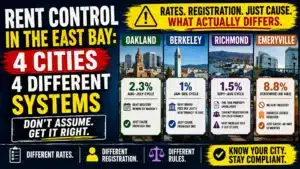

Emeryville has no rent control, but that doesn’t mean fewer rules. In this video, we walk through the 8.8% AB 1482 cap that took effect August 1, why Emeryville’s own ordinance applies just cause from day one of a covered tenancy, the license, notice, and City Clerk steps that go with a termination, and how relocation assistance scales with the number of covered units you own.
What This Video Covers
- Why the AB 1482 cap that governs Emeryville units rose from 6.3% to 8.8% on August 1, 2026
- How Emeryville’s just cause requirement for covered tenancies differs from AB 1482’s generally 12-month threshold
- The chain for terminating a covered tenancy: business license, tenant-rights notice, a notice in substantially the City’s prescribed form, and the City Clerk filing within 10 days of delivery
- Relocation assistance for no-fault terminations, by landlord size
- Whether Emeryville’s inclusionary housing rules apply to existing buildings
- What AEBP tracks as an Emeryville-headquartered property manager
In This Video
Emeryville has no local rent-control ordinance, so California’s AB 1482 sets the cap on most units: 5% plus regional CPI, up to 10%. For August 1, 2026 through July 31, 2027 that works out to 8.8%, up from 6.3%. When we checked the City of Emeryville’s own tenant page in September, it still listed the old figure.
Under AB 1482, just cause protection generally begins after 12 months (with a longer period in some added-tenant situations; see the full guide). Emeryville’s own Residential Landlord and Tenant Relations Ordinance applies from the first day of a covered tenancy, with defined for-cause and no-fault grounds. Some tenancies are exempt, such as hotels, motels and short-term rentals of 30 consecutive days or less; the full guide lists the exemptions.
To terminate a covered tenancy, a landlord must hold a valid residential landlord business license, give the tenant the City’s rights notice, and serve a notice in substantially the City’s prescribed form. A copy goes to the City Clerk within 10 calendar days after the notice is delivered to the tenant; that filing is not a pre-service step. Missing most preconditions can invalidate the notice, but failing to show City service alone does not, though the filing remains mandatory.
For no-fault terminations, relocation assistance scales by landlord size: for a small landlord (four or fewer covered Emeryville units, or a group residential facility of any size), the greater of one month of HUD Fair Market Rent or one month’s rent; for more than four covered units, the greater of five times Fair Market Rent or four times monthly rent. No relocation assistance is owed when the cause is a natural disaster or similar event beyond the landlord’s control.
Key Takeaways
- Emeryville has no local rent control; AB 1482’s 8.8% cap (Aug 1, 2026 – Jul 31, 2027) governs covered units, up from 6.3%
- Just cause applies from day one of a covered Emeryville tenancy, while AB 1482’s generally begins after 12 months
- A valid residential landlord business license is a precondition to terminating a covered tenancy
- File a copy of the termination notice and rental agreement with the City Clerk within 10 calendar days after delivering the notice to the tenant
- Relocation assistance depends on landlord size: four or fewer covered Emeryville units (or a group residential facility) versus more than four; none is owed for natural-disaster terminations
- Confirm the cap against its effective date — even the City’s own page lagged behind the August 1 change
Resources Mentioned
- Emeryville Rental Laws 2026: What Landlords Need to Know (full written guide)
- East Bay Rent Control 2026: Oakland vs. Berkeley vs. Richmond vs. Emeryville
- Thursday Tip: Your Emeryville Business License Isn’t Just Paperwork
- Emeryville Property Management
- Law: Civil Code §1947.12 (rent cap) and §1946.2 (just cause)
- Local ordinance: Emeryville Municipal Code Chapter 5-40 (current through June 2, 2026)
- Federal statistic: BLS Consumer Price Index, San Francisco Area, April 2026 (3.8%, the input to the 8.8% cap)
- City guidance: City of Emeryville Business License FAQs and BMR Rental Program Guidelines
Own rental property in Emeryville?
We’re headquartered in Emeryville and track the license, notice, and City Clerk requirements alongside Oakland’s, Berkeley’s, and Richmond’s across 600+ units in the East Bay.
Video Transcript
Emeryville has no rent control. So does that mean fewer rules? Not even close. Here’s what actually applies.
Start with the rent cap. Because Emeryville has no local ordinance, California’s AB 1482 sets the limit on most units — five percent plus regional inflation, capped at ten. On August first, that number moved. It’s now eight point eight percent, up from six point three. And here’s a detail worth knowing: when we checked the City of Emeryville’s own tenant page in September, it still listed the old six point three.
Now the part that catches owners. Under AB 1482, just cause protection kicks in after twelve months. Emeryville’s own ordinance doesn’t wait. It applies from day one of the tenancy. Every termination of a covered tenancy needs a qualifying reason — either for cause, like nonpayment or a lease violation, or no-fault, like an owner or family move-in.
And before you can serve any termination notice on a covered tenancy, there’s a chain to complete. You need a valid Emeryville residential landlord business license. The tenant needs the city’s rights notice. You use a notice in substantially the city’s prescribed form. And you file a copy with the City Clerk within ten calendar days after delivering the notice. Miss most of these preconditions, and the notice can be invalidated — with attorney’s fees on the line if the tenant challenges it. Failing to show City service alone doesn’t invalidate the notice, but the filing is still required.
If it’s a no-fault termination, relocation assistance applies, and it scales with how many units you own. Four or fewer covered Emeryville units, or a group residential facility of any size: the greater of one month of HUD fair market rent, or one month of the tenant’s rent. More than four covered units: the greater of five times fair market rent, or four times the tenant’s monthly rent. There’s no relocation payment when the cause is a natural disaster beyond your control.
Here’s what we see at AEBP. We’ve been headquartered in Emeryville since 2005, and license renewal sits on our compliance calendar. Emeryville doesn’t have a rent board or a registry to remind you, so the calendar is the reminder. The license runs on a December thirty-first cycle, and the City treats renewals after March first as delinquent.
What about inclusionary housing? That program targets developers of new rental projects with ten or more units. It doesn’t reach ordinary existing buildings — but if you’re buying, check for a recorded affordability agreement.
The bottom line: Emeryville isn’t the easy city. It’s the one where the rules live in a different place. Check the current cap, check your license, and run the full checklist before you serve anything. The complete written guide is linked below.